New Reserve Bank research finds little sign AI has upended the jobs market so far. But the first signs of strain are turning up where HR teams usually hire their juniors
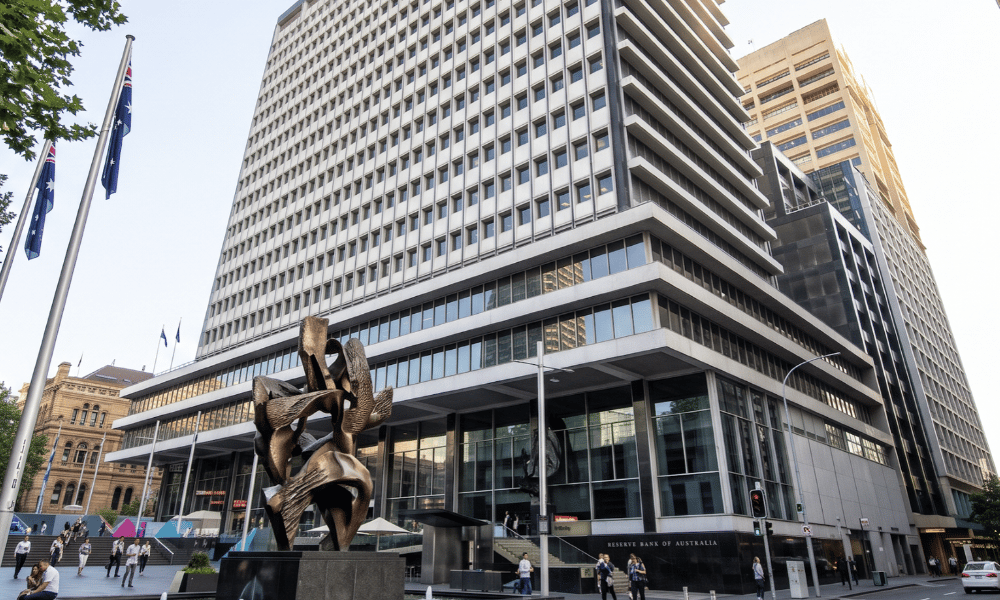
Australia's jobs market hasn't been flattened by artificial intelligence, well not yet, anyway. But new research from the Reserve Bank suggests the first pressure points may be forming at the bottom of the career ladder, in the roles where graduates and school leavers have traditionally got their start.
In an RBA Insight paper published on Monday, economist Mike Major has set out a new tool the central bank will use to track AI's early effects on work. His verdict is that AI has so far done little to materially disrupt the Australian labour market. There are, however, "tentative signs" of weaker outcomes in the occupations most exposed to AI, particularly for younger workers.
The paper has arrived on the same day the RBA's assistant governor (economic), Sarah Hunter, told the UBS Australasia Conference in Sydney that the bank is mindful headline jobs figures can hide real disruption for individual job seekers and for professions that are hit harder than others.
For HR leaders working out next year's graduate intake, those are both important notes.
Read next: Is it really AI that's killing junior hiring – or is remote work the hidden culprit?
Rather than waiting for the unemployment rate to move, the RBA is watching two groups where AI-driven change is likely to show up first: occupations whose tasks most closely resemble what today's AI tools can do, and young workers and graduates.
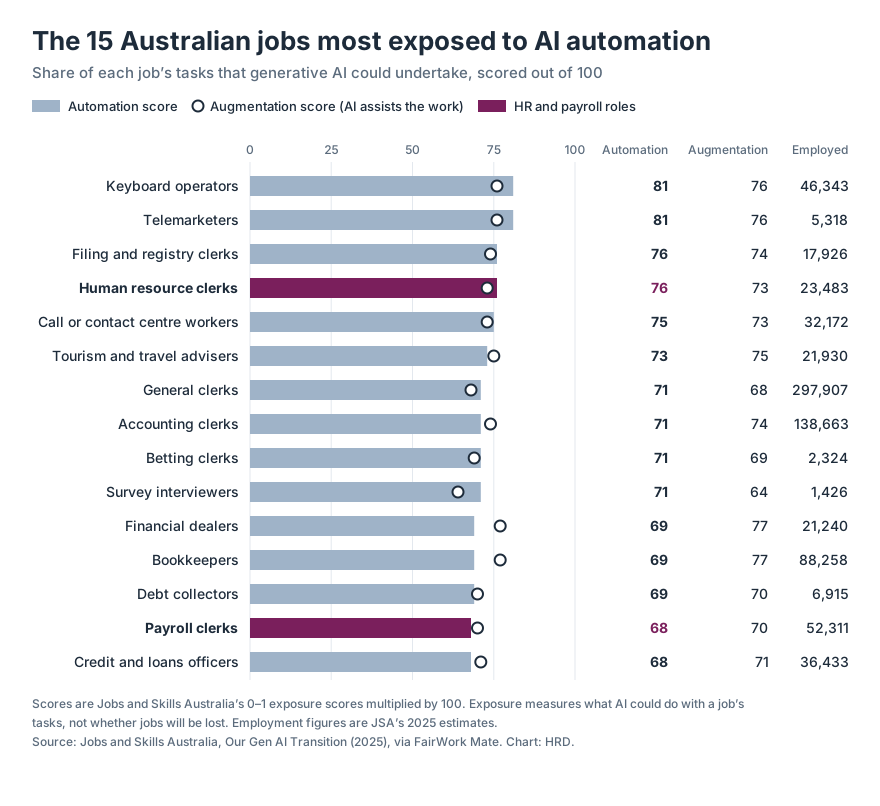
To sort jobs, Major used Jobs and Skills Australia's automation exposure mapping, which scores occupations by how closely their tasks match current AI capabilities. Software developers, clerical workers and administrative staff sit among the most exposed. He then compared outcomes before and after November 2022, the month ChatGPT put generative AI into public hands.
The results are mixed. Job-finding rates, and the rate at which people move from work into unemployment, look much the same regardless of how exposed an occupation is. Employment growth and total hours worked, though, have been a little weaker in the more exposed occupations.
Within the most AI-exposed occupations, younger workers have had weaker employment outcomes and bigger rises in unemployment than older colleagues. That gap doesn't show up in the less exposed jobs.
The job ads point the same way
Job advertising, usually one of the first places a shift in employer demand becomes visible, tells a similar story. Jobs and Skills Australia and SEEK data show the flow of new ads in the most AI-exposed occupations has slowed slightly more than in other jobs. Since November 2022, the biggest contributors to that fall in new JSA ads have been general clerks, software and applications programmers, ICT business and systems analysts, call or contact centre workers, and receptionists.
Meanwhile, the share of SEEK and Indeed ads that mention AI has climbed quickly. The RBA notes some of that may be employers reaching for fashionable language rather than genuinely changing the skills they want.
said contacts reported that AI had not yet affected headcount at most firms, and they didn't expect it to in the next 12 months. A chart in her speech shows roughly three-quarters of firms reporting no change in headcount from AI over the past year. Around 12 per cent said they were hiring more slowly or leaving roles unfilled, about 8 per cent had cut headcount, and about 6 per cent had added staff.
Read next: RBA closely monitoring AI's impact on economy
Both the paper and the speech labour one point: being exposed to AI doesn't mean a job will vanish. Hunter cited JSA estimates that around 4 per cent of Australian workers are highly exposed to automation by AI, against 31 per cent who are highly exposed to AI that augments their work.
"Even where AI replaces tasks, it may not replace the whole job," she said.
Major is equally careful about cause and effect. Youth employment was unusually strong in 2022 because the labour market was so tight, so some of the softening since then may simply be conditions cooling. Post-pandemic work-from-home habits may also be part of the picture, a possibility raised by a Warwick and Oxford working paper that the RBA cites. And the latest complete occupation data only run to February 2026.
That cautious reading lines up with the federal government's own AI and employment in Australia report, released by the Department of Employment and Workplace Relations in July. It found no evidence of broad AI-driven upheaval, but did find that occupations more exposed to automation had grown more slowly than others.
A softer market raises the stakes
The Australian Bureau of Statistics says that the unemployment rate rose to 4.7 per cent in September, its highest level since October 2021, while youth unemployment climbed 0.3 percentage points to 11.1 per cent. The trend rate, which the bureau prefers as a guide to underlying conditions, held at 4.6 per cent. Then on 3 November the RBA lifted the cash rate to 4.85 per cent, its fifth rise this year, on a six-to-three vote.
Big employers have been restructuring too. Canva says 1,271 roles, or 22 per cent of its workforce, will be cut, changed or relocated, after Atlassian's cuts earlier in the year. Co-founder Melanie Perkins told staff "small changes won't be enough", although the company has told AAP that work done by people won't be handed over to AI.
A weaker market plus AI uncertainty makes it tempting for employers to trim junior intakes. HRD has reported on an Oliver Wyman Forum and NYSE survey in which 70 per cent of CFOs planned to step up succession planning, while 64 per cent expected to shift away from junior roles. It's hard to build tomorrow's leaders while hiring fewer of the people who become them.
Read next: Australian workers stay put as economic uncertainty bites
What HR can take from this
The RBA's work is early and descriptive, and Major says plainly that it shouldn't be read as proof of AI displacement. Still, it hands people teams a few practical prompts.
Run your own version of the RBA's monitor. Break down hiring, internal moves and exits by role type and seniority, then compare roles heavy in clerical, admin, coding and contact centre work against the rest. If junior hiring is slipping in some teams, check whether that tracks AI rollouts, hybrid work patterns or plain budget pressure. The answer changes the fix.
Think twice before cutting the graduate pipeline on a forecast. The national evidence is tentative, and most of the RBA's liaison contacts aren't cutting headcount because of AI. A thin intake now means a thin bench of experienced people in five to ten years, just when organisations will need them to oversee the AI tools they're buying today.
Some local employer data points the other way. In the Australian HR Institute's Australian Work Outlook released last November, 41 per cent of organisations said AI had increased their entry-level roles, against 19 per cent reporting a fall. AHRI chief executive Sarah McCann-Bartlett said HR teams would recognise that "investing in career pathways for these roles is becoming more important", especially as Australia's working-age population shrinks.
Redesign entry-level roles rather than deleting them. JSA's estimates suggest far more workers stand to have their jobs augmented than automated. That puts the onus on structured training in using AI well, and on deliberate mentoring where hybrid work has thinned out the informal learning juniors once picked up by sitting near senior staff.
Keep an eye on the next round of data. The RBA says it will keep developing its monitoring, drawing on firm adoption surveys, liaison and wage data. The ABS's switch to a new occupation classification, OSCA, means fresh occupation-level figures due later this year will need a revised mapping. The October labour force numbers land on 19 November, and the RBA's next rate decision is on 8 December.
Read next: Fair Work Commission releases new AI guidance and warns against blind reliance on AI
The bank isn't sounding an alarm. But it has chosen the junior end of AI-exposed occupations as the place to watch most closely, and that is a fair guide to where HR teams should be looking in their own numbers.