Nine in 10 IT leaders say bringing IT and HR together would boost productivity, employee satisfaction and engagement — Canadian experts weigh in

As transformation sweeps across organizations, HR leaders are being pulled deeper into workplace technology, from digital adoption to employee trust in AI. And many technology executives want to go further than collaboration between HR and IT, moving toward structural convergence and even full mergers between the functions, according to one study.
The survey, by digital employee experience company Nexthink, revealed that 93 per cent of IT leaders in the US, UK, France, and Germany said bringing IT and HR together would increase productivity, boost employee satisfaction and drive engagement.
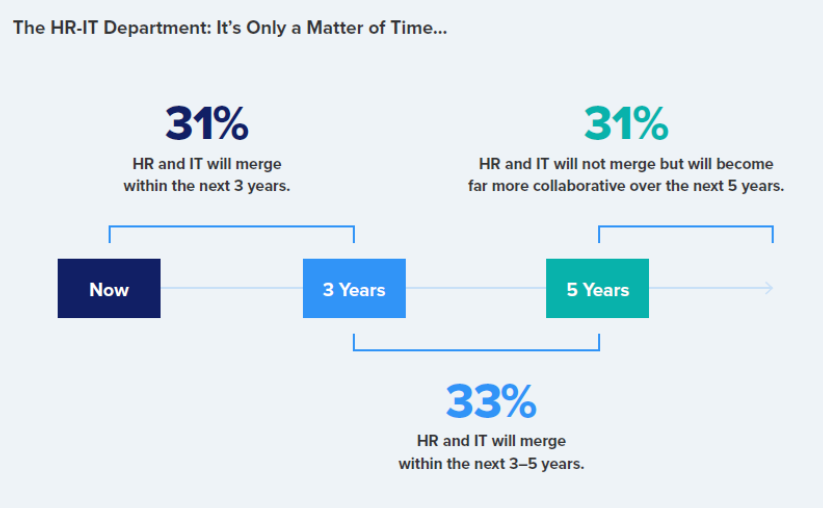
And nearly two-thirds predicted a complete merger will happen within five years, according to the survey.
The results are because of a “crisis of falling engagement and sluggish productivity,” says Nexthink, along with rising workplace app complexity, with an average of 11 applications used by workers, up from six in 2019, and a further 43-per-cent increase predicted over the next three years.
Technology linking all functions
Some organizations are taking up the venture, with biotech company Moderna uniting its technology and HR functions under a chief people and digital technology officer. Montreal based HR software company Workleap has also merged its HR and IT departments.
Organizations and business leaders have to face the fact that the premise of any one function standing alone is already dated, says University of Guelph associate professor Nita Chhinzer.
“Technology is embedded in sales and marketing, it's embedded in human resources, it's embedded in operations, and it’s embedded in logistics and supply chains,” she says. “Technology being a standalone, isolated unit is actually dysfunctional for most organizations.”
With technology and people practices already running through most business decisions, the question for HR leaders is less about whether there is overlap and more about how that overlap is governed, staffed, and measured, says Chhinzer.
What the merger narrative is trying to solve
The Nexthink survey revealed that IT leaders believe combining functions could create tangible improvements, including fewer delays in digital transformation projects, smoother adoption of new digital tools and faster onboarding for new hires.
In practice, the argument centres on employee experience, where technology and HR policy intersect daily, according to Jennifer Bouyoukos, chief people officer at Toronto-based PureFacts.
She describes technology as integral to performance, not a separate back-office concern.
“It's not just HR systems now, it's everything, it’s about productivity,” says Bouyoukos. “It's about every touch point of the employee experience — it's a force multiplier, the systems that we work on, there isn’t one thing that isn’t technology-enabled these days, from the way someone is attracted to the company to the end of the employee life cycle.”
For HR leaders, that creates a practical question: if technology underpins attraction, onboarding, learning, performance and analytics, how should decision-making be structured so that the people mandate and the systems mandate don’t work at cross-purposes?
Where a full merger could go wrong
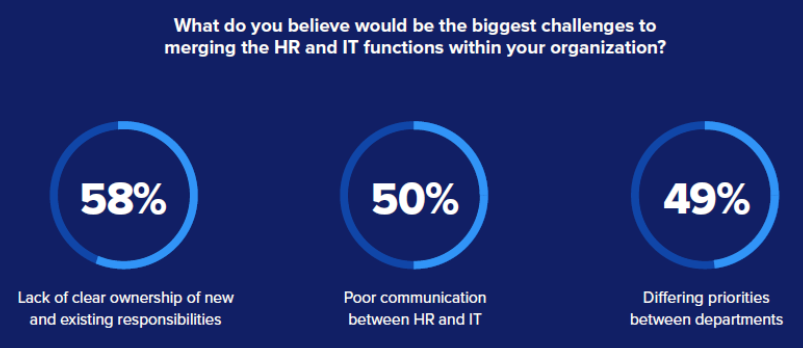
The Nexthink survey noted certain pain points in bringing HR and IT together, with respondents citing concerns such as unclear ownership, poor communication, and differing priorities. Chhinzer believes that a complete merger risks importing a process-first mindset into labour decisions.
“The IT mentality is really about not thinking about people, but thinking about processes and how to speed up and become more efficient — it's an effort for time exchange, and they're trying to put in the least amount of effort and the least amount of time in order to achieve the objective — and while that makes sense for the IT department, it doesn't necessarily align with the strategic goals of HR,” she says.
“With a complete merge of IT and HR, the biggest potential risk is that we end up taking a scientific approach to labour.”
Meanwhile, the strategic goals of HR are depend on creativity, problem solving, and one-off circumstances that can maximize the value of the organization’s talent, and these goals can be weakened if management relies too heavily on stripping out “every piece of slack,” according to Chhinzer.
Bouyoukos also points to a capability and capacity issue: merging doesn’t remove the day-to-day realities of two functions that both face urgent, unplanned work — particularly for IT, where “half of their work is planned and the other half of their work is unplanned.”
What readiness looks like
Both Chhinzer and Bouyoukos believe that readiness for closer operations or a merger depends on how an organization handles the skills and translation challenge — neither side is fully trained for the other’s discipline, and a merger announcement without joint onboarding and development can fail in execution. Chhinzer’s suggested approach is cross-training: IT practitioners building management, communication and human psychology skills, and HR practitioners strengthening data analytics and technical basics.
Bouyoukos, meanwhile, believes that HR leaders may be more digitally capable than many executives assume, in part because they’re already self-organizing into communities of practice to learn and share.
“What I see in the background, so many communities have been pulled together between open-source communities such as AI for HR,” she says. “I see some extraordinary work on leveraging technology and building AI agents, and I just think it doesn't get the press that other areas do — I don't think there's a lot of other departments and functions thatseek out and learn what HR is doing, so I actually think we're more prepared than many think.”
Years ago the conversation around the ideal profile for an HR leader started to include being tech-savvy and using it to enable their own work, says Bouyoukos.
“HR is accountable for not just how the work gets done and how the people experience the company,” she says. “And IT is often seen as a back-office utility for the employees, but it's really the infrastructure for performance — when you think about the ideal HR leader, it’s always thinking about technology and how it enables performance.”
How to test convergence without breaking core services
Rather than treating this merger as an all-or-nothing decision, Chhinzer recommended pilots that bring HR and IT together on specific work, with metrics focused on the value delivered to the organization.
“It's not a top-down approach, it's a very practical and applied approach,” she says. “How I would measure the metrics, it's not about whether the project was done as quickly as possible, it's about whether there's been a shift in understanding of the two teams and whether it's actually resulted in the increased productivity for the masses.”
Bouyoukos describes an operating model built around treating employee experience as inseparable from the systems employees rely on. “The problem that we're solving is that right now it’s segregated, and it needs to come together and be part of the same system,” she says. “The employee experience is really a systems experience.”
In that model, HR leaders would be closer to decisions on technology priorities, governance, privacy, and change management, while IT expertise remains central to design, security, and reliability, adds Bouyoukos.