Research shows most teams 'still doing the hard part, making output accurate, complete and ready for real-world use’
Most employees using artificial intelligence at work do not consider it reliable without human oversight, according to new research.
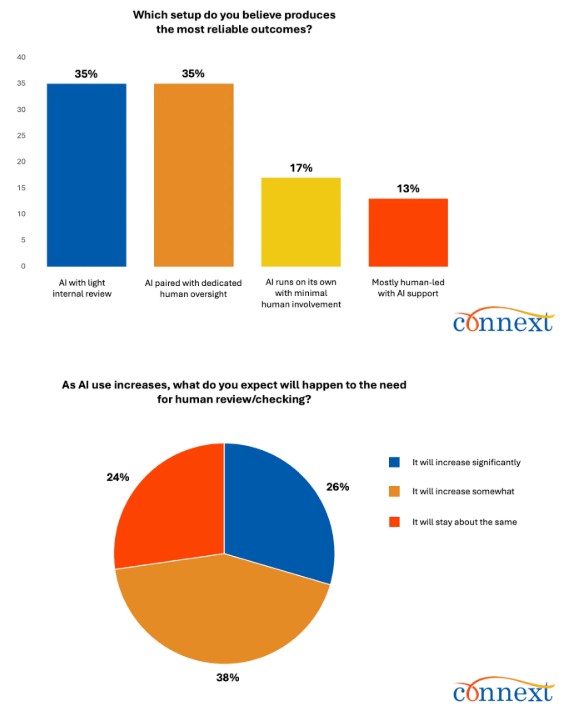
The Connext Global 2026 AI Oversight Survey of 1,000 U.S. adults who use AI in their day-to-day work finds that only 17% say AI can “run on its own with minimal human involvement.” By contrast, 70% define reliable AI as a human-in-the-loop model – either “AI plus light review” (35%) or “AI plus dedicated oversight” (35%), Connext reports.
According to the report, “autonomy is not the standard most users trust,” and reliability is being defined less by automation and more by the workflow, review and accountability systems wrapped around AI tools.
Successful AI transformation requires an organization to be technologically and culturally ready, says talent acquisition leader Thomas Byun.
Demand for human review rising
The Connext report provides a view into the “operational reality of workplace AI.”
“AI can be a powerful accelerator, but this research shows most teams are still doing the hard part, making output accurate, complete and ready for real-world use,” says Tim Mobley, president and CEO of Connext Global. “The opportunity is not just adopting AI, it is building the oversight habits that keep quality high while speed increases.”
According to the study, 64% of workers say the need for human review or checking will increase, including 26% who expect a significant increase and 38% who anticipate a somewhat higher need.
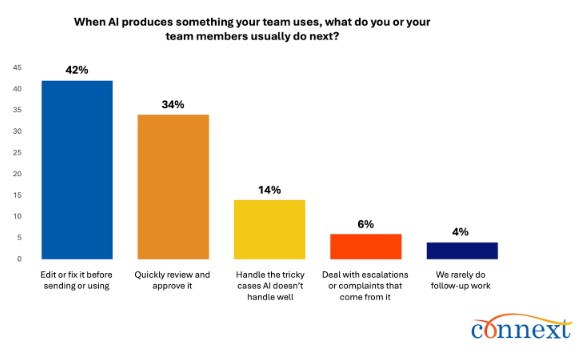
Ongoing monitoring is already the norm. According to Connext, AI “needs attention almost every time (28%) or sometimes (54%), while just 4% say it can usually run without much attention.” Follow-up work is described as “nearly universal,” with only 4% saying they rarely do it; the most common tasks are “editing or fixing” (42%) and “review or approval” (34%).
However, output quality is a central constraint in the Connext data. Only 37% of respondents say AI is right without fixes most of the time. Nearly two in three (63%) say it is right only sometimes or less, including 45% who say “sometimes,” 16% “rarely” and 2% “almost never.”
When AI output needs fixing, 46% say it takes about the same time as doing the work manually and 11% say it takes more time. Connext notes that this “can erase the time savings” of AI when significant correction is required, reshaping the return on investment for everyday tasks.
TELUS previously described public sentiment on AI as “optimism tempered by caution,” with 57% of Canadians believing the technology can improve quality of life while also expressing concern about serious risks.
Context loss, employee trust
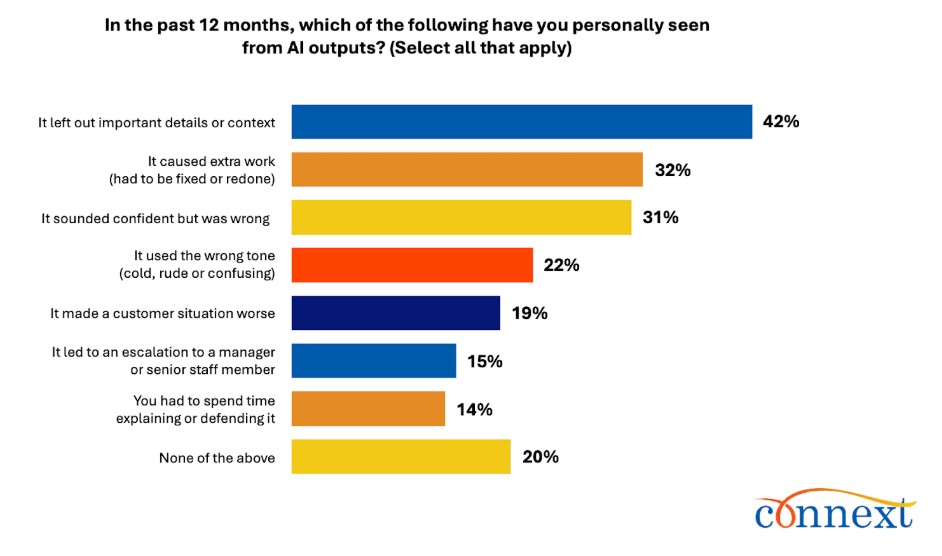
The Connext report also points to context loss as a major source of breakdown. Over 2 in 5 (42%) respondents say AI left out important details or context, 32% say it caused extra work to fix or redo, and 31% say it “sounded confident but was wrong.” In people-related and customer-facing workflows – such as candidate outreach, policy explanations or support interactions – that mix of missing nuance and confident error can amplify compliance and reputational risks.
Customer impact is already visible: about one in five workers (19%) say AI made a customer situation worse. Overall, 60% report having personally been involved in AI negatively affecting outcomes, including 18% who cite frustration or complaints and 11% who report lost revenue or churn.
According to Connext, these experiences suggest that “the competitive advantage will come from building repeatable oversight, not simply expanding usage.”
Connext concludes that “workplace AI is widespread, but it is not self-sufficient in the way many organizations hoped.”
In an article posted on Littler’s website, legal experts note: “AI usage policies can help minimize legal, business, and regulatory risks by ensuring compliance with operative laws and regulations. AI usage policies are also beneficial with the evolving regulatory landscape by preemptively establishing a framework that helps mitigate risks.
“Having a policy in place before engaging in high-risk uses of AI (such as, for example, AI systems intended to be used in HR processes to evaluate job candidates or make decisions affecting the employment relationship) is critical for businesses to protect themselves from open-ended liability.”
Seven in 10 U.S. managers say employees have made mistakes using AI tools in the past year, with some errors costing employers more than US$50,000, according to a previous survey by Resume.org.