Canadians call for tighter AI rules but doubt governments can keep pace, finds study

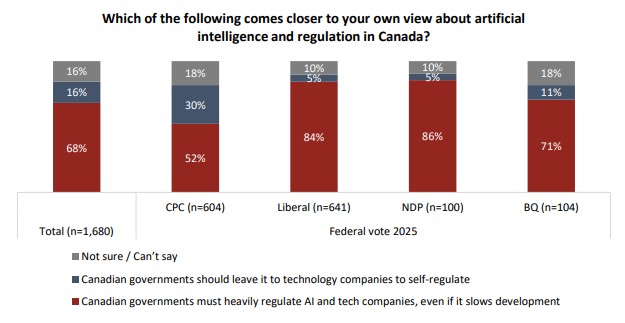
Canadians overwhelmingly want stronger regulation of artificial intelligence (AI), even if it slows innovation, but most lack confidence that governments can keep up with the technology’s rapid evolution, according to new research from the Angus Reid Institute.
Currently, over two-thirds (68%) of Canadians are “adamant that it is the place of government to heavily regulate AI and tech companies, even if doing so slows development,” according to the think tank.
By contrast, just 16% of respondents say regulation should be left to the private sector.
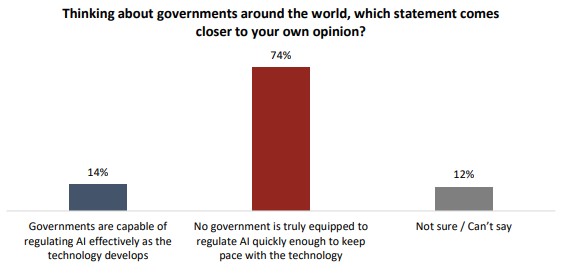
However, the same study reveals widespread skepticism about institutional capacity. According to Angus Reid, three-quarters (74%) say “no government is truly equipped to regulate AI quickly enough to keep pace with the technology.”
The findings come as the federal government prepares to unveil its national AI strategy, which is expected to focus on areas including adoption, skills development and public-sector integration.
Ottawa launched AI for All today, pledging more than $2.3 billion and targeting an additional $200 billion in economic growth to reshape how the country works and competes.
 Job loss fears dominate outlook
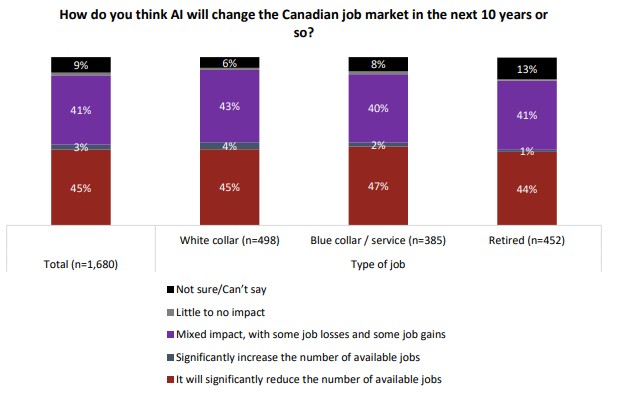
Concerns about the labour market impact of AI remain pronounced. The Angus Reid Institute reports that 45% of Canadians say it will lead to significant job losses, while just 3% say it will lead to “significant gains”.
Another 41% anticipate a mixed impact, with both job creation and displacement.
The report notes that these concerns cut across occupational groups, including white-collar and blue-collar workers, suggesting widespread unease about automation.
Support is also strong for government intervention when jobs are replaced by AI. Angus Reid finds that four-in-five (79%) support imposing additional taxes on companies that lay off workers and replace them with automation.
Nearly half (48%) of 1,500 hiring managers surveyed in Canada predict AI will help increase headcount in the next two years, according to a separate report from Robert Half.
Canadians favour cautious approach
Beyond employment concerns, Canadians are urging policymakers to proceed carefully. The Angus Reid Institute reports that“seven-in-10 (70%) say Ottawa should be cautious about adopting AI because of the risk of unintended consequences.”
Only a minority support accelerating adoption to improve efficiency in public services.
This cautious stance reflects broader uncertainty about how AI will reshape both the economy and everyday life.
The research also points to potential challenges in building the infrastructure needed to support AI systems. While 46% of Canadians say domestic AI infrastructure is necessary to maintain control over digital services, 68% would “oppose a large AI data centre being built within a few blocks of where they live.”
Opposition is consistent across urban and rural areas and is driven in part by environmental and community concerns. Angus Reid reports that 67% believe such facilities would be harmful to energy and environmental sustainability, while 63% say they would negatively affect neighbourhoods.
At the same time, Canadians are divided on the economic benefits of data centres, with 29% saying they would support local business activity and 36% disagreeing.
Here are some AI data-centre projects in Canada that have actually been announced publicly:
|
Project / Operator |
Location |
Status |
Key details |
Source |
|
Bell AI Fabric (Bell Canada) |
Kamloops, B.C. |
First centre opened June 2025 |
7 MW, built with U.S. firm Groq |
CBC, May 29 2025; Barchart |
|
Bell AI Fabric |
Merritt, B.C. |
Planned, end of 2025 |
Part of B.C. "supercluster" |
CBC, May 29 2025 |
|
Bell AI Fabric |
Kamloops, B.C. (2nd) |
Planned by end of 2026 |
26 MW, with Thompson Rivers University |
Barchart |
|
Bell AI Fabric |
Kamloops, B.C. (3rd) |
Planned 2027 |
Additional capacity |
CBC; Barchart |
|
Bell AI Fabric |
Two B.C. sites, not yet named |
Advanced planning |
400+ MW combined, high-density workloads; ~500 MW total hydro-powered across all six |
Barchart |
|
TELUS sovereign AI factory |
Rimouski, Québec |
Announced (with NVIDIA) |
Described as Canada's first fully sovereign AI factory |
NVIDIA blog |
|
"Wonder Valley" AI data-centre park |
M.D. of Greenview, Alberta |
Proposed only |
Up to $70 billion proposal; not confirmed |
Energy News Beat, Dec 2024 |