The next-generation Proteus changes the relationship between workers and automation fundamentally
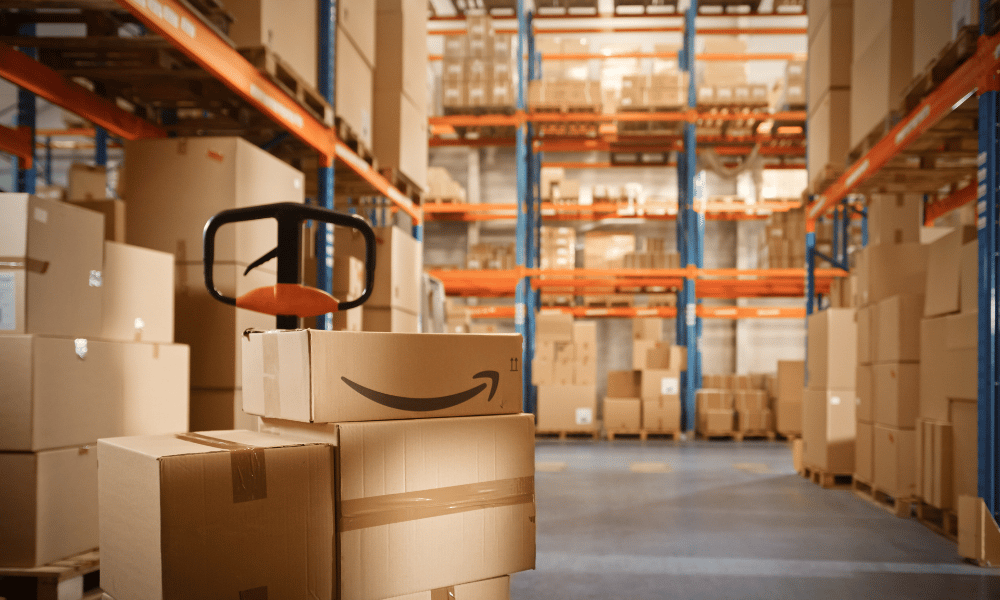
Amazon on Thursday unveiled a warehouse robot that workers direct using plain conversational language — the same way they would ask a colleague to move something. No technical commands, no programming interface. The employee states the task; the robot determines the priority, the route, and the timing.
"You tell it what needs to be done. It figures out the priority, the route, the timing," said Scott Dresser, vice president of Amazon Robotics. "It becomes your assistant for material movement."
The next-generation Proteus was unveiled at Amazon's "Delivering the Future" event in Dartford, England, as part of a €10 billion investment in its European fulfilment network. Currently in lab pilots, it is planned for deployment in the first half of 2027. The existing Proteus operates at 25 US sites in dock areas only; the new model works across entire warehouse floors. Amazon also showcased STARK, a tote-handling system first piloted in Barcelona expanding to 15 European sites by 2027, and Vulcan, its first robot with a sense of touch, able to pick and stow approximately 75% of stored items at speeds comparable to frontline employees.
The announcement arrived the same morning Prime Minister Carney launched Canada's national AI strategy — "AI for All" — committing $2.3 billion and setting a target of raising business AI adoption from 12 per cent today to 60 per cent by 2034. As HRD Canada's coverage of the strategy noted, only 26 per cent of Canadians think AI will improve the Canadian job market, and only 20 per cent believe it will improve their own job. A robot that answers to plain language, appearing on a warehouse floor, is exactly the kind of visible automation event those workers will interpret through that lens.
The job architecture question Canadian HR can't defer
When a robot requires specialist software, only trained operators interact with it — the job boundary is clear. When a robot responds to plain language, every worker on the floor is a potential operator. The question of who is responsible for supervising its decisions, correcting its errors, and managing its task prioritization becomes an employment relations question, not a technology one.
In practical terms: a warehouse team leader role in a Canadian logistics operation deploying conversational robotics in 2027 will require the ability to supervise, evaluate, and where necessary override robotic task allocation. That is a supervisory skills profile that current warehouse job descriptions do not reflect and current pay grades do not capture. Amazon says its own fulfilment centre in Louisiana, launched in late 2024, required 30% more employees in various roles because of advanced robotics — more people, differently skilled, in roles that did not previously exist. That is the pattern conversational robotics accelerates.
HR teams that redesign those roles before deployment retain workers through the transition. Those that wait until after the technology is live lose the people best placed to adapt — and face the additional cost of redesigning roles under operational pressure rather than ahead of it.
Amazon's own workers have already been caught gaming the AI productivity leaderboards that HR designed — a reminder that measurement architecture matters as much as technology architecture. The same principle applies to how you evaluate workers' performance in directing conversational robots. If the metric is task volume, you will get task volume. If the metric is task accuracy, safety compliance, and exception handling, you will get a different and more useful performance picture.
The contradiction that sits in your people managers' teams
The same day Amazon unveiled Proteus, three of its own engineers appeared before Seattle's Land Use and Sustainability Committee to publicly oppose new large-scale AI data centre construction. The committee voted unanimously in favour of a one-year moratorium.
"It's been reported that this year, Amazon is spending $200 billion on capital, with most of it going to data centres and AI," said Patrick Schloesser, a software engineer at Amazon Web Services. "Meanwhile, the leaders at my company have laid off 30,000 corporate employees in the last eight months."
The 30,000 figure is Schloesser's characterization. The structural pattern it describes — large-scale capital flowing to automation infrastructure while headcount falls — is one HRD Canada has tracked since it began arriving in Canadian organizations in late 2025, with TD Bank, Scotiabank, Air Canada, and others announcing workforce reductions as AI adoption accelerated.
Amazon is pairing Thursday's robotics announcement with a $1 billion commitment to its Career Choice upskilling programme — part of a broader $2.5 billion Future Ready 2030 pledge — focused on cybersecurity, mechatronics, software development, and logistics. In Europe alone, Amazon is investing more than €30 million in Career Choice in 2026.
"We couldn't find enough skilled people for the roles we need, so we made a decision: we're going to develop them ourselves," said John Boumphrey, Amazon UK Country Manager.
Amazon says it has helped more than 700,000 employees globally through Career Choice since 2019 and plans to grow its European fulfilment workforce by 25,000 in the coming years.
The upskilling commitment is real. So is the workforce reduction. Both will be read by Canadian employees through the lens of the Ipsos AI Monitor 2026, which found that 67 per cent of Canadians say AI makes them nervous — one of the highest rates globally. Managing that gap between what the organisation is communicating and what employees are experiencing is not a communications task. It is a workforce planning task, and it falls entirely to HR.
Three things to act on before the robot arrives
Redesign the job architecture now. A worker who directs a robot in plain language is performing a supervisory function that current entry-level job descriptions do not recognize. Build the pathway from warehouse associate to robot fleet supervisor — with a defined title, pay grade, and competency profile — before deployment begins. Canada's national AI strategy commits to "employer-led training on AI-enhancing skills for mid-career workers" but provides no mandatory framework. The pathway will not design itself.
Review your Ontario AI disclosure obligations for any logistics roles you are posting. Ontario's Working for Workers Four Act, in force since January 1, 2026, requires employers with 25 or more employees to disclose in publicly advertised job postings whether AI is used to screen, assess, or select applicants. Ontario's definition of AI is deliberately broad. If you are recruiting for roles in operations environments that involve AI-directed robotics — and using any automated candidate screening — that obligation applies. HRD Canada's compliance coverage of Ontario's new AI hiring rules sets out what the requirement demands in practice and what the doubled ESA penalties mean for non-compliance.
Build a specific answer to the contradiction before your employees ask. Amazon's workers are publicly describing a gap between capital investment in automation and investment in the people working alongside it. Canadian workers are among the most AI-sceptical in the world. When they see a robot answering to plain language on a warehouse floor, they will draw conclusions. A credible, specific response — not a communications campaign but a visible upskilling pathway and an honest account of how roles will change — is what separates organizations that retain their workforce through automation from those that do not.