Declines in immigration, economic uncertainty driving changes: report

Human resources professionals in British Columbia face a new era of workforce planning challenges, as the province’s 2025 Labour Market Outlook reveals a sharp drop in projected job openings and a significant decline in immigration-driven labour supply.
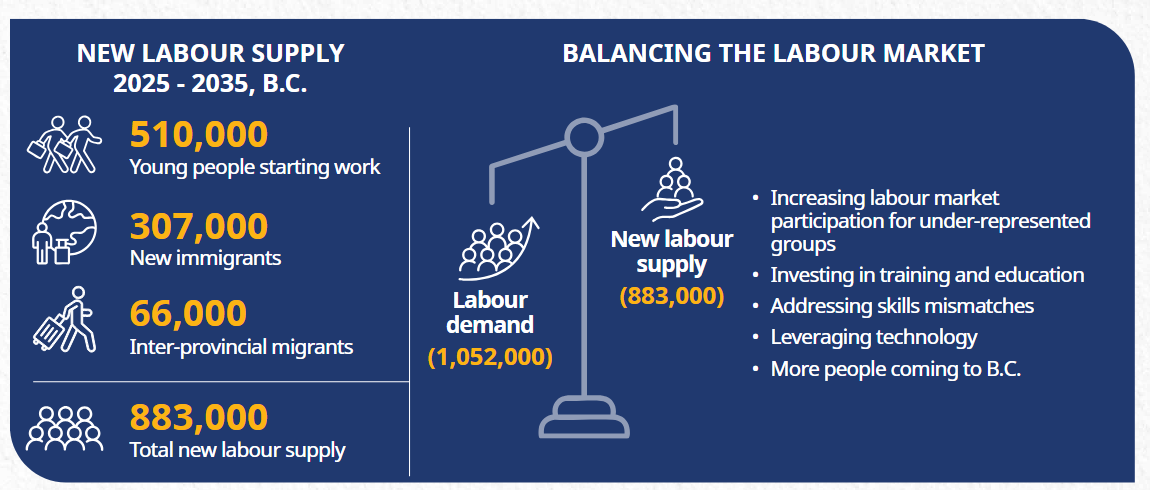
British Columbia is expecting 1,052,000 job openings between 2025 and 2035—a decrease of about 70,000 compared to last year’s forecast.
The reduction is attributed primarily to a slower population forecast, driven by significant changes in federal immigration targets and ongoing economic uncertainties, according to the province’s 2025 Labour Market Outlook.
“This year’s Outlook assumes slightly slower economic growth than in the previous year, in part reflecting the uncertainty caused by tariffs. Some other uncertainties, like the speed with which artificial intelligence (AI) will impact the labour market, remain. Due to this, the B.C. Labour Market Outlook is revised annually to reflect changing circumstances,” said Jessie Sunner, Minister of Post-Secondary Education and Future Skills.
Labour projections for B.C.
The report provides several predictions for the next 10 years:
Job openings: 1,052,000 job openings are projected, with employment expected to reach 3.3 million by 2035—an annual average growth rate of 1.2 percent.
Retirements: 65 percent of these openings (687,000) will be to replace retiring workers, while 35 percent (365,000) will be new jobs created through economic growth.
Immigration: Immigration is expected to supply less than a third of the new workers needed over the next 10 years, a notable decline from last year’s assumption that nearly half would come from newcomers.
Youth entry: Roughly 510,000 young people are expected to enter the labour force for the first time, 14,000 fewer than previously projected, mainly due to reduced immigration.
Interprovincial workers: Workers from other parts of Canada are expected to account for 6 percent of new entrants.
Changes: immigration, tariffs
The most significant change in this year’s forecast comes from an updated immigration outlook, following the Federal Immigration Levels Plan released in November 2024. Canada’s permanent resident target for 2025 was reduced from 500,000 to 395,000, with further declines anticipated in 2026 and 2027.
Temporary residents are now capped at five percent of the total population, and refugee and protected admissions targets have also been lowered.
As a result, B.C.’s population growth is expected to slow to 0.9 percent per year, down from 1.6 percent in the previous Outlook.
Tariffs and trade uncertainty are also affecting the province’s economic outlook. Nearly 14 percent of B.C. businesses anticipate that U.S. tariffs on Canadian imports will have a high impact on their operations, with sectors like softwood lumber, steel, and aluminum facing additional risks. However, increased production at LNG Canada and efforts to diversify trade are expected to partially offset slower activity in other areas.
Canada’s economy experienced its largest quarterly contraction in nearly a decade outside of the pandemic earlier this year, as escalating trade tensions and U.S. tariffs weighed heavily on output, hiring, and investment, according to a report.
Weaker population growth is expected to reduce household formation and investment in new homes. Housing starts are projected to average 49,000 per year over the forecast period, slightly lower than in previous forecasts, which may temper growth in the construction industry.
Which sectors will drive job openings
Five industries will generate 58% of job openings:
- Health care and social assistance (199,200 openings)
- Professional, scientific and technical services (162,200)
- Retail trade (100,900)
- Construction (87,300)
- Finance, insurance and real estate (64,700)
Health care and tech-related roles are expected to see the strongest demand, with the aging population driving growth in health services and rapid innovation fueling opportunities in tech, says the report.
Among occupations, the top five categories will account for nearly 80% of all job openings:
- Sales and service
- Business, finance and administration
- Trades, transport and equipment operators
- Education, law, social, community and government services
- Natural and applied sciences
The report also highlights 125 “High Opportunity Occupations” (HOOs), which are expected to offer strong demand, competitive wages, and long-term prospects. These include registered nurses, software engineers, accountants, and various skilled trades.
Predicting the future
The Labour Market Outlook has been published nearly every year since 2011 and draws on data from BC Stats, the B.C. Ministry of Finance, Statistics Canada, and other federal departments. Employers, unions, industry groups, and post-secondary institutions are consulted to validate the projections.
The report is intended as a tool for exploring possible future scenarios in the labour market, rather than as a definitive prediction. Its accuracy depends on various factors, including unforeseen events such as economic crises, pandemics, or natural disasters, says the government.