‘While trade tensions between Canada and the U.S. are unique to the present day, layoffs in any industry are not’
Recent trade tensions between Canada and the United States have led to potential job losses related to tariffs—and some workers may be disproportionately affected, according to a recent Statistics Canada (StatCan) report.
That’s because Canadian industries dependent on U.S. demand for Canadian exports (IDUSCEXs) employ a workforce that is disproportionately male, older, and includes a high share of immigrants.
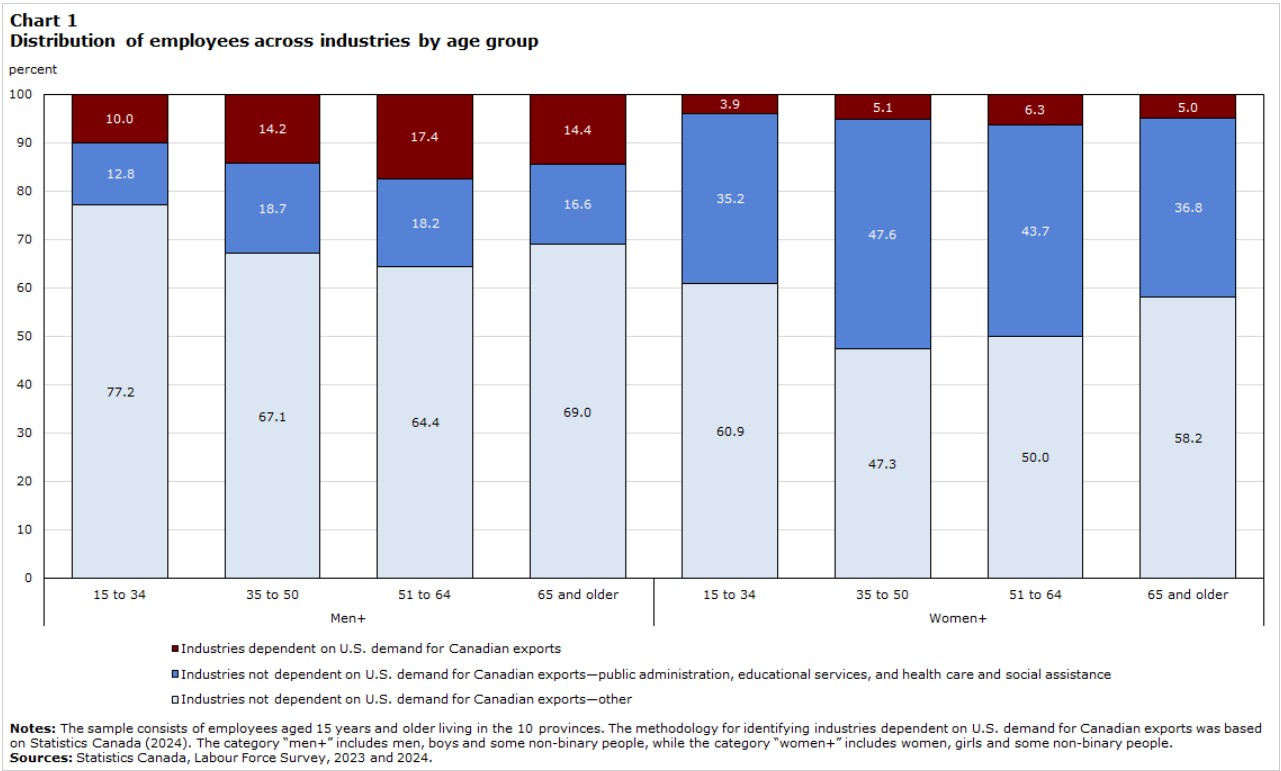
Citing Labour Force Survey data from 2023 and 2024, StatCan notes that 13.3% of men were employed in IDUSCEXs, compared to just 4.9% of women.
Older workers are also more likely to be employed in these sectors: among men, 17.4% of those aged 51 to 64 and 14.4% of those aged 65 and older worked in IDUSCEXs, compared to 10% of those aged 15 to 34. Similar trends were observed for women, though at lower rates.
Education levels also play a significant role. Workers with a bachelor’s degree or higher are the least likely to be employed in export-dependent industries. For men, only 10.6% with a bachelor’s degree or above worked in these sectors, compared to 15.3% with a high school diploma or less and 16.8% with a trades certificate or diploma. The pattern is similar for women.
With the U.S. tariffs on Canada in place, Canada’s national unemployment rate could jump to about 7.9% by the end of 2025, according to one expert from TD Bank.
Immigrants, geographic regions
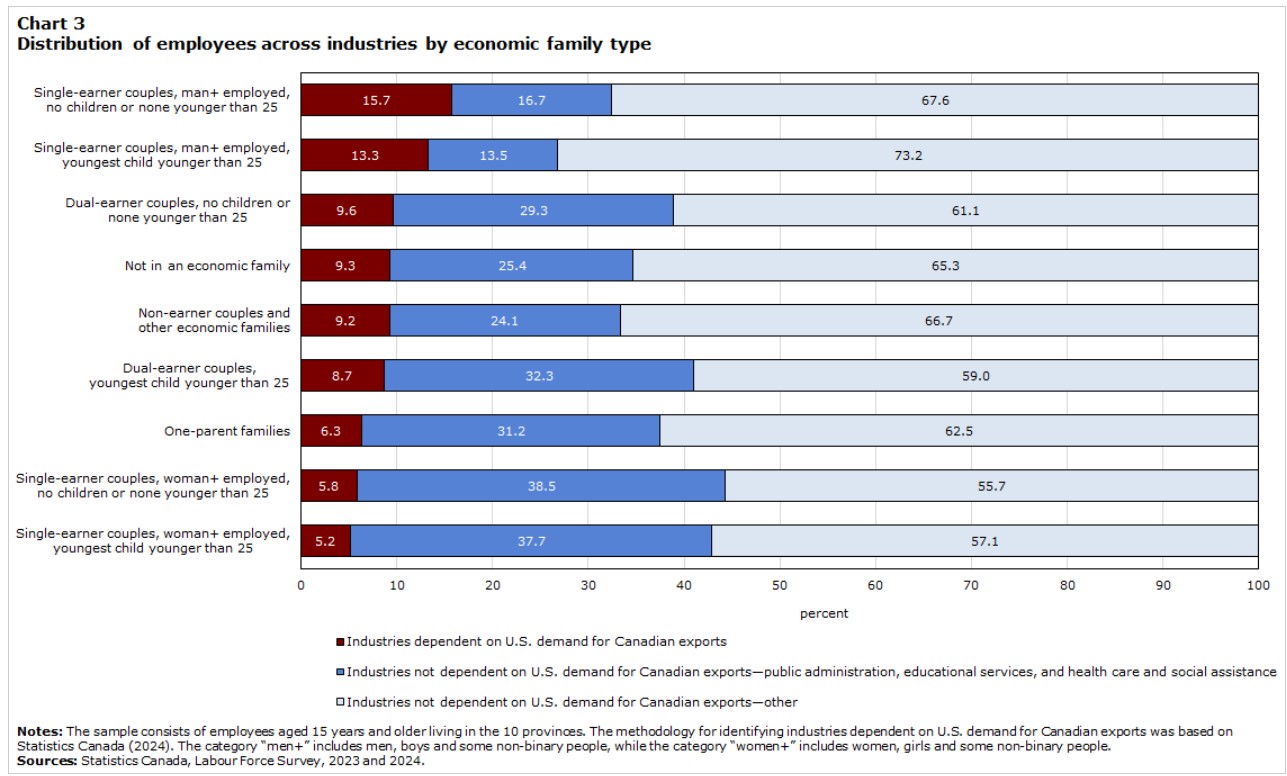
Family structure is another factor. Individuals in single-earner couples where the man is employed are most likely to work in IDUSCEXs, while single-earner couples where the woman is employed are least likely. Among couples, those whose spouse holds a bachelor’s degree or higher are less likely to be employed in these industries.
Immigrants are also overrepresented in export-dependent sectors. StatCan found that 10.8% of immigrants who landed before 2019 and 9.7% of those who arrived from 2019 to 2024 were employed in IDUSCEXs, compared to 8.7% of Canadian-born workers. Immigrants from Southern and Southeast Asia (12.1%) and Southern and Eastern Europe (11.2%) are especially likely to work in these industries, while those from Eastern Asia and the Middle East and West Central Asia are less likely.
Geographic region also matters. The highest concentrations of workers in export-dependent industries are found in Wood Buffalo–Cold Lake, Alberta (24.8%); Centre-du-Québec, Quebec (19.8%); and Banff–Jasper–Rocky Mountain House and Athabasca–Grande Prairie–Peace River, Alberta (17.6%). The lowest concentrations are in Outaouais, Quebec (3.0%), and Ottawa, Ontario (4.3%).
“Following potential trade-related job losses, the labour market outcomes of affected employees may depend, in part, on these socioeconomic characteristics,” say Marc Frenette and Tahsin Mehdi, with the Economic and Social Analysis and Modelling Division, Analytical Studies and Modelling Branch, at StatCan.
“Future research could investigate historical patterns of labour market adjustment following job loss in IDUSCEXs. While trade tensions between Canada and the U.S. are unique to the present day, layoffs in any industry are not. Investigating how workers in IDUSCEXs have previously fared following job loss could shed further light on the adaptability of workers in these industries.”
The fear of job loss among Canadians has risen in the face of the U.S. tariffs, according to a previous report, and a number of employers have already laid off some workers because of the trade war.