'Economic uncertainty appears to be encouraging some retirees to re-enter the job market as volatile equity markets create financial unease'

Trade volatility and shifting economic conditions are having a massive impact on employers’ hiring intentions and workers’ job security, according to a Royal Bank of Canada (RBC) report.
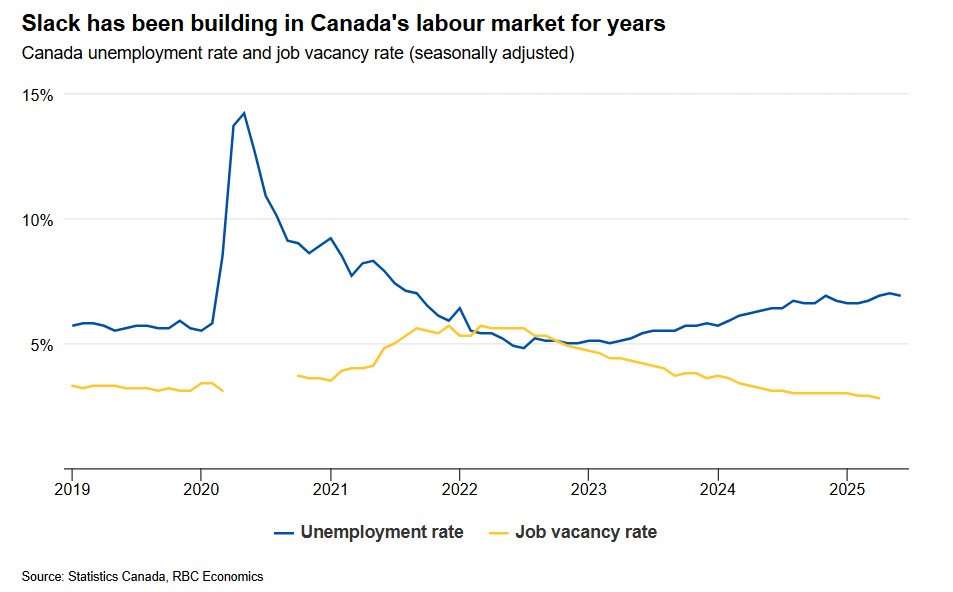
After a brief period of stability in late 2024 and early 2025, the national unemployment rate is once again on the rise, while job vacancies continue to decline. Although June saw a slight improvement over May, RBC notes that the unemployment cycle has likely not yet reached its peak.
The unemployment rate stood at 6.9% in April, 7% in May, and 6.9% in June.
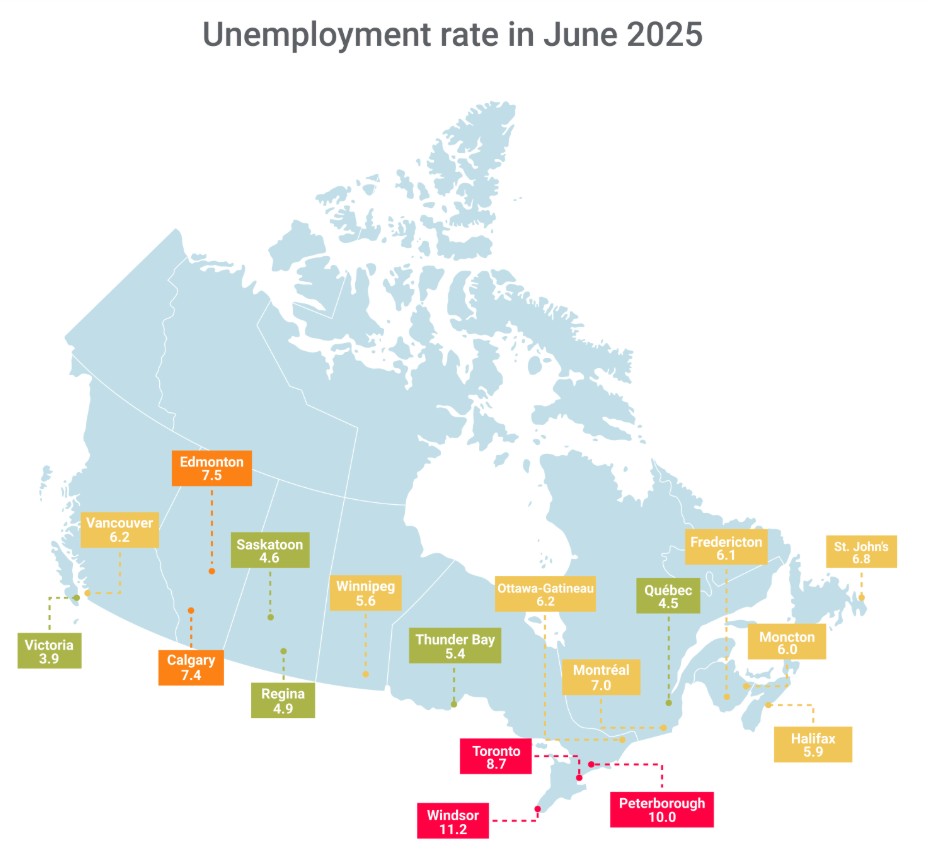
Among key metropolitan areas, Peterborough, Windsor, and Toronto have the highest unemployment rates.
Nationwide, the jobless rate has been climbing for nearly three years, following a post-pandemic recovery that brought unemployment to a 53-year low and sparked robust wage growth as employers competed for workers.
“But the underlying dynamics in Canada’s labour market have evolved significantly. In the wake of the pandemic, rising unemployment primarily reflected the slow absorption of new entrants into the workforce—particularly recent graduates and newcomers—who struggled to find work,” says Rachel Battaglia, an economist at RBC.
 3
3
“Now, permanent layoffs are not significantly higher than a year ago, but workers are taking longer to find jobs, and there are clearer signs of job losses in sectors vulnerable to cross-border trade. That’s created fault lines across specific regions and demographics.”
Canada’s job market rebounded in June, posting its first significant employment increase since January, according to data from Statistics Canada (StatCan).
Job losses in Canada
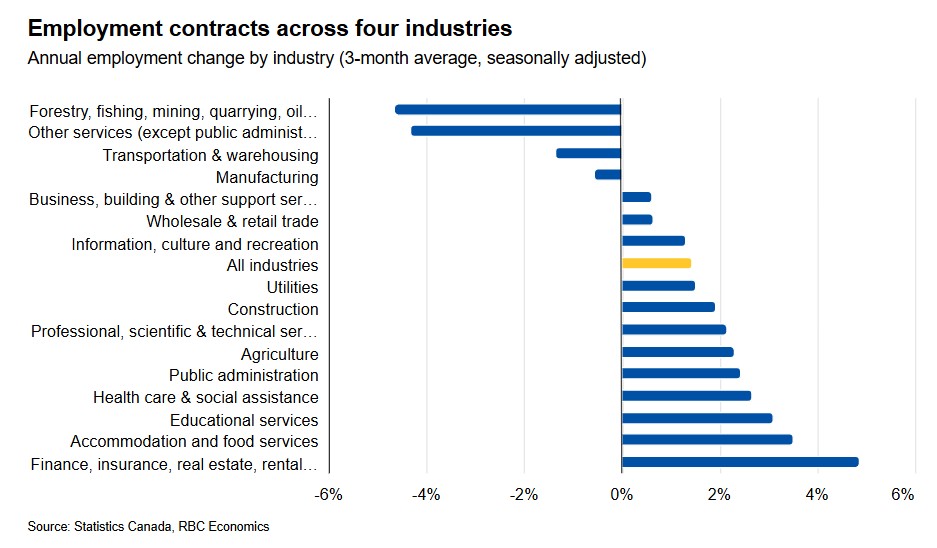
Tariff anxiety has dampened hiring intentions throughout the economy, but actual job losses remain largely concentrated in trade-related sectors, according to the report.
Specifically, manufacturing, primary resources, transportation and warehousing, and certain services outside of public administration have borne the brunt of recent employment declines.
The Canadian-born workforce is also facing more pronounced challenges compared to newcomers, driving roughly 60% of the unemployment rate increase in the last year.
Varying labour market trends can be seen among age groups as well. Late-career workers (aged 45-plus) are experiencing the most acute softening, accounting for nearly 40% of the unemployment rate increase since a year ago.
Core career workers (aged 35-44) accounted for a quarter (25%), while early career workers (aged 15-24) contributed a slightly larger 31% to the increase. Early-to-mid career workers (aged 25-34), however, have contributed significantly less (9%) to the overall unemployment rate increase.
Growing labour market weakness
Canada’s labour market softened in April, with job vacancies falling by 16,800—or 3.2%—to 501,300, marking the first notable monthly decline in nearly a year, according to StatCan. As a result, the national job vacancy rate dipped to 2.8%, down from 2.9% in March. That figure represents the lowest rate since October 2017, according to the report.
“Growing labour market weakness among Canadian-born and core-to-late career-aged workers likely stems from the concentrated nature of industry-specific softness. Indeed, goods-producing sectors employ a disproportionately high share of late career-aged workers, making them particularly vulnerable to current economic headwinds,” says Battaglia.
“Economic uncertainty also appears to be encouraging some retirees to re-enter the job market as volatile equity markets create financial unease—particularly for those living on a fixed income. This pattern is shown by recent increases in job-seeking activity among those 55 and older who had recently left the workforce.”