Which industries recorded the biggest losses?

Canada ended 2025 with fewer employees on payrolls and more vacant positions, according to new figures from Statistics Canada (StatCan).
The report points to a labour market that is shifting under HR’s feet. StatCan is flagging simultaneous declines in payroll employment across key sectors like manufacturing, transportation, wholesale and hospitality, alongside a rise in unfilled positions and growing pressure in construction and other high‑demand fields.
At the same time, average earnings are inching up only modestly while hours worked are slipping, suggesting pay expectations, workload and retention risks may not align neatly. For HR leaders, that mix means revisiting workforce plans, reviewing pay strategies and rethinking where and how to recruit — especially in sectors already warning of deeper labour shortages tied to recent immigration and policy changes.
In its monthly release "Payroll employment, earnings and hours, and job vacancies, December 2025," the government agency reported that the number of employees receiving pay and benefits from an employer fell by 35,400 (-0.2%) in December, following little change in November.
On a year-over-year basis, payroll employment was down 28,300 (-0.2%) in December.
Monthly payroll employment declines were recorded in 9 of 20 sectors. 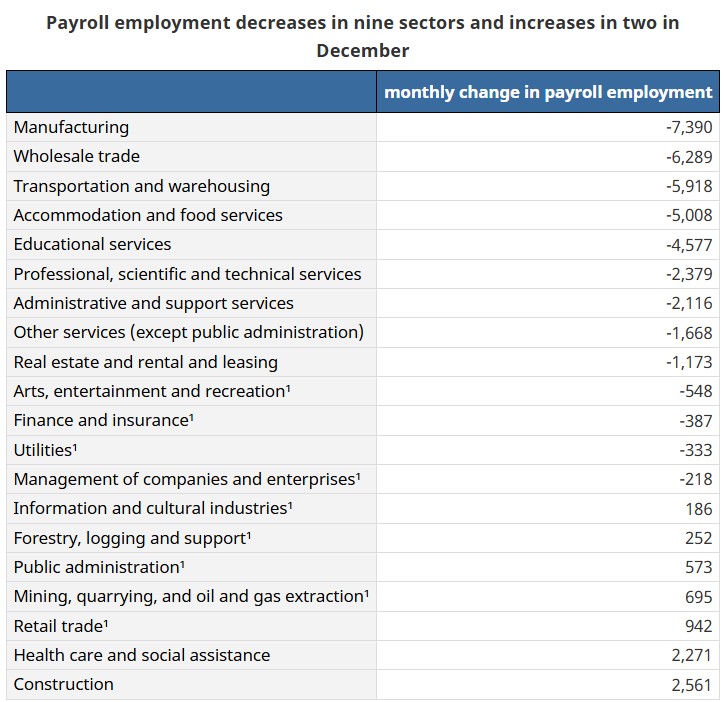
Manufacturing (-7,400; -0.5%), wholesale trade (-6,300; -0.8%), transportation and warehousing (-5,900; -0.7%), accommodation and food services (-5,000; -0.4%) and educational services (-4,600; -0.3%) all posted losses. Meanwhile, construction (+2,600; +0.2%) and health care and social assistance (+2,300; +0.1%) were the only sectors to report gains.
In manufacturing, payroll employment fell by 7,400 (-0.5%) in December, with declines in 10 of 21 subsectors, led by fabricated metal product manufacturing (-1,200; -0.7%) and wood product manufacturing (-1,100; -1.2%). Since January 2025, “payroll employment in this sector has generally trended down, with an overall decline of 40,600 (-2.6%) over the period,” led by transportation equipment, food and chemical manufacturing.
Transportation and warehousing recorded a payroll employment decline of 5,900 (-0.7%) in December, led by truck transportation (-6,100; -2.9%). Despite the monthly drop, payroll employment in the sector was up year over year (+9,000; +1.1%), driven by gains in couriers and messengers, warehousing and storage, and transit and ground passenger transportation, partly offset by declines in truck and water transportation.
Payroll employment in wholesale trade fell by 6,300 (-0.8%) in December, extending a downward trend since September 2024 for a cumulative decline of 17,600 (-2.1%). Most subsectors recorded losses, including machinery, equipment and supplies merchant wholesalers, personal and household goods merchant wholesalers, building material and supplies merchant wholesalers and miscellaneous merchant wholesalers.
Accommodation and food services saw payroll employment decrease by 5,000 (-0.4%) in December and by 8,800 (-0.7%) since September. Year over year, payroll employment in the sector fell by 12,900 (-1.0%), with full-service and limited-service restaurants accounting for more than 80% of the decline.
Recent federal immigration policy changes are expected to intensify chronic labour shortages in Canada’s restaurant sector, with more than half of operators anticipating a negative impact on their businesses, according to Restaurants Canada.
In contrast, construction posted a payroll employment increase of 2,600 (+0.2%) in December, led by other specialty trade contractors, other heavy and civil engineering construction, and highway, street and bridge construction, noted StatCan. The sector recorded six consecutive monthly gains in the second half of 2025, adding 13,100 (+1.1%) jobs since July.
Vacancies and regional pressures
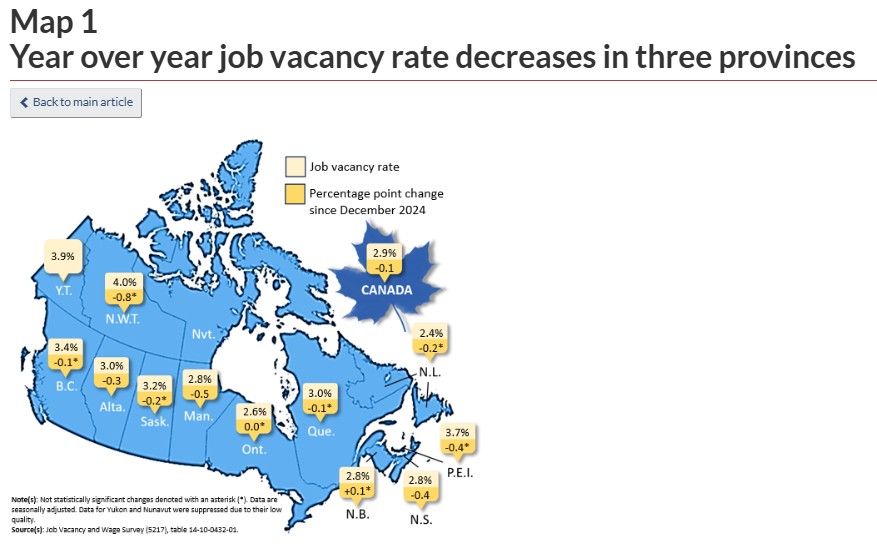
Meanwhile, job vacancies rose to 514,600 in December, up 23,700 (+4.8%) from November and the highest level since March 2025. Year over year, vacancies were down by 20,500 (-3.8%), and there were 3.0 unemployed persons for every job vacancy, unchanged from November but up from a year earlier.
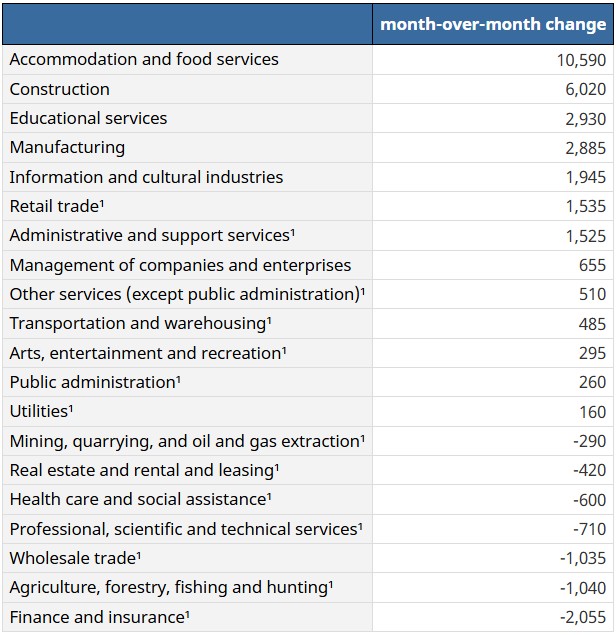
Vacancies increased in six sectors, led by accommodation and food services (+10,600; +18.9%), construction (+6,000; +17.6%), manufacturing (+2,900; +8.2%) and educational services (+2,900; +17.9%).
By province, vacancies rose in British Columbia (+10,900; +14.4%) and Ontario (+10,600; +6.3%), and fell in Manitoba (-2,000; -10.4%). These sectoral and regional shifts will shape HR planning around where to focus recruitment, adjust wage offers and refine talent mobility strategies across Canada.
Human resources employment has expanded significantly faster than overall employment over the past three decades, yet employer demand for new HR hires remains higher than pre‑pandemic levels, according to a previous report.
Earnings and hours
Average weekly earnings increased 1.9% year over year to $1,316 in December, following a 2.3% rise in November, according to StatCan. The agency noted that “growth in average weekly earnings can reflect a range of factors, including changes in wages, composition of employment, hours worked and base-year effects.”
Month over month, average weekly earnings were little changed. Average weekly hours worked declined by 0.3% to 33.2 hours in December and were down 0.9% compared with a year earlier.