‘This could develop into one of the most divisive issues on the political landscape’

With some politicians suggesting that the Temporary Foreign Worker Program (TFWP) should be put to an end, Canadians are divided on the matter, according to a recent report.
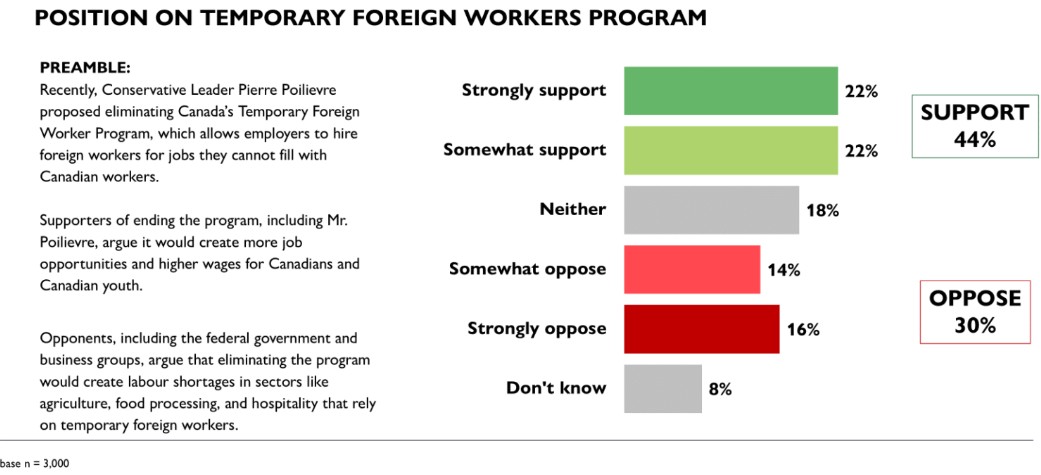
Overall, 44% of Canadians support phasing out the program, while 30% are opposed and 18% are neutral or undecided, reports Abacus Data.
“This could develop into one of the most divisive issues on the political landscape, cutting cleanly across age, region, and political affiliation,” says David Coletto, founder, chair, and CEO of Abacus Data.
“Immigration has risen over the last three years to one of the top five issues in the country, with close to one in four putting it in their top three national issues.”
Recently, British Columbia Premier David Eby called for the cancellation or significant reform of the TFWP, citing concerns that the current system is contributing to ongoing challenges in the province.
Differences across generations, regions
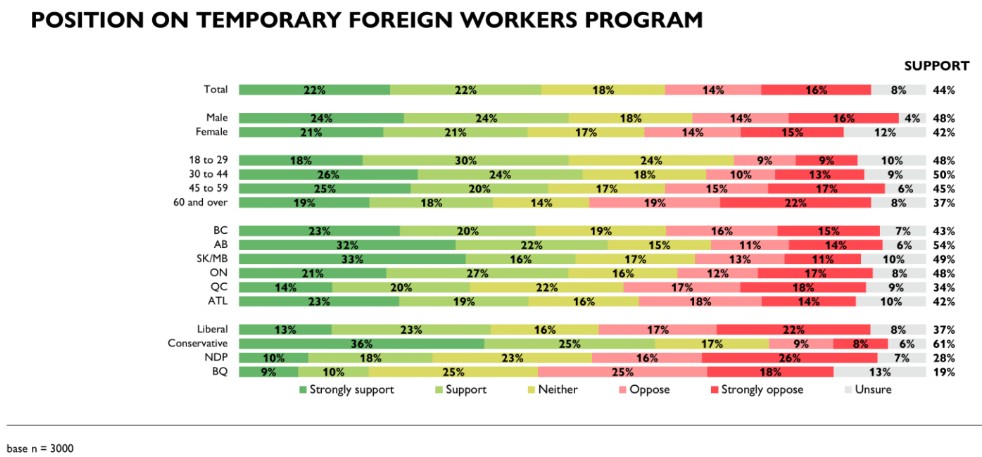
Support for eliminating the TFWP is strongest among younger Canadians, with 50 % of those aged 30 to 44% and 48% of those aged 18 to 29 in favour, according to Abacus Data’s survey of 3,000 Canadians from Sept. 4 to 7, 2025.
In contrast, only 37% of Canadians aged 60 and over support the proposal, indicating greater concern among older Canadians about workforce stability and economic disruption.
Regionally, support is highest in Alberta (54%) and Saskatchewan/Manitoba (49%), with Ontario close behind at 48%. Quebec is the most resistant province, with only 34% supporting the elimination of the program.
Politically, the divide is clear. Sixty-one per cent of Conservative voters support ending the TFWP, compared to just 37% of past Liberal voters. Among Liberals, opinions are nearly evenly split, with 39% opposed and 37% in favour, creating a challenging situation for the Carney government.
Businesses in need of workers
Some businesses heavily rely on foreign workers simply because Canadians would not take the jobs that these workers do, according to Di Shao, owner of Sushi Galore.
Sushi chefs, for example, are few and far between in Canada, Shao said in a CBC report.
Shao often hires local workers for front-of-house jobs, such as serving. However, the kitchen staff who prepare the sushi are often hired through the TFWP, according to the report.
“They know it's not an easy job, it's very tiring,” he said. “They would rather go be a server and make extra money from tips than work in the kitchen.”
He added that increasing wages to attract workers is not an option, as restaurants are struggling to meet the demands of minimum wage increases, rising food costs, and other operating expenses.
“Even though people feel like it's not enough because the price of everything is going up, honestly, for small businesses, it's been kind of maxed,” he said, according to the report.
However, a United Nations (UN) official previously said that the TFWP “serves as a breeding ground for contemporary forms of slavery, as it institutionalizes asymmetries of power that favour employers and prevent workers from exercising their rights”.