‘Having more gateway opportunities would help companies get the workers they need,’ says expert

Canada's oil and gas sector will need roughly 72,000 workers by 2035, the majority to replace retiring employees — a demographic squeeze that makes succession planning, early-career recruitment and reskilling immediate priorities for human resources teams across the energy industry.
The projection comes from a new report by Careers in Energy, a division of Energy Safety Canada, CBC News reported. Warren Mabee, director of the Institute for Energy and Environmental Policy at Queen's University, said the figure is credible and rooted in demographics rather than expansion.
"This is probably about right," Mabee said in an email to HRD . "The sector has an ageing population, and across the various subsectors... I would guess that there will be a strong need to simply keep up with retirements." The sector "isn't adding a lot of new jobs every year but has seen steady growth, which simply adds demand," he said.
Recently, sales rose in 17 of the 21 manufacturing subsectors nationally, with Alberta posting record-high totals at $10.5 billion, up 16.7% month-over-month, according to Statistics Canada's Monthly Survey of Manufacturing released in June. Quebec also reached its highest-ever monthly manufacturing figure at $20 billion, according to the report. That kind of broad-based momentum, spanning food production, petroleum and coal, and chemicals, has direct implications for talent acquisition, production scheduling, and labour relations across multiple provinces.
Retirements, not growth, drive the demand
The replacement need rather than net expansion is the defining feature of the hiring challenge, a distinction that points HR teams toward succession strategies and away from assumptions of aggressive growth.
The Careers in Energy report's figures bear this out. Canada's oilpatch directly employed 192,500 people in 2025 and is projected to reach 210,900 by 2035, according to Careers in Energy — modest net growth that nonetheless layers fresh demand on top of a heavy replacement need.
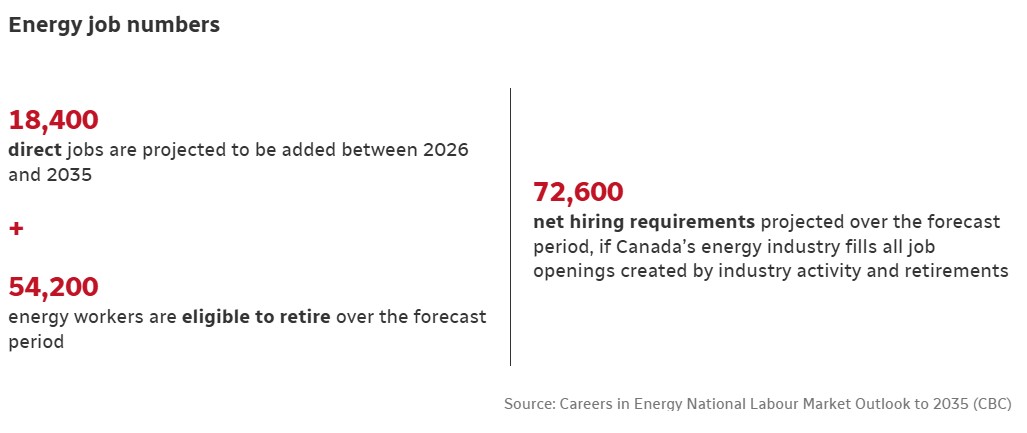
The crunch is expected to begin around 2027 as retirements accelerate, Careers in Energy director Lisa Stephenson told CBC. The total could climb above 100,000 positions if proposed major projects such as pipelines proceed, the report said.
A small but high-value workforce
The sector occupies a comparatively small footprint in the national labour market, but one whose figures HR planners should treat with care, Mabee told HRD. Drawing on 2025 data, he points to roughly 55,500 workers in oil and gas extraction, 16,600 in petroleum and coal product manufacturing, and 77,400 in support activities for oil, gas and mining, alongside sizeable chemical and plastics manufacturing workforces of about 93,600 and 83,000 respectively.
Not all of those workers can be attributed to oil and gas, Mabee cautioned. His working estimate is about 65,000 employed directly in oil and gas, plus at least 150,000 in downstream processing or support — a total of roughly 215,000 people. Against a national workforce of 18.3 million, that places about 1.1 per cent of Canadian workers in the orbit of the sector.
"Total related to oil and gas is a bit hard to get from the stats," Mabee said — a caution for HR teams benchmarking compensation or forecasting demand against sector-wide totals that are best treated as approximations.
Building a pipeline into the sector
Mabee's central prescription for employers is structural: companies need to build a route into the industry well before a vacancy opens.
"Employers need to develop a 'pipeline' into their sector," he told HRD. "Many of these jobs are in remote places; they pay well, but can be hard to attract youth into. Having more gateway opportunities would help companies get the workers they need (think more summer positions, internships, etc.)."
The recruitment hurdle is well documented. Attracting younger workers has been a persistent challenge for the sector, CBC reported, owing to concerns about remote work, work-life balance and the industry's environmental reputation — despite average sector salaries that topped $170,000 in 2024, more than double the Canadian average of just over $78,000, according to the report and Statistics Canada data. With the unemployment rate for Canadians aged 15 to 24 at 13.4 per cent in May, roughly double the national rate, the gateway roles Mabee describes could connect young jobseekers with some of the country's better-paid work.
There is a need for diversity in the C-suite in Canada’s oil and gas sector, according to a previous report.
AI seen reshaping, not shrinking, employment
Mabee expects artificial intelligence to reshape the sector's employment pattern rather than simply reduce it, with implications for how HR plans both hiring and training.
AI will likely automate some roles — he points to self-driving trucks and equipment — while converting others into remote opportunities that could become urban-based, potentially widening the talent pool by loosening the tie to a remote posting. That shift could itself become a recruitment tool for employers willing to redesign how and where work is done.
"AI might reduce the overall level of employment although I think it is more likely it will simply slow growth in additional employment, as companies will retool to use the technology," he told HRD. For HR, that points to a reskilling agenda alongside broadened entry points — and, Mabee added, to a generation of recruits weighing how the work aligns with their values. "They want to know that they're contributing to solutions and not contributing to problems," he told CBC.