‘As volume increases and precision declines, the hiring process risks becoming slower and less effective for everyone involved’

‘Doomjobbing’ is leading to higher volumes of poorly matched applications for HR professionals— lengthening and inflating the cost of screening, according to a report from Monster.
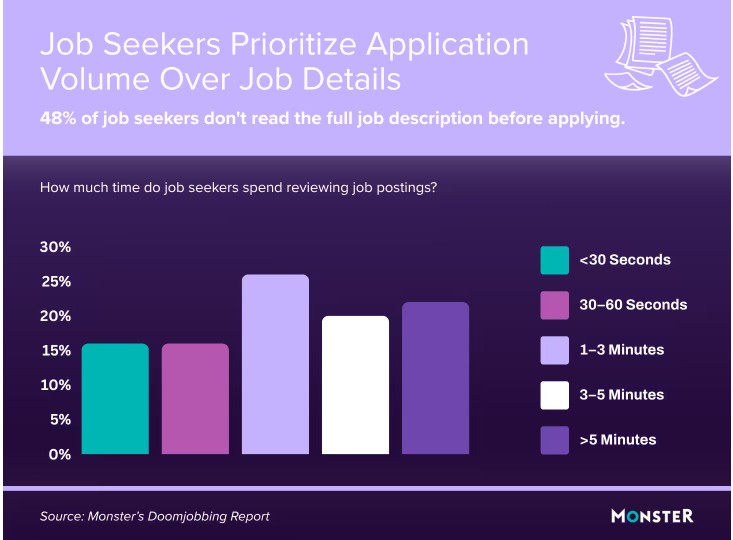
Overall, 48% of candidates admit they apply without reading the entire job description, and 32% spend one minute or less reviewing a posting before applying:
-
16% spend less than 30 seconds
-
16% spend between 30 seconds and 1 minute
-
26% spend 1–3 minutes
-
20% spend 3–5 minutes
-
22% spend more than 5 minutes
Over 6 in 10 (61%) HR leaders say AI-generated applications are slowing down hiring’ rather than speeding it up and nine in 10 HR teams have heavier workloads because of it, according to a previous report.
A search driven by volume
The Monster report describes doomjobbing as a high-volume application strategy in which candidates apply to numerous roles "in rapid succession with minimal vetting." Vicki Salemi, the career advice expert who authored the report, says the process "has become increasingly transactional rather than thoughtful."
According to Monster's findings, 42% of job seekers apply to four or more roles in a single session, with some submitting as many as 16 applications in one sitting, while the remaining 58% apply to between one and three jobs per session.
When asked how they approach the search, 47% of respondents said they try to balance quality and fit, 32% said they focus on strong matches, and 21% said they apply to as many roles as possible.
And the amount of time candidates take to find jobs varies significantly, according to the survey of 1,006 U.S. job seekers conducted on April 28, 2026:
-
36% find roles in under a month.
-
26% find a new position in 1–3 months.
-
25% remain searching for 6 months or longer, including 18% for over a year.
'Growing sense of urgency' in job market
The high-volume application strategy “reflects a growing sense of urgency in today’s job market,” says Salemi. “When candidates don’t hear back, they often respond by applying to more roles, more quickly, and with less scrutiny. It creates a cycle where quantity increases, but meaningful matches don’t.”
This is indicative of “a job market under strain,” she says.
“Candidates are applying faster and with less attention to detail, not because they want to, but because they feel they have to. As volume increases and precision declines, the hiring process risks becoming slower and less effective for everyone involved,” says Salemi.
“Breaking this cycle will require more transparency, better communication, and a hiring experience that rewards quality over quantity.”
Canada's slow-adjusting labour market – long a cushion against recessions – could instead deepen and prolong job losses if the next downturn coincides with rapid artificial-intelligence adoption, according to a report from TD Economics.