What are the top reasons why people are looking for a new job?

Recruitment and retention will be key challenges for human resources professionals early in 2026, based on the findings from a recent survey.
Specifically, 33% of employed Canadian professionals plan to look for a new job in the first half of the coming year, signalling a potential rise in staff turnover that could affect employers across sectors.
That number is up from 26% in July 2025, according to the Robert Half report.
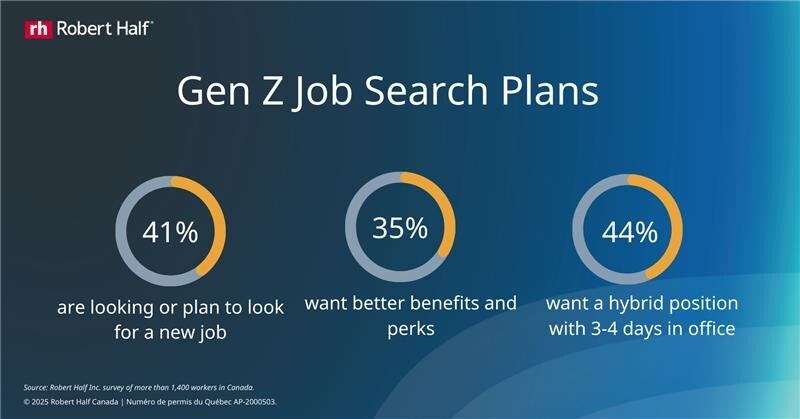
Technology professionals (43%) are the ones most likely to search for a new job in H1 2026, followed by Gen Z workers (41%) and working parents (39%).
Retaining top talent and finding talent quickly when it’s needed are the top two priorities for small- and medium-size businesses until the end of 2026, according to a previous report.
Why do people want to change their jobs?
For the second time since Robert Half began tracking worker sentiment, better benefits and perks emerged as the leading motivator for professionals considering a move, according to the survey of more than 1,480 employed professionals and 350 unemployed job seekers across Canada.
A third (33%) of respondents cite improved benefits and perks as their top reason for exploring new roles, followed by competitive pay (31%) and limited career advancement opportunities in their current position (23%).
“Many professionals chose not to make a job change throughout 2025, due to economic and global uncertainty, but signs of greater movement are showing as we enter 2026,” says Koula Vasilopoulos, senior managing director, Robert Half, Canada.
She says workers “are once again highlighting the value they place on perks and benefits like flexibility, competitive salaries, and career growth, and are feeling less inclined than they were this past year to remain with organizations that aren't providing those essential elements.”
Less than 1 in 10 (7.7%) employees agree or strongly agree that they might lose their job in the near future, according to a previous Statistics Canada (StatCan) report.
What are the top challenges for job seekers?
The Robert Half research also highlights significant challenges facing job seekers, especially those currently between roles. In a separate survey of 350 unemployed job seekers, more than six in 10 (61%) said they expect their current job search to take longer than their previous one.
Among this group, the most commonly cited obstacles are:
- too many applicants and competition for positions (62%)
- difficulty finding a job that matches their workplace preferences (41%)
- challenges showcasing their qualifications (32%)
- lengthy hiring processes (31%)
- their skills not fully matching job requirements (30%)
“Job seekers are facing new challenges in the current landscape, and it may feel harder than ever to stand out in a crowded market,” Vasilopoulos says. She notes that “keeping skills current and prominently featured in applications, networking effectively, and researching areas of demand to focus the search can all help with landing the right opportunity.”
Nearly three-quarters (73%) of Canadian workers say they would be more likely to apply for a job that includes the pay range in the posting, according to a previous report from Indeed.