B.C., Manitoba and parts of Ontario stop changing clocks Nov. 1, leaving national employers with shifting time gaps

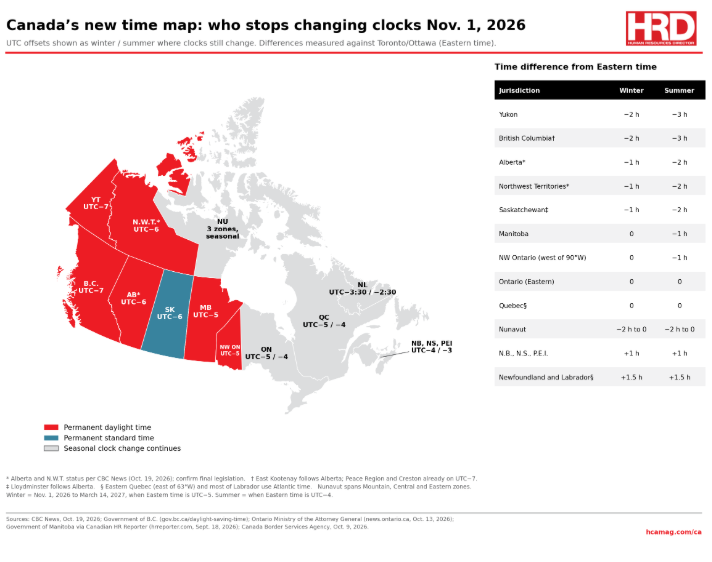
National employers face a redrawn map of Canadian time on Nov. 1, 2026. That day, much of Western Canada and part of northwestern Ontario stop turning clocks back, while the rest of the country keeps switching.
British Columbia and Manitoba move to permanent daylight time, joining Yukon. Saskatchewan has stayed on permanent standard time since 1966. Alberta and the Northwest Territories adopted similar measures this year, CBC News reported.
For HR leaders with multi-province teams, the result is time gaps that shift with the seasons.
Patchwork of time zones across Canada
Manitoba Premier Wab Kinew announced the change on Sept. 17, 2026, after a provincial survey drew close to 72,000 responses. In all, 92% wanted an end to seasonal clock changes and 58% preferred permanent daylight time, according to the Manitoba government.
Kinew called the move “good for our health, good for business and good for parents.” Loren Remillard, president and CEO of the Winnipeg Chamber of Commerce, said it “reduces friction for companies working across provincial borders.”
Ontario followed on Oct. 13, 2026. It announced that Kenora and communities west of the 90th meridian will stay aligned with Manitoba under the province’s Time Act. Those communities will share the same time as the rest of Ontario in winter, the province said.
“Providing certainty and predictability is essential to supporting strong communities and a competitive economy,” said Ontario Attorney General Doug Downey.
The rest of Ontario, Quebec and Atlantic Canada will keep changing clocks. Ontario says co-ordination with Quebec and New York State remains important for trade, the stock market and broadcasting.
B.C. will sit two hours behind most of Ontario in winter, CBC News reported.
Federal workforce adjusts first
The Public Service Alliance of Canada (PSAC) told CBC News that more than 100 call-centre staff at the Canada Revenue Agency (CRA) in B.C. will work until 6 p.m. rather than 5 p.m. – 8 p.m. Eastern time.
“It’s going to mean that folks are going to need to have child care for an hour later … elder care as well,” said Jamey Mills, PSAC’s regional executive vice-president for British Columbia.
The Canada Border Services Agency (CBSA) is adjusting hours at land crossings in B.C., Alberta and Manitoba from Nov. 1, 2026, to March 14, 2027, to match U.S. ports of entry.
What HR leaders should review
Nathan Fehr is a sales employee based in Coquitlam, B.C., for a biotech company headquartered in Boston. He expects old habits to break.
“I’m going to be in the habit of probably just Googling it quickly before a meeting,” he told CBC News.
Employers can limit errors by auditing recurring meetings, listing time zones in invites and updating scheduling and payroll systems before Nov. 1. They may also need to review shift-differential and overtime rules tied to time-of-day triggers, and collective agreement language that refers to seasonal time changes. Alberta’s own move to permanent daylight time adds to the cross-jurisdictional complexity facing multi-province employers.
Safety is another concern. Skies could stay dark until about 9 a.m. in Vancouver this winter, according to CBC News. The BC Construction Association (BCCA) warned that “many crews start work early in the day when visibility is most important.”
Employers that bridge time gaps with after-hours calls should also revisit expectations, a lesson underscored by Ontario employers’ frustration with right-to-disconnect education.