Marks lowest number of job vacancies since first quarter of 2018: StatCan

Job vacancies in Canada declined for the second consecutive quarter as total labour demand fell following two quarters of consecutive increases, according to Statistics Canada (StatCan).
Overall, there were 505,900 unfilled positions in the second quarter of 2025, down 18,900 positions (-3.6%) from the previous quarter.
This marks the lowest number of job vacancies since the first quarter of 2018 and reflects a 12.6% decrease compared to the same period last year, according to the report.
Total labour demand—which includes both filled and vacant positions—fell by 54,800 (-0.3%) in the second quarter, driven by decreases in both job vacancies and payroll employment.
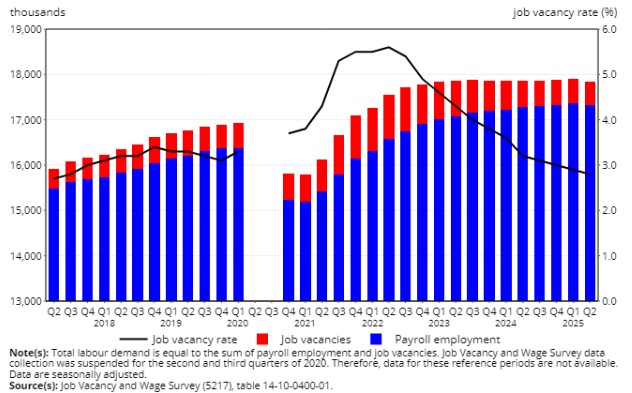
The national job vacancy rate dropped by 0.1 percentage points to 2.8% in Q2 2025. Year over year, the rate is down 0.4 percentage points. StatCan also notes a rise in the unemployment-to-job vacancy ratio, which climbed to 2.9, up from 2.2 a year earlier. This ratio was highest for positions requiring a bachelor’s degree or higher, reaching 4.9, indicating increased competition for higher-skilled roles.
Canada’s labour market took a sharp downturn in August, with employment falling by 66,000, according to a previous StatCan Labour Force Survey (LFS).
Job vacancies by sector
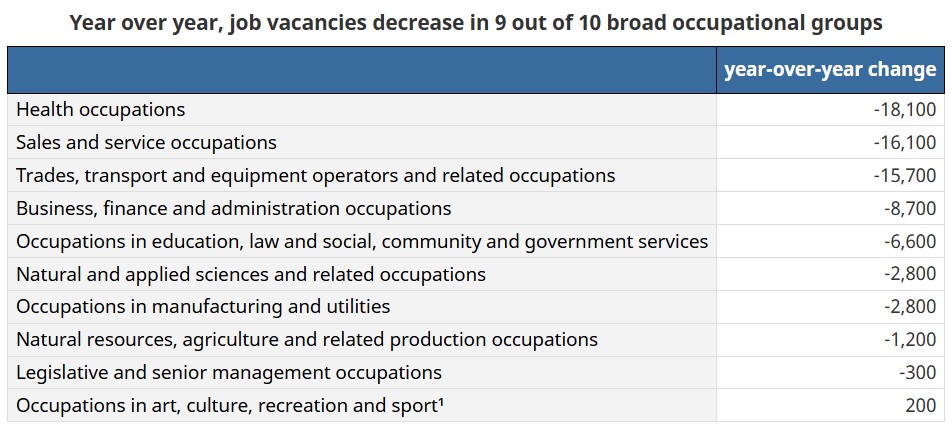
In the second quarter of the year, job vacancies decreased in six of ten broad occupational groups, including trades, transport and equipment operators, health, and business, finance and administration, according to StatCan.
The only occupational group to see an increase was art, culture, recreation and sport, which rose by 9.5%. On a year-over-year basis, health occupations led the decline, with vacancies dropping by 20.8%.
“Overall, the recent weakness in StatCan job vacancies has been broad-based, and unlike the employment data, trade-exposed sectors (particularly manufacturing) have evolved similarly to others,” says Brandon Bernard, senior economist at the Indeed Hiring Lab, in a previous report.
“Business sentiment was weak throughout the economy in Q2, so it’s not surprising that some firms put hiring plans on hold. Across the private sector (from construction to finance to retail), declining job openings have been the norm since 2022. However, some industries that have seen the fastest declines in vacancies over the past year are in public-sector related areas, like healthcare (the largest of the group), education, and public administration, which had previously been holding well above pre-pandemic levels. This suggests the strong public sector job gains of recent years are set to slow.”
Job vacancies by region
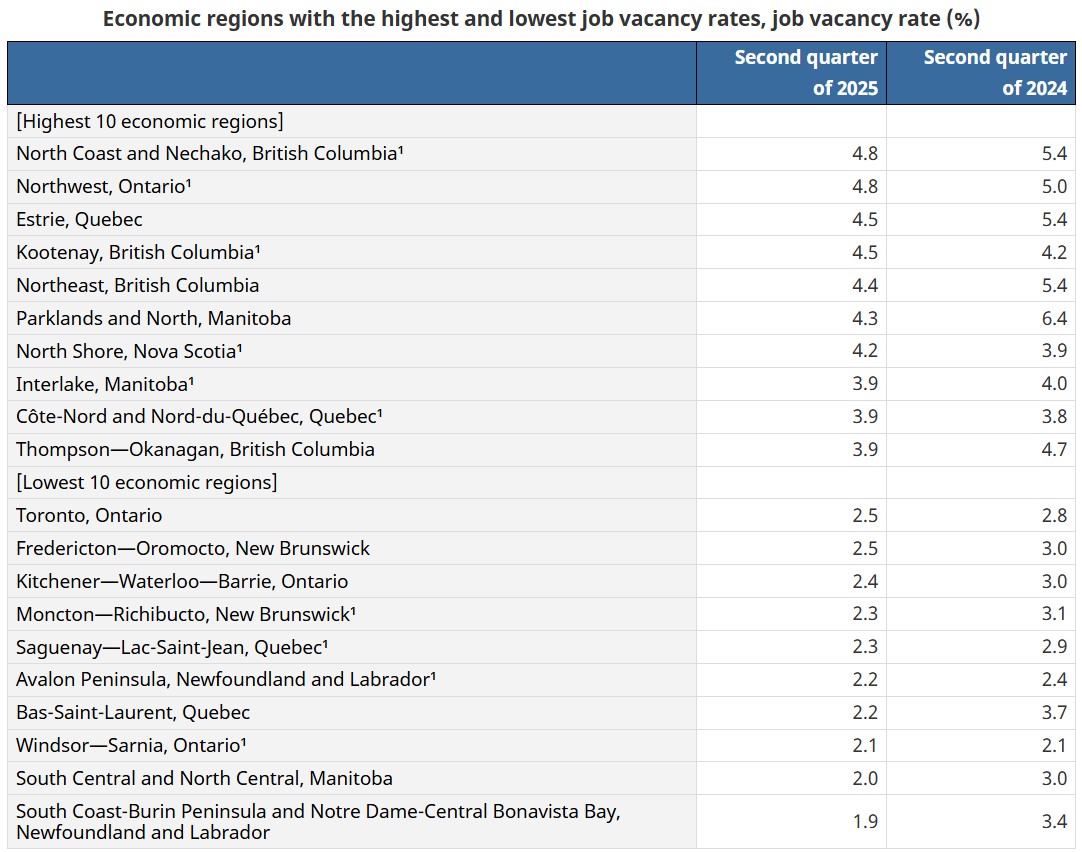
Regionally, job vacancies fell in Quebec, Ontario, Manitoba, Newfoundland and Labrador, and Prince Edward Island, according to StatCan. The largest decreases in vacancy rates were observed in the Northwest Territories, Parklands and North in Manitoba, and South Coast–Burin Peninsula and Notre Dame–Central Bonavista Bay in Newfoundland and Labrador.
The highest job vacancy rates were recorded in Northwest Ontario and North Coast and Nechako, British Columbia, both at 4.8%.
The average offered hourly wage for job vacancies requiring a bachelor’s degree or higher was $43.60, more than double the $21.65 for roles requiring a high school diploma or less. Across all vacancies, the average offered hourly wage increased by 4.5% year over year to $28.00, though this growth has slowed compared to previous quarters, says StatCan.
The average offered hourly wage for job vacancies requiring a bachelor’s degree or higher was $43.60, more than double the $21.65 for roles requiring a high school diploma or less. Across all vacancies, the average offered hourly wage increased by 4.5% year over year to $28.00, though this growth has slowed compared to previous quarters.
The proportion of long-term vacancies—positions unfilled for 90 days or more—declined to 27.5% nationally, down from 30.1% a year earlier. The largest decreases were seen in art, culture, recreation and sport, business, finance and administration, and trades, transport and equipment operators.
As economic clouds gather over Canada, both statistical indicators and workplace sentiment suggest the country may be on the brink of a recession, according to a previous report.