‘The central challenge is not widespread compliance failure. It is the growing gap between expanding obligations and the infrastructure required to manage them sustainably’

For HR leaders, compliance demands are expanding rapidly while governance and technology investments lag behind, according to a recent report.
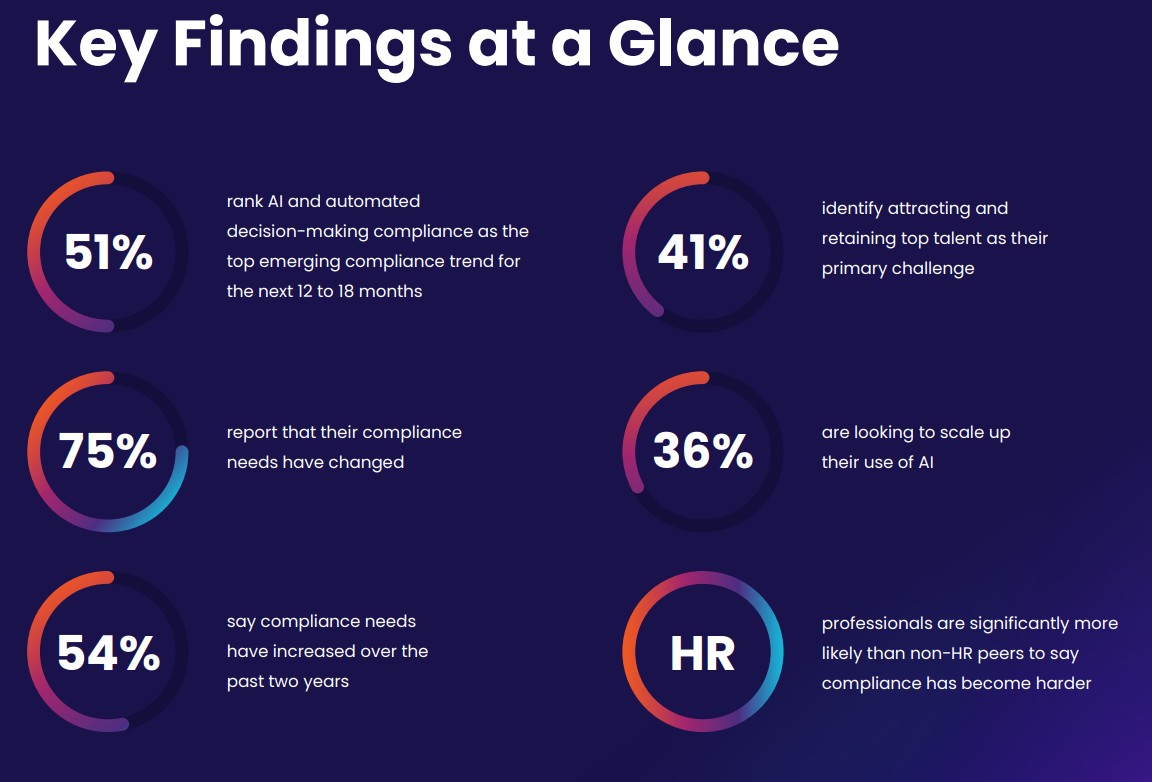
Three in four (75%) respondents say their compliance needs have changed, according to a survey of 500 U.S. professionals across HR and adjacent functions.
And 54% report that those needs have increased over the past two years, reflecting regulatory expansion, pay transparency rules, data privacy obligations, wage‑and‑hour enforcement and scrutiny of automated decision‑making.
“HR compliance in 2026 is not fundamentally broken. It is under increasing structural pressure,” says Mitratech’s State of HR Compliance 2026 report. “The central challenge is not widespread compliance failure. It is the growing gap between expanding obligations and the infrastructure required to manage them sustainably.”
People strategy top challenge
Also, 41% of HR leaders identify attracting and retaining top talent as their primary challenge, according to Mitratech’s survey of 500 U.S. professionals across HR and adjacent functions.
Meanwhile, 35% cite employee engagement and 29% point to career growth and workforce development as key concerns.
This means HR leaders are being pulled between people strategy and regulatory complexity, says David Deitering, CEO of Mitratech’s HR Solutions division.
“Today’s HR leader must balance two critical mandates: delivering strong people outcomes while also managing an increasingly complex compliance environment,” Deitering says. “Our research shows that while attracting and retaining the right talent remains the top priority, HR professionals are increasingly concerned and distracted by compliance requirements that are constantly changing and expanding for most organisations. That combination is creating pressure for HR teams already operating with limited resources and can prevent them from delivering on their core mission.”
The study finds many employers continue to rely on fragmented systems and manual processes to manage compliance, creating operational strain for HR and increasing the risk of incomplete documentation, unclear ownership and inconsistent execution.
A key driver of workplace trust is legal compliance, adhering to employment standards, respecting employee rights, and fostering a fair, safe and transparent environment, according to Paulette Haynes, founder of Haynes Law Firm, a boutique employment law firm in Toronto.
AI as core compliance priority
AI‑related obligations are emerging as a key pressure point for HR leaders. Mitratech reports that 51% of respondents rank “AI and automated decision-making compliance” as the top emerging trend for the next 12 to 18 months.
The report notes that as AI adoption expands, “decision velocity and operational reach increase. Governance expectations increase alongside them,” and warns that “AI does not eliminate the need for compliance infrastructure. It increases its importance.”
Mitratech distinguishes between “compliance around AI” – ensuring automated tools comply with employment law, anti‑discrimination standards, disability protections and data privacy requirements – and “compliance through AI,” where automation is used to interpret regulations, generate documentation and streamline workflows but may introduce risk if outputs are inaccurate or insufficiently reviewed.
Deitering says the pace of change is outstripping regulatory clarity in many areas. “AI is accelerating decision-making and expanding the scale of HR operations, which means governance expectations are evolving just as quickly,” he says. “At the same time, with limited regulatory clarity around AI, HR practitioners are navigating new layers of complexity without clear guardrails in place. That’s why having trusted experts and compliance‑focused technology to rely on is more important than ever.”
Mitratech also links compliance execution directly to the employee experience, stating that pay accuracy, accommodation handling, policy consistency and equitable decision‑making influence how staff perceive fairness and accountability. “When compliance processes fail, employees experience them as fairness issues, not technical oversights,” the report notes.
Employee retention is a critical challenge for Canadian organisations, especially in a labour market defined by diversity along with rapid technological and legislative changes, and increasingly high expectations for workplace culture and employee safety and well‑being, according to one employment lawyer.
Treating compliance as an investment in culture, growth and resilience, rather than a chore or a cost centre, is key to aligning an organisation’s compliance practices with its overall business strategy, according to a previous report.