'Job-changers are highly sensitive to real-time economic conditions,' says expert

Employers who will fail to increase their workers’ pay risk losing their talent, as new reports show that those who choose to switch companies are earning more than those who remain loyal to their employers.
Canadian job-changers saw base pay rise 5.6% year-over-year in August, compared with a 3.0% increase for job-stayers, according to the ADP Canada Pay Insights report.
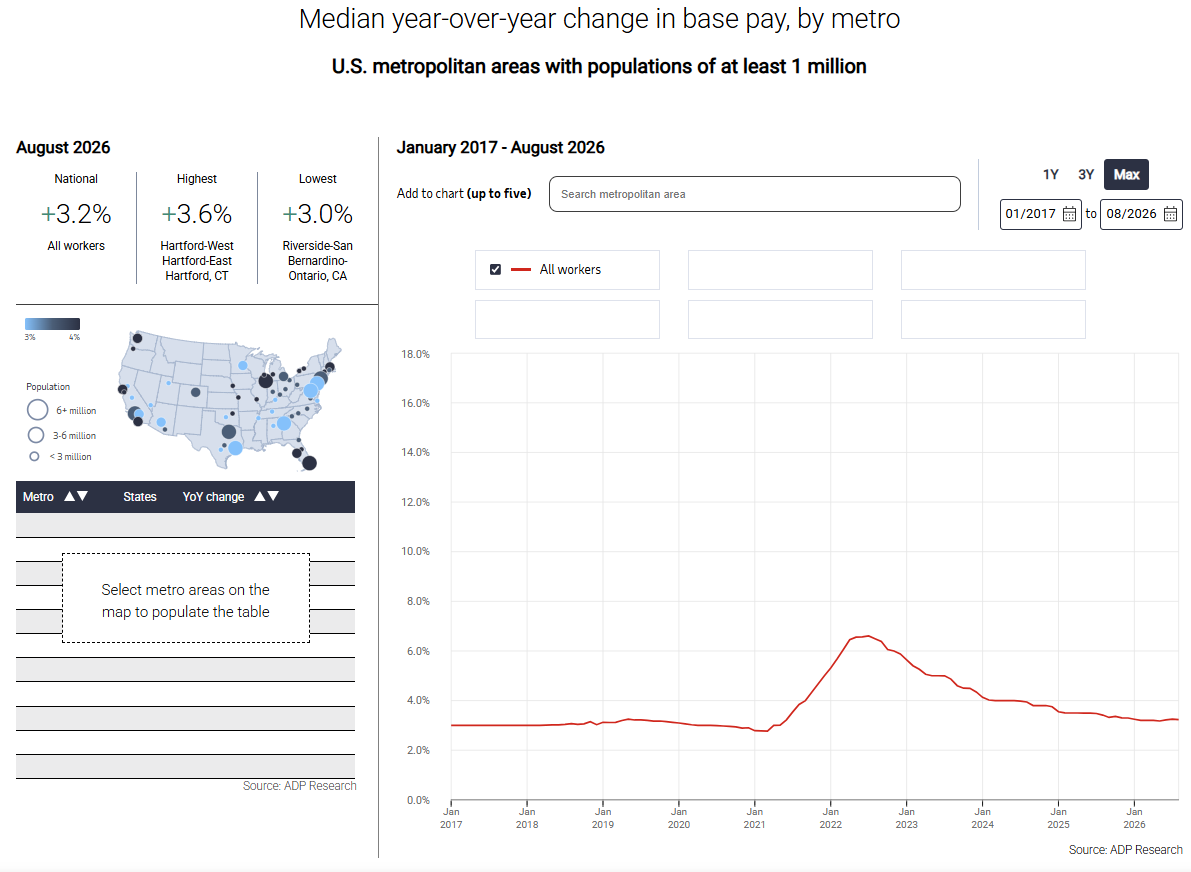
In the United States, the gap was narrower, both those jumping ship are still earring more than those staying put. The August 2026 U.S. Pay Insights report from ADP Research put job-changer base pay growth at 4.7%, down slightly from 4.8% the prior month, while job-stayer pay growth held steady at 3.0%
A separate ADP release, the July 2026 National Employment Report produced with the Stanford Digital Economy Lab, showed U.S. job-changer pay accelerating to 7.0%, the fastest pace in nearly a year, while job-stayer pay held at 4.4%.
Geographical, sectoral difference
In Canada, base pay growth for job-stayers was uneven across the country. Prince Edward Island led all provinces at 4.2%, followed by Nova Scotia at 3.7% and New Brunswick at 3.5%, while Yukon trailed at 2.5%.
By sector, education and health services posted the strongest job-stayer pay growth, at 3.3%, followed closely by professional and business services at 3.2%. Most other sectors clustered near the national median of 3.0%.
Age was also a factor. Workers aged 25 to 34 saw the fastest job-stayer pay growth, at 3.6%, while those aged 55 to 85 saw the slowest, at 2.8%. Firm size, by contrast, made little difference in Canada this month, with job-stayer pay growth flat at 3.0% regardless of employer headcount.
Here’s the data for the U.S. side:
Cost-of-living pressure is cutting into Canadian workers' productivity, according to the Q2 2026 TELUS Mental Health Index.
‘Highly sensitive to real-time economic conditions’
ADP's chief economist, Dr. Nela Richardson, said job-changer pay trends reflect underlying labour market conditions. "Job-changers are highly sensitive to real-time economic conditions, and their rapid pay growth implies supply constraints in parts of the labor market," Richardson said.
Richardson added that hiring patterns are also shifting. "Typical hiring patterns, meanwhile, are changing as employers react to shifting macro-economic conditions," she said.
Gross pay figures, which include overtime and bonuses, showed an even wider divide in Canada: job-changers saw gross pay rise 9.6% year-over-year, compared with 4.4% for job-stayers.
The ADP Research Canada Pay Insights report draws on the anonymized payroll data of approximately 1.6 million Canadian workers each month, using a matched-sample methodology to track individual workers over 12-month intervals.
But just how much pay increase should employers give to their loyal workers? Mercer previously found that only 4% of surveyed organizations gave the same increase to everyone in 2026. Elizabeth English, senior principal in Mercer's career practice, said: "Our latest compensation planning survey clearly shows that Canadian employers are being strategic with their compensation budgets, rather than delivering across-the-board increases. Companies are prioritizing performance, market value, and internal equity to differentiate pay. This approach is designed primarily to retain top talent in a competitive market."
Mercer's own broader guidance echoes this: its 2026 compensation planning material notes that pay growth is diverging sharply by role, with skilled trades, frontline, and on-site positions commanding "premium wage growth due to persistent staffing challenges," while pay growth in technology and professional-services roles has cooled.
Mercer's QuickPulse Canada Compensation Planning Survey – a survey of 271 employers, released March 2026 – found that the average merit increase delivered in 2026 was 3.0%, with total increases — including promotions and other adjustments — reaching 3.3%.
Broken down by employee group, non-executive salaried staff received a 2.9% merit increase (3.3% total), non-executive hourly workers received 2.8% (3.0% total), and executives received 2.5% (2.7% total).
Canadians are bracing for a tougher financial year in 2026, with large majorities expecting the cost of living, housing affordability and the broader economy to deteriorate, according to the MNP Consumer Debt Index released in January.