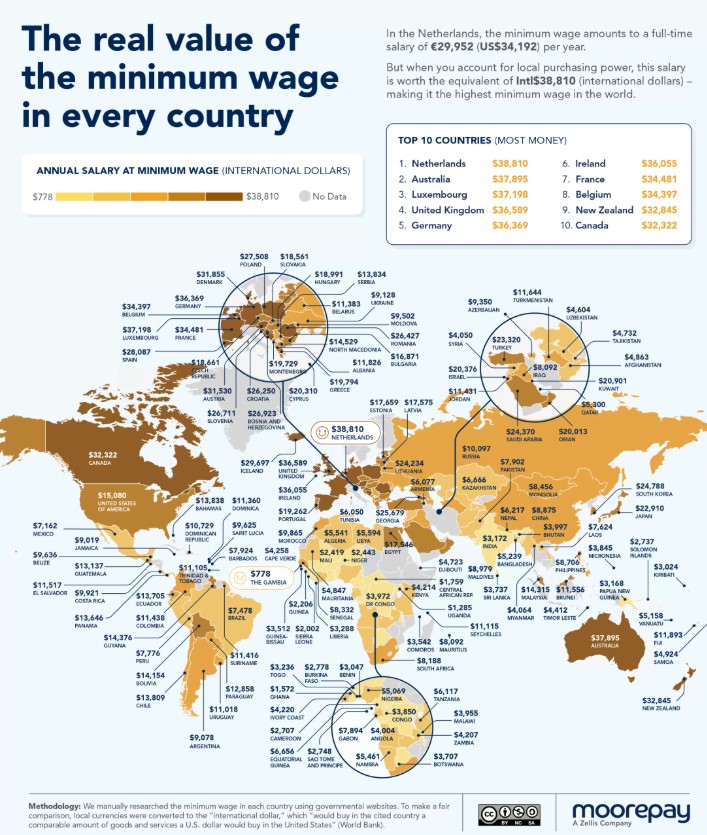
Report looks at value of minimum wage in each country, converting rate into annual salaries in international dollars

Canada is outpacing the United States when it comes to a minimum wage, and ranks about 10th in the world, according to a report.
While the minimum wage varies greatly across the world, the cost of living in these countries is also vastly different.
To discover the real value of minimum wages in each country, Moorepay converted each country’s annual minimum wage into international dollars. Moorepay researched the current statutory minimum wage in every country using government sources and converted these figures into annual salaries.
"To make a fair comparison, we then converted these local salaries into international dollars using the Purchasing Power Parity conversion factors for each country. The international dollar is a hypothetical currency the World Bank uses to create a realistic comparison of the buying power of local currencies. It reflects 'the comparable amount of goods and services a U.S. dollar would buy in the United States.'"
Canada's minimum wage salary
Based on this analysis, Canada’s minimum wage salary is $36,920, equivalent to $32,322 international dollars, reports the U.K.-based payroll company.
Meanwhile, the U.S. federal minimum wage stands at $15,080; the figure is the same in international dollars, since the INTL is pegged to U.S. purchasing power.
Globally, Canada’s minimum wage salary ranks 10th, according to the study, which is based on the assumption that a year’s work equals 2,080 working hours.
Topping the list is the Netherlands, where the minimum wage amounts to INTL$38,810. However, Dutch employees are receiving relatively less for their contribution to the economy than they did in 2014, according to an earlier column by Frank van Weegberg, expert strategist at apg, an investment company: “Cumulatively, wages are now about 2.5 to 4 per cent behind price rises [2021-2024]. Assuming that prices will rise by about 3 per cent next year, a wage increase of between 5 and 7 per cent would compensate for the loss of purchasing power over the past four years.” In the event, the January 2025 minimum wage rise was just 2.78%.”
Australia, Luxembourg, the U.K., and Germany complete the top five. Meanwhile, Ireland, France, Belgium, and New Zealand took the next four spots, just ahead of Canada.
Numerous Canada governments have announced minimum wage increases this year. Ontario, for example, will see a base pay increase of $0.40 starting October, according to a CBC report.
Eight of the ten countries with the most valuable minimum wage are in Europe, while the same number of African countries are among the 10 with the least valuable wage, found Moorepay. The federal minimum wage in the United States is $7.25 (£5.37), which gives a salary of $15,080 (the figure is the same in international dollars since the INTL is pegged to U.S. purchasing power).
This makes the U.S. minimum wage just the 23rd most powerful in the world, ranking just below Japan and Poland and above Lithuania.
Pros and cons to higher minimum wages
A previous report found that mandatory minimum wage increases have led some employers to eye automation and layoffs.
And m
It said that r
But making upwards adjustments to base pay rates can bring a lot of positives for employers, according to the Canadian Centre for Policy Alternatives (CCPA).
“Increasing wages reduces employee turnover, which is costly as employers spend to hire and train people, and when people leave, expertise is lost,” it said. “Additionally, a higher minimum wage can lead to more on-the-job training as businesses seek to invest in and retain workers.”
Minimum wage increases also allow small employers to compete for talent with big corporations, according to the CCPA.
“When the minimum wage goes up, it goes up for all competitors. They are on the same playing field and can gradually adjust prices to cover the cost."