'We need a way to resolve work stoppages to keep our railways and ports open for business,' says senator
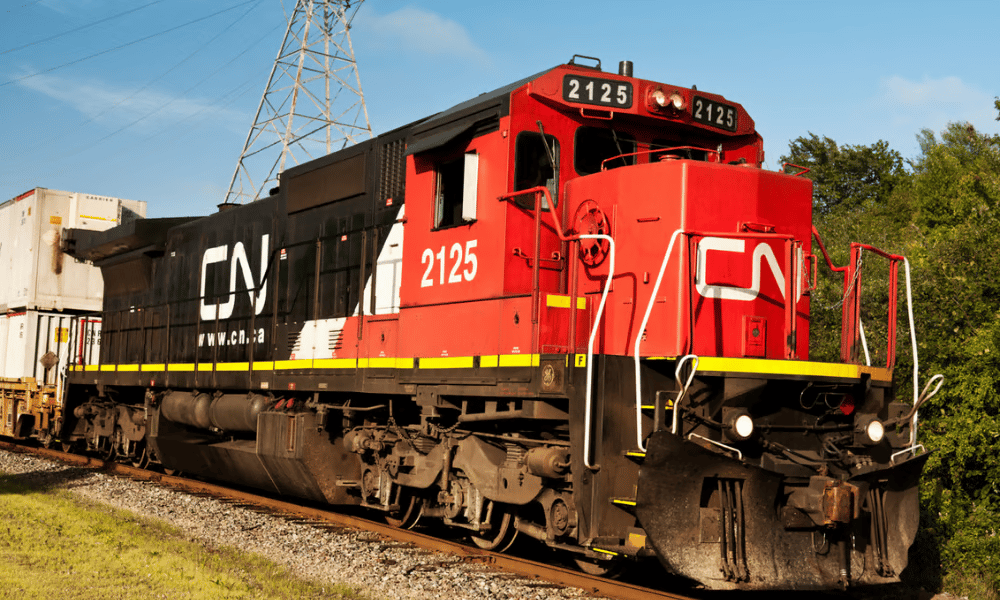
Canada's largest unions have condemned a Senate committee report that recommends Ottawa be empowered to halt strikes and impose contracts through binding arbitration in the rail and marine sectors.
The report, Keep Canada Moving, was released by the Standing Senate Committee on Transport and Communications after it heard 45 witnesses and received 36 briefs. Its centrepiece is a call to create a Supply Chain Reliability Act or amend the Canada Labour Code to establish a permanent, independent tribunal with marine and rail expertise.
According to the recommendation, where the tribunal judged a stoppage would harm the national interest, it would impose mediation and arbitration, with a mediator-arbitrator involved from the start of bargaining. If no deal emerged, the Governor in Council could ultimately order binding arbitration and prohibit the strike or lockout.
“Tariffs and trade tensions are already straining Canada’s economy — another rail or port strike could be disastrous,” said Senator David Wells, Chair of the committee. “It’s clear that the current system for addressing labour disruptions isn’t fit for purpose. We need a new way to resolve work stoppages to keep our railways and ports open for business.”
Recently, the Canadian Federation of Independent Business (CFIB) called on the federal government to prioritise supply chain stability in any reforms to the Canada Labour Code (CLC). In a statement issued just as Ottawa concluded consultations on potential changes to the Code, the CFIB urged the government to reduce compliance burdens on small businesses and modernise federal labour rules it says have long been tilted toward large unions.
The committee also recommended removing the word "immediate" from section 87.4 so the Canada Industrial Relations Board could weigh a serious but not imminent danger to public health or safety. It urged clearer criteria for section 107 — used seven times between June 2024 and August 2025 to refer disputes to the board — including an economic harm threshold set in consultation with unions and employers.
The committee's case rests partly on how the board has read the law. In a 2024 ruling on a Canadian National (CN) dispute, the Canada Industrial Relations Board wrote:
"There is no doubt that a work stoppage at CN would result in inconvenience, economic hardship and, possibly, as some groups and organizations have suggested, harm to Canada's global reputation as a reliable trading partner. While such possible harm is by no means insignificant, these are not factors that are to be considered by the Board when addressing a referral under section 87.4 of the Code."
In 2024, the Canadian government intervened to bring an end to a nationwide rail strike. Labour Minister Steve MacKinnon invoked Section 107 of the Canada Labour Code to impose binding arbitration on the dispute between CN, Canadian Pacific Kansas City (CPKC), and the Teamsters union, which represents engineers, conductors, and yard workers.
Unions reject proposals
Unifor — Canada's largest union in the federally regulated private sector — said it was appalled. National President Lana Payne called the recommendations "shocking, radical" and warned that "the growing argument against the Charter rights of workers from those in power should be very concerning to all people in Canada."
Payne said the committee was "creating a crisis where no such crisis exists," arguing that unions and employers routinely avoid disputes by bargaining in good faith. She also noted that the Senate did not call any Unifor witnesses and heard from only three groups representing workers, though Unifor submitted a written brief in the fall of 2025.
The Canadian Union of Public Employees was equally blunt. National President Mark Hancock said the government should put the report "straight into the trash bin," while National Secretary-Treasurer Candace Rennick said "the right to strike is a fundamental and protected right of all workers." The Canadian Labour Congress launched a campaign urging members to lobby senators.
Labour's objections predate the report. In a brief submitted during the study, the CLC told the committee:
"In the CLC's view, Senators should dismiss the suggestion that transportation company interests are coextensive with the national interest, while unions stand accused of 'holding Canadians hostage' when they pursue their legitimate workplace objectives. Rather, we encourage the committee to inquire into the underlying frustrations with job quality, work organization, and work intensification that have mounted over time."
What's at stake for bargaining teams
The unions' core objection rests on the 2015 Supreme Court of Canada decision in Saskatchewan Federation of Labour, which recognised that the right to strike is constitutionally protected, though not absolute. The report acknowledges that ruling and notes that most federally regulated bargaining concludes without a work stoppage.
Minister of Jobs and Families Patty Hajdu told the committee that the Federal Mediation and Conciliation Service supported more than 200 negotiations in the last fiscal year, 97 per cent of which settled without a stoppage.
Yet collective agreements covering CN and West Coast ports employees are set to expire by year's end, sharpening the stakes for bargaining teams.
Expanding sectoral bargaining could reshape how work is organised across Canada’s low-wage industries and solve Canada’s labour market challenges, two experts from the Canadian Centre for Policy Alternatives (CCPA) claimed.