Some employees say feedback is more specific, actionable; others say it's become more generic, less useful

Managers are increasingly turning to artificial intelligence (AI) to write performance reviews, often without telling employees – a gap that puts trust, fairness and accountability in performance management squarely on HR's agenda.
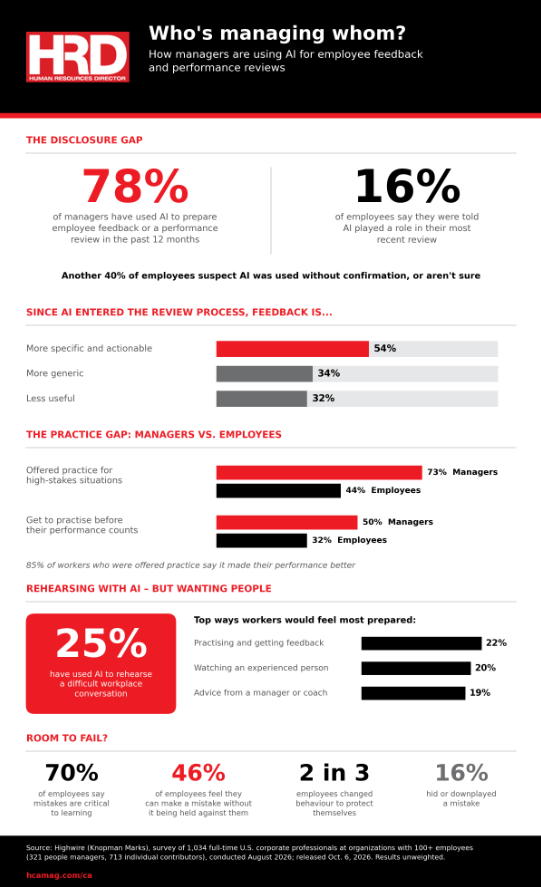
Some 78% of managers say they have used an AI tool to prepare employee feedback or a performance review in the past 12 months, yet only 16% of individual contributors said they were told AI played a role in their most recent review, according to Highwire, a New York-based professional development offering from Knopman Marks.
Another 40% either suspect AI was used without confirmation or are unsure, found the August 2026 survey of 1,034 full-time U.S. corporate professionals.
Mixed results from AI-assisted performance reviews
Employees are split: 54% said feedback has become more specific and actionable, but 34% said it has grown more generic and 32% less useful.
"AI can help you write a faster review, but it doesn't replace human judgment, context, nuance, and empathy," said Liza Streiff, co-founder and CEO of Highwire.
"AI is filling a gap, not addressing the issue. That should concern every leader."
Privacy is a related concern. A July 2026 survey of 399 managers and 208 CEOs and business leaders by The Predictive Index, based in Westwood, Mass., found 44% of managers admit entering employee names or performance details into public AI tools, as noted in HRD Canada's coverage of whether managers should be using AI for difficult conversations.
Employees rehearse with AI instead of colleagues
One in four professionals (25%) told Highwire they have used an AI tool to rehearse a difficult workplace conversation.
While 73% of managers said they had been offered practice for high-stakes situations, just 44% of employees had.
Yet the three approaches respondents ranked highest for feeling prepared all involved people: practising and receiving feedback (22%), watching an experienced person handle the situation (20%) and getting advice from a manager or coach (19%).
A growing roster of platforms now pull data from Slack, project trackers, and goal systems to draft review summaries, flag coaching moments, and even detect bias in language. The technology is efficient, scalable, and increasingly popular. What it doesn’t account for, according to two researchers who study workplace behavior and emotion, is how the employee on the receiving end of that feedback is actually wired to receive it.
“The message is just words on a page,” said Anthony Belluccia, head of science at The Predictive Index in Boston. “What determines whether feedback actually works is what happens inside the person receiving it.”