Recent report shows U.S. labour productivity grew three times as fast as Canada — HR leader offers possible solutions from HR

It’s almost the end of 2025 and yet still, Canada is struggling with a productivity issue — as highlighted in a recent report from the Frasier Institute.
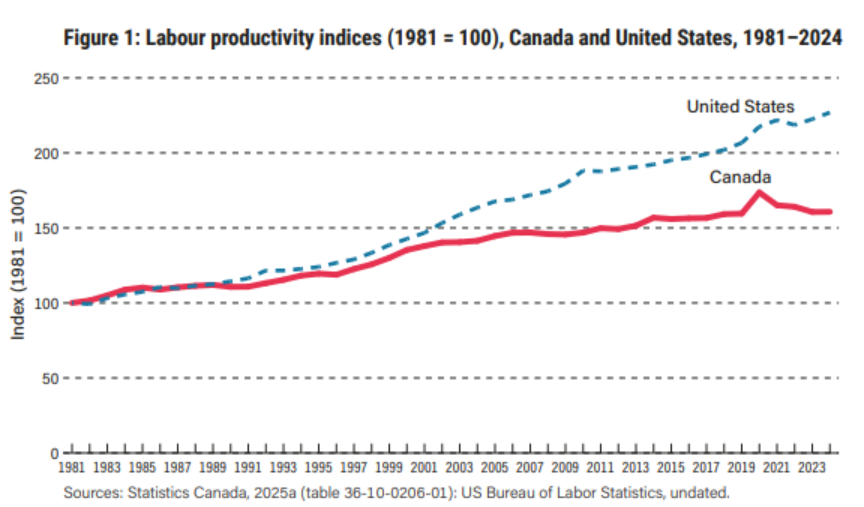
From 1981 to 2001, labour productivity in the United States increased by roughly 47%; in Canada, it increased by about 38%.
Over the full period from 1981 to 2024, labour productivity increased by about 127% in the United States but in Canada by only about 61%, it says.
According to the Fraser Institute’s report, Canada lags significantly behind in information and communications technology (ICT) investment compared to the U.S.
Adding roles requires strategic thinking
While large employers are driving job creation in Canada, the assumption that hiring people equates to better productivity requires scrutiny, says Lola Obomighie, Vice President, People, Culture and Organizational Effectiveness at Northumberland Hills Hospital in Cobourg, Ont.
“Adding roles doesn’t always have a direct correlation with productivity,” she says. “It's thinking about when those roles are added and who goes into them, how are they finding their ability to perform in those roles, and do they have the right tools and technology?”
HR leaders in larger organizations must ensure that the roles they are adding are supported by adequate infrastructure, technology systems, and managerial capacity, says Obomighie. Without these elements, new employees may struggle to perform effectively, undermining the hiring decision. HR's role must include ensuring that new team members have what they need to succeed, she says.
Small firms possess structural advantages that HR leaders should study, says Obomighie.
“Smaller organizations often have the ability to operate like startups, and they can leverage technology more to do repetitive tasks, or to use technology to augment roles or processes,” she says.
HR’s role in boosting productivity
Obomighie believes that within that function, HR has a key role in pushing forward strategies to put Canadian organizations on a better productivity trend during economic uncertainty.
“HR is a strategic function, and if we realize that, we need to invest in the capability of HR professionals so that we can then support the organization and its productivity efforts,” says
A recent Queen's IRC report says that many organizations still treat HR as a transactional function rather than a strategic partner in business decisions.
“There has to be an alignment between HR and business strategy — HR needs to understand the strategy and also be a co-creator in the strategy,” says Obomighie, who insists that HR professionals must have a voice in decisions about hiring levels, organizational design, technology investment, and strategic direction — not after those decisions are made, but during the decision-making process.
Obomighie stresses that HR can’t work effectively for an organization if it's a reactive function.
“It needs to be at the table contributing to the conversation about what’s a barrier to morale and contributing to burnout,” she says. “And how to tackle the impact on productivity — for example, we went through the pandemic where a lot of people were remote working and now some organizations are saying, ‘Come back to the office two or three days a week’ — how is that impacting productivity?”
Engagement and psychological contracts
While the Queen's IRC report identified engagement improvements as a key organizational success, engagement remains a persistent challenge, according to survey respondents. Engagement is frequently designed and delivered by HR as a function rather than being led by managers and leaders as a core responsibility, but engagement's connection to productivity operates through the psychological contract, not merely the formal employment agreement, says Obomighie.
“It's not the nine-to-five contract that I sign, it's the discretionary effort that isn't captured on a paper contract,” she says. “Evidence tells us that the discretionary effort from the psychological contract has a direct correlation with productivity.”
When employees feel engaged, valued and supported — a healthy psychological contract — they invest discretionary effort that extends beyond the minimum requirements of their role, and this is where meaningful productivity gains emerge, according to Obomighie. This comes from shifting engagement from a survey-and-action-plan exercise into a leadership competency that managers actively practice daily, she says.
Leadership development drives culture and productivity
The Queen's IRC report reflects the widespread recognition that leaders shape organizational culture and performance, but many organizations struggle to translate this priority into meaningful outcomes, with driving performance and productivity along with ethical use of AI among the lowest on the list of organizational successes.
The connection between leadership competency and productivity is direct, as many leaders advance into management based on technical expertise rather than people leadership skills, yet without development in emotional intelligence, communication, and cultural awareness, they can’t create environments where employees perform at their best, says Obomighie.
“The leaders are making the decisions, driving the culture and strategy, and are the ones setting the tone and the pace,” she says. “When that leadership competency is built, then it sets the tone for the organization creating and sustaining the conditions that allow these things to thrive."