How many would comply if forced back to the office?

As major employers across Canada demand workers return to their desks, new research reveals a growing disconnect between corporate expectations and employee preferences.
The Angus Reid Institute survey of 1,918 Canadian adults found that 59% of workers would prefer to spend most of their working time at home if possible.
Among those who have experienced remote work, this preference jumps dramatically to 76%.
Those who did return are far from pleased. Indeed, one-quarter say they’re “very upset” (27%) while a similar number are “upset” (24%) about a return to office. One-in-three (32%) say it made no real difference to them, while 17 per cent were pleased.
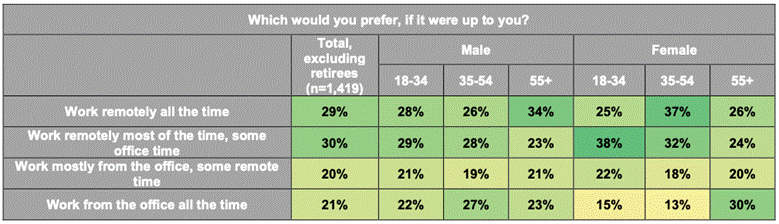
The resistance is particularly strong in professional sectors facing the most pressure to return. Among technology, finance, and knowledge workers—many of whom are being called back to corporate offices—68% say they would rather work from home most of the time. Just 9% in these sectors prefer full-time office work.
“The balance shifting to more in-office time runs against the preferences of working Canadians,” the report states.
Workers push back on compliance
The return-to-office movement has gained momentum as Canada’s major banks—TD, RBC, Scotiabank and BMO—recently requested employees work from offices at least four days per week starting this fall.
However, this strategy is not common among Canadians who have worked from home at some point in their career, according to the survey. Two-thirds (65%) say they have not been asked to work more days in the office than they had agreed to, while one-third (35%) were either asked to return full time (11%) or increase the portion of the work week they spent on-site:
When asked to return, employee responses vary significantly. While 72% complied overall, among current remote workers, only 28% say they would return without complications if asked.
Nearly one-quarter (24%) say they would likely quit outright, while 32% would return but start exploring other job options, found the survey..
The survey found that 58% of hybrid workers always meet minimum office requirements, while 28% mostly comply and 14% frequently fall short—echoing compliance issues noted in federal government departments.
Mental health and commuting preferences
Workers cite transportation savings (78%) and improved mental health (49%) as the biggest benefits of remote work. Social isolation (46%) and difficulty separating work and personal life (46%) emerge as primary concerns.
Women, particularly those aged 35-54, show stronger preferences for remote work, with 37% wanting to work from home full-time compared to 25% of men in the same age group.