Gender pay gap: System 'converts high expectations into compromised outcomes’

Canada is unlikely to reach gender pay parity without systemic change, according to new analysis of how women and men actually move through the job market.
Canadian women set significantly higher salary targets than men but still end up applying for lower‑paid roles, reports JobLeads. The company analysed behavioural data from 36,522 users of its platform in Canada between October and December 2025.
Women’s upper salary expectations are 34% higher than men’s, with women signalling they would be willing to earn up to $162,492 versus $121,488 for men.
Yet when it comes to the roles they actually apply for, women target positions with a median salary of $68,274, compared with $71,378 for men – a difference of $3,104, or about 4%.
“This is not a story about women expecting less or reaching lower,” according to JobLeads. “Canadian women reach higher, and something in the process pulls them back down. Women browse jobs ambitiously, set bold salary expectations, then pull back at the apply button and cluster into part-time, soft-skill-heavy, and lower-paying roles. The pay gap is not built from low expectations in Canada. It is built from a system that converts high expectations into compromised outcomes.”
The gender wage gap in Canada has narrowed considerably over the past four decades, but full equality remains out of reach, according to a previous report from Statistics Canada (StatCan). Achieving gender pay parity across the world will likely take nearly two centuries as gaps in employment remain large, according to another report from the International Labour Organisation (ILO) released in 2025.
Where the gap widens: the apply button
Globally, women earn 23% less than men on average, according to previous data released by Women and Gender Equality Canada, released in 2025.
The sharpest divergence in the JobLeads data appears at the moment of application. Among users who clicked on a job posting, 76% of men went on to apply, compared with 64% of women. JobLeads identifies this 12‑percentage‑point gap as “the single largest behavioural gender gap in the entire dataset” and a key mechanism “that converts high expectations into lower offers.”
Sector‑level results are particularly stark in finance and legal, where women dominate the candidate pool but still end up in lower‑paid roles. In finance, women account for 54% of job seekers but apply to jobs offering nearly 10% less than those men pursue, with median advertised salaries of $78,961 for women versus $87,523 for men. In legal, women make up 65% of job seekers yet apply to roles paying 6.9% less, at a median of $81,449 compared with $87,523.
For employers and HR leaders, the findings suggest that strong female representation in candidate pipelines does not automatically translate into equal access to higher‑paid opportunities.
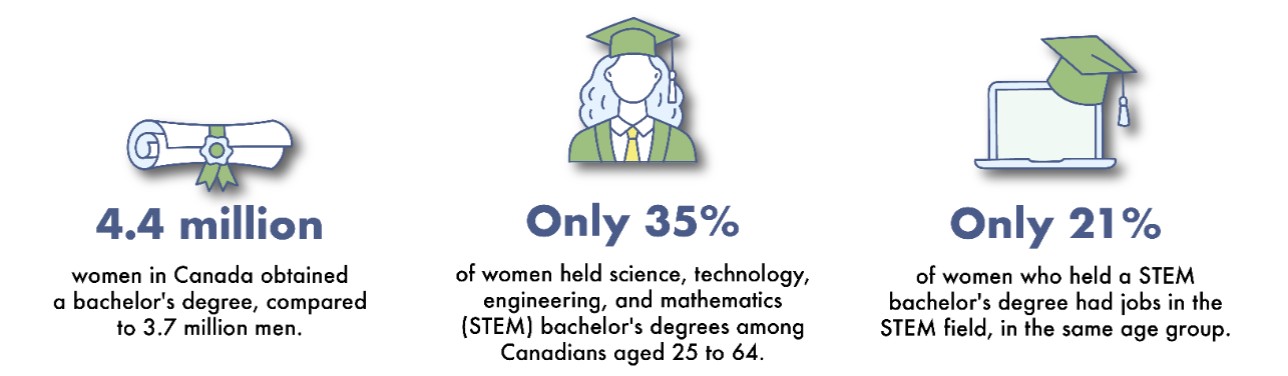
Women are also far behind in numbers when it comes to STEM education and careers, according to data from Women and Gender Equality Canada, which further channels men and women into different pay trajectories.
Skills, flexibility and the system behind the gap
The JobLeads report also links pay outcomes to the nature of the roles candidates choose. Women are more likely to apply to positions with a heavier soft‑skills component: on average, roles where 31% of skills demanded are soft skills, compared with 28% for men.
That difference carries a cost. JobLeads calculates that this preference for “soft‑skill‑heavy” roles leaves women $7,998 worse off at the median, underscoring how people‑focused work is often undervalued in organisational pay structures.
Work patterns add another layer. One‑third (33%) of women in the sample searched for part‑time positions, versus 23% of men, a trend the report says is “likely driven by caregiving demands.” Women and men opted for hybrid work at identical rates (13% each), but median pay for men in hybrid roles was $8,287 higher than for women.
What are the causes of the gender pay gap?
In an article last updated in March 2025, the European Parliament highlighted several structural causes of the gender wage gap that echo the Canadian picture:
-
Women do significantly more unpaid work (childcare, housework), so nearly 28% work part‑time versus 8% of men, limiting their time in paid roles and depressing earnings.
-
Career choices are shaped by family responsibilities: more women than men complete higher education, but women are more likely to take career breaks for childcare (about one‑third of employed women vs 1.3% of men), which disrupts progression and pay.
-
Women are over‑represented in low‑paying sectors such as care, health and education (about 3 in 10 women vs 8% of men), while men are more concentrated in higher‑paid STEM fields.
-
Women are under‑represented in senior roles and paid less when they reach them, holding only about 34.7% of managerial positions and earning roughly 23% less per hour than male managers.
-
Closing the gender pay gap would boost gender equality, reduce poverty and strengthen the economy, with evidence that a one‑percentage‑point reduction in the gap could increase GDP by 0.1%.
“Reducing the gender pay gap creates greater gender equality while reducing poverty and stimulating the economy, as women would get more to spend more,” says the European Parliament. “This would increase the tax base and would relieve some of the burden on welfare systems. Assessments show that reducing the gender pay gap by one percentage point would increase the gross domestic product by 0.1%.”
Katherine Scott, with the Canadian Centre for Policy Alternatives (CCPA), argues Canada’s response must be equally systemic. “The response to the economic assault confronting Canada can’t be a raft of programs focused solely on displaced workers on the shop floor, as important as that goal is,” she says. “It must take an inclusive approach that builds out essential community infrastructure, strengthens employment standards, fosters unionization, contains skyrocketing income inequality, and transforms compensation and hiring practices through proactive pay equity and gender pay reporting.”