'HR professionals can be more strategic by asking a lot of questions both ways, to senior leadership and to employees,' says expert

Transformation has become not just frequent, but constant for many organizations. But a recent survey indicates that it may be overwhelming one of their most key assets — employees.
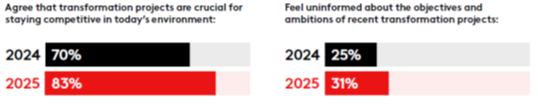
The global survey of more than 750 business leaders revealed that 83 per cent said transformation projects are crucial for staying competitive, yet half reported transformation fatigue in their organization and 45 per cent said burnout due to ongoing change was a problem.
The consequences of transformation fatigue and sloppy implementation are also clear. The survey also found that 44 per cent of respondents would consider leaving their job because of organizational changes.
"Momentum begins to slow when employees struggle to keep up or disengage from new initiatives," says Theresa Chika-James, associate dean and associate professor of management and organizational behaviour at MacEwan University in Edmonton. "These symptoms often worsen when organizations introduce additional changes before the benefits or positive outcomes of earlier initiatives have been realized.”
Melanie Peacock, owner of Double M Training and Consulting in Calgary, agrees that excessive transformation initiatives can take their toll.
“People are being bombarded by ‘Please amend this, please alter this, please change this, please do that' — and that really causes a lot of fatigue,” says Peacock. “It's almost like information or request overload.”

Fatigue from excessive, unending transformation
Fatigue comes about when system updates, process tweaks and new priorities keep piling up without space to absorb them, and employees begin to experience transformation not as improvement, but as relentless noise, says Peacock, recipient of the award for lifetime achievement in HR at the 2020 Canadian HR Awards.
She also points to a second pattern that can drain commitment over time: “It’s not as readily apparent, especially to senior leaders, but it’s a change initiative that doesn't end.”
That observation aligns with the survey's finding that 31 per cent of organizations have seen significant delays of more than six months to digital transformation projects and nearly as many cited high employee churn. When people can’t see clear milestones, closure, or benefits to transformation initiatives, their willingness to stay engaged starts to erode, according to Peacock.
Open communication channels key to battling transformation fatigue
The survey by business services firm Emergn also shows how communication gaps can intensify fatigue. One in three respondents said they feel uninformed about transformation objectives and ambitions, and more than four in 10 reported insufficient training and support during change initiatives. One in five said they had seen failed digital transformations linked to lack of training.
Effective communication to the workforce is an essential factor to reduce fatigue, according to Chika-James.
“HR leaders should consistently reinforce the purpose, end goals, and milestones achieved along the way — in larger organizations, designating specific HR people or change professionals to focus on employee wellbeing and resistance analysis can help ensure issues are addressed early,” she says.
Peacock warns against assuming that quiet means everything is on track. “If no one's complaining or no one's saying what's going wrong, to me that's an immediate red flag,” she says. “Silence is not golden, particularly during times of transformation and transition.”
For HR, that means staff asking questions, pushing back, and even expressing frustration are signs of engagement rather than problems to shut down. Peacock believes that when people feel safe to raise concerns, fatigue is revealed early enough that leaders can respond, instead of discovering resistance only when projects stall.
Chika-James agrees, noting that not all resistance is inherently negative, as she believes that it often reflects legitimate concerns about the transformation process. She also suggests that organizations which sustain transformation momentum tend to have leaders who consistently acknowledge the demands placed on employees during change.
“Effective HR and people leaders openly recognize the additional effort required and provide meaningful support across different phases of transformation,” she says. “Clear communication, care, and visible support are critical, although they’re not easy to maintain because HR leaders and senior managers are themselves navigating the same complex changes.”
Shared ownership of transformation
The survey data also point to execution challenges HR is often asked to fix. Thirty-six per cent of respondents said they would consider leaving their job due to organizational transformation and nearly one in three cited high employee churn linked to lack of training.
HR can only reduce fatigue if leaders at the top own the consequences of their transformation agenda, says Chika-James, and people leaders can expose risks before they translate into burnout and departures by asking disciplined questions about purpose, timing, readiness and support.
Peacock suggests one practical way HR can create a reality check for the C-suite: a change audit to keep track of all the transformation taking place in the organization.
“It's really important to know how many change initiatives are going on in a company and where they are in each of their planned rollouts,” she says, noting that change can quickly become incoherent from an employee perspective if too much is going on at the same time. A structured audit allows HR to replace vague concerns about morale with concrete evidence of volume, overlap, and potential conflict across initiatives, says Peacock.
HR's role in being strategic
Peacock also believes that HR’s role is to shape the conditions around change, not to shoulder full responsibility for it.
“During times of change, HR leaders are given lots of responsibility and no authority — they often don’t have that same control, for the lack of a better word, as senior leaders do,” she says. “HR professionals can be more strategic by asking a lot of questions both ways, to senior leadership and to employees — but it's not HR’s job, in many ways, to be the architect of the transformation.”
According to Chika-James, HR leaders must be trusted advisors with strong credibility and integrity in their organizations through the use of data from metrics such as turnover rates, absenteeism, use of wellbeing services, and feedback from frontline managers.
“[Data] can help demonstrate when change volume is becoming too high, and HR leaders can engage the C-suite in constructive dialogue about pacing, sequencing, or reshaping initiatives,” she says.
Growing organizational adaptability to ongoing transformation
Despite the risks, the survey shows leaders aren’t turning away from change, as the 83 per cent figure for those agreeing that transformation projects are crucial to staying competitive demonstrates. For Peacock, the path forward for HR requires a deliberate mindset shift about what this work represents.
“It's difficult work, but it can be the most meaningful work that you get involved with,” she says. “You’re helping an organization and the individuals within it grow and thrive, and reach new horizons and possibilities — and if you take that mindset away from being another administrative task or procedure, and you understand the power and possibility of change, it can transform HR’s role and thoughts around it.”
HR leaders will need to shift from viewing transformation as a series of discrete projects to seeing it as an ongoing organizational capability, says Chika-James.
“This requires embedding adaptability, learning, and wellbeing into everyday systems, and protecting long-term organizational health will depend on balancing performance demands with employees wellbeing to ensure that staff are supported not just to endure change, but to grow through it.”