‘By enabling earlier intervention and more efficient care delivery, the model reduces long-term costs while improving well-being’

Expanding employer‑funded virtual mental health care could reduce the economic impact of mental health challenges in Canada by an estimated $22.2 billion a year, according to a new analysis.
The cost‑benefit study found that rolling out employer‑funded virtual mental health care could cut the economic burden of mental health issues by 29% while improving access to care for employees.
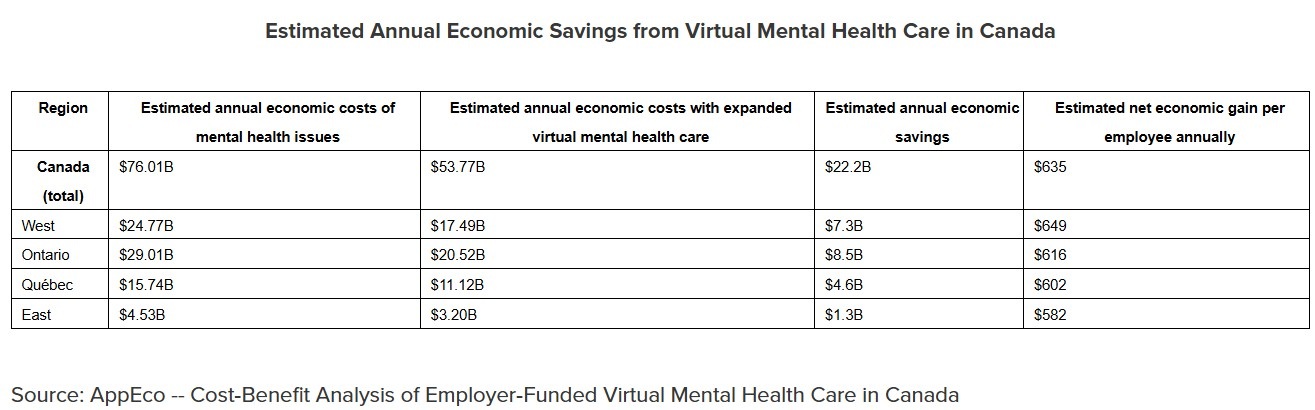
At the national level, the study estimates that mental health issues cost the Canadian economy approximately $76.01 billion annually, largely due to lost productivity. With expanded employer‑funded virtual care, that figure could fall to $53.77 billion, generating estimated economic savings of $22.2 billion, says Dialogue Health Technologies Inc
Leading-edge employers are adopting virtual mental health solutions, according to a previous report.
Access gaps and return on investment
Mental health challenges affect about one in five Canadians, yet nearly half of those who meet the criteria for a mood, anxiety or substance‑use disorder do not receive professional care, the report notes. The study – titled 13x the ROI: The business case for virtual mental health care – evaluates the economic and societal impact of expanding employer‑funded virtual mental health services.
The report concludes that increasing access to care by just 10 per cent through employer‑funded virtual services could reduce the number of untreated cases and help people get support sooner. For employers, the model is framed as a financial as well as clinical intervention.
According to the report’s economic model, employer‑funded virtual mental health care could deliver a return on investment (ROI) of up to 13 to 1, with results varying by industry, geography, wage level and programme engagement. For a company with 500 employees, the analysis projects an average net gain of $635 per employee, per year.
Virtual care model and workplace benefits
“Mental health care must be accessible, timely, and integrated,” said Dr. Marc Robin, Medical Director at Dialogue. “This analysis shows that when care is delivered through a coordinated virtual model, we not only improve outcomes for patients, but we also generate measurable benefits for employers and society. Expanding access is fundamentally about improving people’s health, while also strengthening workplaces and the broader economy.”
AppEco’s study also examines the potential impact of employer‑funded virtual mental health care on governments, employers and individuals, including changes to health‑care spending, medication costs, missed workdays and productivity losses. It concludes that by improving access and care co‑ordination, virtual models can significantly reduce absenteeism and presenteeism, which together account for the majority of mental health–related costs in Canada.
The study provides regional estimates of annual economic savings from expanded employer‑funded virtual mental health care across the country. In the West, the estimated economic costs of mental health issues fall from $24.77 billion to $17.49 billion, for projected savings of $7.3 billion and an estimated net economic gain of $649 per employee annually.
In Ontario, costs declined from $29.01 billion to $20.52 billion, for savings of $8.5 billion and a $616 net gain per employee, according to the analysis. In Québec, the report estimates that costs would drop from $15.74 billion to $11.12 billion, generating $4.6 billion in savings and a $602 net gain per employee per year.
In the East, estimated costs declined from $4.53 billion to $3.20 billion, for savings of $1.3 billion and a $582 net economic gain per employee annually. The regional figures suggest that similar virtual care models could deliver measurable financial benefits across diverse labour markets.
Over 8 in 10 employers already offer virtual therapy benefits to workers, according to a previous report.