CFIB report reveals majority of small firms are losing faith in US as stable market due to tariffs, political uncertainty
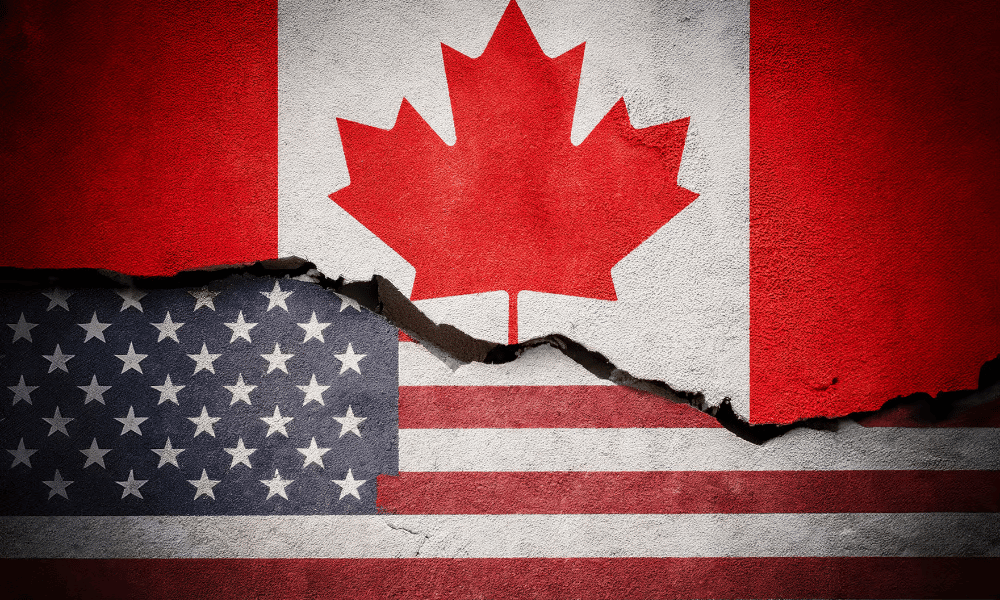
Trade friction with the United States is prompting many Canadian companies to rethink how heavily they rely on their largest export market, according to a new report.
New data from the Canadian Federation of Independent Business (CFIB) shows that just over half of small firms no longer see the US as a reliable trading partner. A large majority of small businesses — 75 per cent, an increase from 49 per cent in March 2025 — report a strained relationship with US partners or clients because of tariffs, and many say sudden policy shifts have made long-term planning far more difficult.
US tariffs negatively impacting most businesses
Nearly seven in 10 respondents say they’re being negatively affected by US tariffs.
The report comes from two CFIB member surveys conducted in December 2025 and February 2026.
Tariffs and threats of new barriers have hit sectors such as manufacturing, metals, auto and auto parts especially hard, according to Global News. These are industries with specialized trades, high union density and complex supply chains — 44 per cent of the survey respondents say steel and aluminum tariffs are a major challenge.
Government support programs largely unused
Ottawa has tried to cushion the blow of tariffs through targeted support programs, but many small businesses report that the main relief initiative was poorly tailored to their needs, with strict eligibility rules and paperwork that discouraged applications, and more than three-quarters say they simply never heard about it, according to the CFIB.
The current climate has given new urgency to diversification efforts. Many firms are looking for more Canadian suppliers, exploring opportunities in other markets, or nudging sales teams to deepen domestic business. Some are investing in digital channels to reduce reliance on any single geography. CFIB’s report points to a growing appetite to reduce over‑dependence on the US, even if complete decoupling is unrealistic in the near term.
Yet the reality for most employers is that the US remains too big to ignore. The integrated nature of North American supply chains means even companies that sell mainly within Canada often depend on inputs that cross the border multiple times. For HR leaders, that means planning for a new normal in which the US is still a significant trade partner, but political and policy swings are a constant background risk.
Economic uncertainty taking a toll
“Small businesses have faced massive uncertainty since the trade battle began last year,” said Dan Kelly, CFIB president, in a release. “Small business owners have been dealing with the whiplash of trying to keep up with sudden changes and threats, including many that don’t happen or are revised within hours. With CUSMA coming up for review in the months ahead, the stakes are even higher.”