HR, business leaders should take the long view on economic benefits of new border crossing: BMO's chief economist
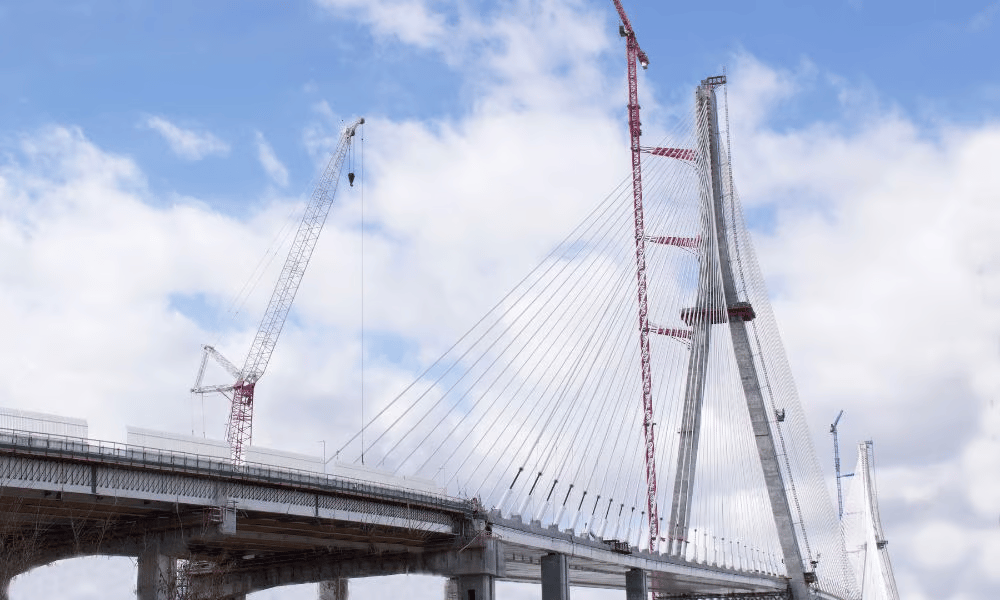
The Gordie Howe International Bridge opened to traffic on July 27, 2026, marking the completion of one of the most consequential infrastructure projects in Canadian history. For business and HR leaders in trade-exposed industries, the six-lane cable-stayed crossing between Windsor, Ont., and Detroit is more than a ribbon-cutting moment — it’s the beginning of a long-term reconfiguration of workforce geography, supply chain resilience, and regional labour demand, according to Douglas Porter, Chief Economist and Managing Director Economics at BMO Capital Markets in Toronto.
The bridge, which cost Canada $6.4 billion to build, according to the Windsor-Detroit Bridge Authority (WDBA), gives trucks and travellers a new route across the US–Canada border at Detroit — the number one port for truck traffic between the two countries, according to the US Department of Transportation. Before the new bridge’s opening, the two options for the Windsor-Detroit crossing were the privately-owned Ambassador Bridge, built in 1929, and the Detroit-Windsor Tunnel, which is restricted to passenger vehicles.
The bridge got off to a strong start on opening day, with approximately 7,500 vehicles making the trip between Windsor and Detroit within the first 12 hours, the WDBA told CTV News.
A generational investment in trade
Although the bridge opens during a period of frayed trade relations between Canada and the US, business and HR leaders shouldn’t measure this project against near-term economic indicators, says Porter. Instead, the economic benefits of the new crossing need to be understood in decades.
"The tunnel and the Ambassador Bridge are both almost 100 years old," says Porter. "It's not impossible that the Gordie Howe Bridge will still be in operation a century from now. We have to take the long view here."
That long view matters for workforce planning. Since construction started in October 2018, more than 15,800 individuals, including a strong unionized labour force, worked over 20.1 million hours on the project, which contributed an estimated $1.3 billion to Windsor's gross domestic product while investing in community infrastructure, neighbourhood improvements, and workforce development, according to a WDBA press release.
The Detroit–Windsor corridor already handles more than four million truck crossings annually and nearly $70 billion in two-way trade, and the new bridge will improve reliability and throughput for companies that depend on just-in-time movement, according to the federal government.
Porter points to a practical and immediate benefit that carries real operational value for HR teams in logistics and manufacturing: reduced wait times at the border. "There were some pretty serious jams on the Ambassador Bridge — some really long wait times on certain days and at certain times," he says. "Hopefully this will help alleviate it and reduce some trade frictions between Canada and the US."
He also adds that having some redundancy at such a key border crossing and a new, more efficient route will benefit cross-border commerce.
What the bridge means for manufacturing and HR resilience
The timing is, as Porter acknowledges, sharply ironic. The bridge opens as Canada navigates some of the most disruptive trade conditions in a generation. Canada faces new 10 per cent US tariffs — and 50 per cent on certain goods such as hockey sticks and alcohol — as Prime Minister Mark Carney has vowed to shield Canadian workers and businesses from trade war disruption.
Porter draws a distinction between how HR leaders in different sectors should interpret the bridge's opening. For domestically oriented industries, the trade battle with the US is relevant but peripheral, he says — it’s manufacturing where the calculus is most complex and where the bridge carries the most direct significance.
"In sectors that are directly affected, they have to stay aware of what's going on and how it might affect the broader economy," Porter says. "But I think for the most part, they can largely keep acting as they would have under normal conditions — knowing that federal policy will try to mitigate whatever negative effects we have from the trade war, whether it's the possibility of lower interest rates or spending."
He adds that manufacturing's resilience over the past year has been one of the more underreported economic stories in Canada. "We haven't seen a big change in manufacturing employment in the last year — it's weakened a bit, but it's nothing that we haven't seen before,” he says. “Manufacturing in general has found a way to work through this, and I think that probably goes for the HR departments as well."
The advice Porter offers leaders in trade-exposed industries: "I don’t think it’s going away, so they have to be nimble,” he says. “They have to realize that we're going to be dealing with a lot of uncertainty for quite a period of time, but we’ve managed."
Underappreciated workforce opportunities on the horizon
Beyond the industrial corridors, Porter sees a less-discussed opportunity with the new border crossing — tourism and cross-border mobility. The bridge features a multi-use path to accommodate pedestrians and cyclists, according to the federal government — a feature that differentiates it from the Ambassador Bridge, which lost pedestrian access after September 11, 2001.
"It's possible that we could get a bit more flow coming into Canada, especially with the Canadian dollar at such a low ebb," says Porter. "Our tourism sector is very competitive at these levels for the currency, and the new bridge will ease the flow of traffic both ways — opening another seemingly more efficient way to get across the border could actually support the tourism sector."
The opening of the bridge at the same time as troubled trade relations also reinforces why Canada must not scale back its broader infrastructure agenda, according to Porter. "This should not dissuade provincial and federal governments from investing in trade infrastructure," he says. "The Gordie Howe Bridge happens to be directly tied to the US economy, and the auto industry in particular, at a time when this administration is trying to throw up roadblocks, but that's not going to be the case for a lot of other big infrastructure projects we're looking at, like improving port facilities in Vancouver and Montreal."
The opening of the Gordie Howe International Bridge is, at its core, a signal about Canada's long-term intent. HR leaders in organizations navigating the Canada–US tariff landscape and labour market disruption should read it as an argument for the same: plan for the long horizon, stay nimble in the short term, and recognize that workforce infrastructure — like physical infrastructure — takes decades to fully pay back, according to Porter.
"The payback's going to be measured in decades, not in days,” he says.