Prime minister touts Canada‑funded Gordie Howe span as vital trade and commuter lifeline, even as Trump threatens to block project
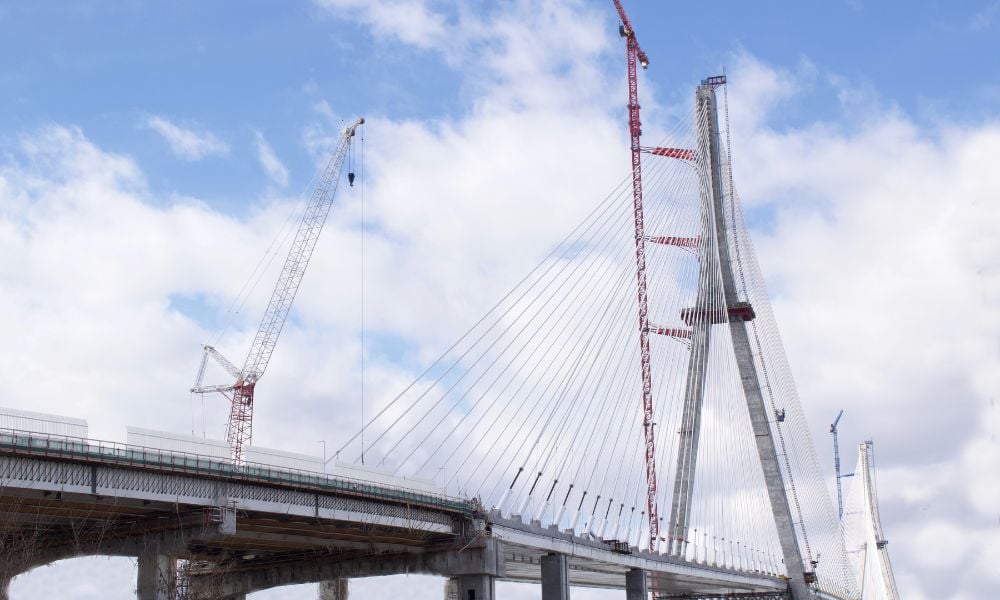
Prime Minister Mark Carney is trying to turn a tense cross‑border phone call with Donald Trump into a positive backdrop for the long‑awaited opening of the Gordie Howe International Bridge – a project that Ottawa says is critical for trade, local jobs and thousands of daily worker commutes.
Carney told reporters he spoke with the U.S. president early Tuesday about the Windsor‑Detroit crossing, after Trump threatened to block the project and claimed there was “virtually no U.S. content” used in its construction, according to CBC.
Carney said he pushed back, stressing that Canada is footing the roughly $4‑billion construction bill and that the bridge itself was built with both Canadian and American labour and steel. He also reminded Trump that the U.S. is not a bystander: the bridge is publicly owned by Canada and the State of Michigan, with operations handled by the Canadian Crown corporation Windsor‑Detroit Bridge Authority (WDBA), CBC reported.
“This is a great example of co‑operation between our countries,” Carney said, according to CBC, adding that what matters most is the commerce, tourism and everyday travel that will soon move across the span.
A once‑in‑a‑generation trade and transport link
Beyond the political drama, the Gordie Howe International Bridge is being billed as a “once‑in‑a‑generation” infrastructure project that will reshape one of the most important trade corridors in North America.
The bridge’s official project website describes it as a landmark undertaking that will deliver long‑needed transportation improvements for international travellers while creating jobs and economic growth in the Windsor‑Detroit region.
Federal government materials emphasize that nearly one-third of Canada‑U.S. truck trade moves through Windsor‑Detroit, and about one quarter of all bilateral trade crosses at this corridor annually.
“With one-quarter of the overall Canada-U.S. trade passing through this crossing annually, having a second bridge with efficient highway-to-highway connectivity, is essential to support trade between Canada and the U.S. and for our national security,” said Ottawa.
Promised relief for workers and truckers
Local economic leaders say the bridge is arriving at a pivotal moment.
The new span is “a game‑changer in so many ways,” Gordon Orr, CEO of Invest WindsorEssex and Tourism Windsor Essex Pelee Island, told the Windsor Star. He said that even amid trade tensions tied to Trump’s policies, the bridge must be seen as a long‑term, generational investment linking two allied economies.
Traffic modelling from the Detroit River International Crossing study suggests up to 60 per cent of commercial trucks and passenger vehicles that currently use the Windsor‑Detroit corridor could be redirected to the Gordie Howe crossing, according to the Star.
For workers and freight haulers, that could mean fewer snarls and less time crawling through city streets. The new highway‑to‑highway link eliminates red‑light intersections and local road sharing, feeding six bridge lanes directly into 60 primary inspection booths and 46 commercial secondary bays at the ports of entry, the Star reported.
The federal government underscores that having both the Gordie Howe Bridge and a fully functioning Ambassador Bridge is key to “ensure capacity and reliability at Canada’s busiest crossing.” Ottawa argues that redundancy and modern facilities are vital if Canada wants to protect supply chains and avoid the costly delays that ripple through factories and warehouses when border traffic stalls.
Border agency ‘settling in’ ahead of opening
On the ground, preparation is shifting from pouring concrete to staffing booths.
Canada Border Services Agency officers have already moved into the new Canadian port of entry to get ready for operations, according to CTV News. The $6.4‑billion span is still expected to open this fall, with construction nearing completion, though an official opening date has not yet been announced.
More than 250 CBSA officers are expected to work at the new crossing. Hiring is still underway, with job postings for border officers open until February 2026. Heather Grondin, chief relations officer for WDBA, told CTV that construction is progressing at the 24 primary inspection lanes, 16 toll lanes and 11 structures on the Canadian side, while similar work continues at the U.S. port, which will feature 13 structures and 36 inspection lanes.
Massive construction and employment story
The scope of the project is almost as striking as its 220‑metre‑high towers.
Construction formally began in October 2018. As of August 2025, around 19 million worker hours had been logged, with more than 40 per cent of those workers hired locally in Windsor‑Essex and Detroit, according to figures cited by the Windsor Star. At peak construction in the summer of 2023, as many as 3,000 workers were on site daily across the bridge, the two ports of entry and the new Michigan I‑75 interchange. In total, more than 15,000 workers were oriented to work on the project.
At 853 metres, the main span is the longest cable‑stayed bridge span in North America and among the longest globally. The total bridge length is about 2.6 kilometres. Each of the twin towers weighs roughly 30,000 tonnes – about the equivalent of three Eiffel Towers apiece – and their foundations extend deep into the bedrock, the Star reported.
The 216 stay cables contain more than 16,000 steel strands; strung end‑to‑end, those strands would stretch from Windsor to Anchorage, Alaska, roughly 5,000 kilometres by air.