Unemployment holds at 6.7% but average pay continues to rise: StatCan

Canada’s labour market paused in March, with employment barely budging and the unemployment rate stuck at 6.7%.
Employment was little changed in March (up 14,000) and the employment rate held steady at 60.6%. The unemployment rate was unchanged at 6.7%, according to Statistics Canada’s Labour Force Survey for March 2026.
On a year-over-year basis, employment was up by 87,000 (+0.4%) in March, largely reflecting gains over the final four months of 2025, says the agency, which noted that the employment rate in March was just above the low of 60.5% recorded in August 2025 and was down 0.3 percentage points year over year.
‘Flat, broader trend’: economist
Indeed senior economist Brendon Bernard said the latest monthly figures “reinforce the flat broader trend: despite all the economic events over the past year and a half, at 6.7%, the prevailing unemployment rate has remained quite steady since the second half of 2024.”
In previous periods, March’s net-employment growth of 15,000 would be “fairly underwhelming,” he said. “However, now that Canada is on the other side of its post-pandemic immigration boom, flat readings will be the norm in the near-term.”
He added that the size of the adult population has plateaued, and excluding Canadians over 65, is now in slight decline.
“This will slow the trend in employment growth… it also means that overall job gains don’t need to be strong for conditions, summed up by metrics like the unemployment rate, to hold steady.”
Layoffs low but hiring slower
Statistics Canada said the layoff rate—representing the proportion of people who were employed in February but had become unemployed in March as a result of a layoff—was 0.6%, comparable with the corresponding proportion from 12 months earlier (0.7%) and with the pre-pandemic average (0.7%).
“Over the past few years, the Canadian labour market has been stable for some, static for others,” Bernard said. “Workers in full-time, career-track jobs have benefited from low layoffs, and wage growth has remained robust. However, conditions remain difficult for job seekers across a wide range of circumstances.”
The March job numbers suggest this dynamic “is lingering, as the situation evolves in 2026,” he said.
Labour force participation and demographics
Statistics Canada said there was little variation in the number of public and private sector employees, and among people in the core working age of 25 to 54 years old, the unemployment rate was virtually unchanged at 5.8% for both men and women in March, while among youth aged 15 to 24, the unemployment rate was little changed at 13.8%.
The unemployment rate for people aged 55 years and older was 4.9% in March, unchanged in the month and down 0.3 percentage points from the same month a year earlier.
Statistics Canada also noted that the participation rate—the proportion of the population aged 15 and older who were employed or looking for work—was unchanged at 64.9%, and on a year-over-year basis, the labour force participation rate was down 0.4 percentage points.
Wage growth picks up pace
Average pay continued to rise faster than earlier in the cycle. Statistics Canada said, “average hourly wages among employees increased 4.7% (+$1.68 to $37.73) on a year-over-year basis in March, following growth of 3.9% in February (not seasonally adjusted),” calling it “the highest growth rate since October 2024.”
Across age groups, the agency reported that year-over-year hourly wage growth in March was highest among employees aged 55 and older (+5.2%) and lowest among young employees aged 15 to 24 (+1.8%), while among core-aged (25 to 54 years old) employees, the average hourly wage was up 4.5% over this period.
It also said that “using a method that holds constant the composition of employees by occupation and job tenure,” average hourly wages grew by 3.6% on a year-over-year basis in March.
Mixed jobs picture across industries
On the industry side, employment shifts were modest. Employment rose in the ‘other services’ industry (+15,000; +1.9%), which includes personal and repair services, and was little changed compared with 12 months earlier.
The agency also reported that employment increased in natural resources (+10,000; +3.0%), with nearly half of those gains coming from Alberta (+4,500; +3.2%), while employment fell in finance, insurance, real estate, rental and leasing (-11,000; -0.8%) in March — “the first significant monthly decline since November 2023.”
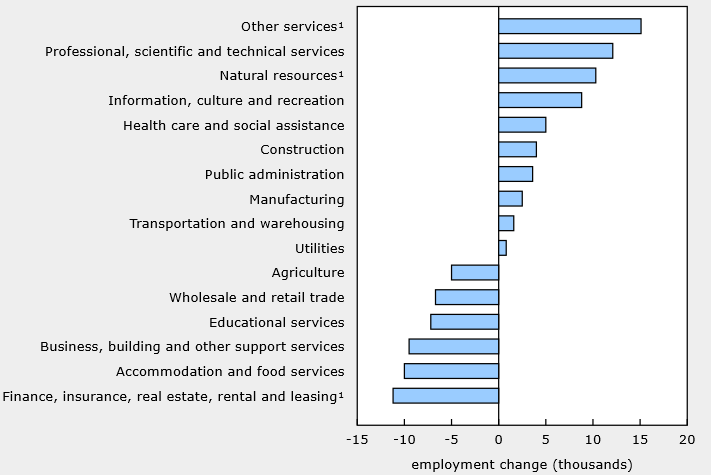
Although overall employment in health care and social assistance was little changed in March, Statistics Canada said it was up 94,000 (+3.3%) compared with 12 months earlier, the largest employment growth among industries, while over that same period, the largest employment decline among industries was in manufacturing (-44,000; -2.4%).
Regional variation in employment
Regionally, Statistics Canada reported that fewer people were employed in British Columbia (-19,000; -0.7%), while employment rose in Manitoba (+11,000; +1.5%), Saskatchewan (+5,800; +0.9%) and Nova Scotia (+3,900; +0.7%). It said that in B.C., the unemployment rate rose 0.6 percentage points to reach 6.7% in March, matching the national average but the highest level for the province since February 2016 (excluding 2020 and 2021).
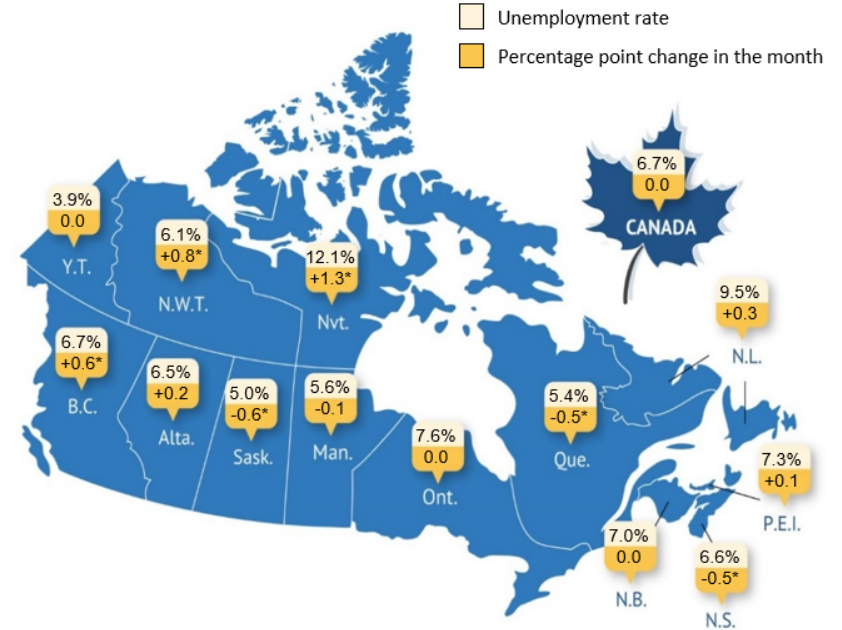
In Ontario, employment held steady for the second consecutive month, after declining by 67,000 (-0.8%) in January, and the unemployment rate in the province was unchanged at 7.6% in March. The agency noted that regions of Southern Ontario continued to experience challenging labour market conditions and elevated unemployment rates, in a context that includes ongoing economic uncertainty related to tariffs on exports to the United States.
Employment also held steady in Quebec, following a decline of 57,000 (-1.2%) in February. The unemployment rate fell 0.5 percentage points to 5.4% in Quebec in March, as fewer people searched for work, and the unemployment rate was unchanged at 6.6% in March in Montreal, while in the Quebec City census metropolitan area, it stood at 2.6%—the lowest rate among Canada’s 20 largest CMAs.