
As rivals warn of a jobs apocalypse, the Amazon founder is banking $41 billion on the opposite problem
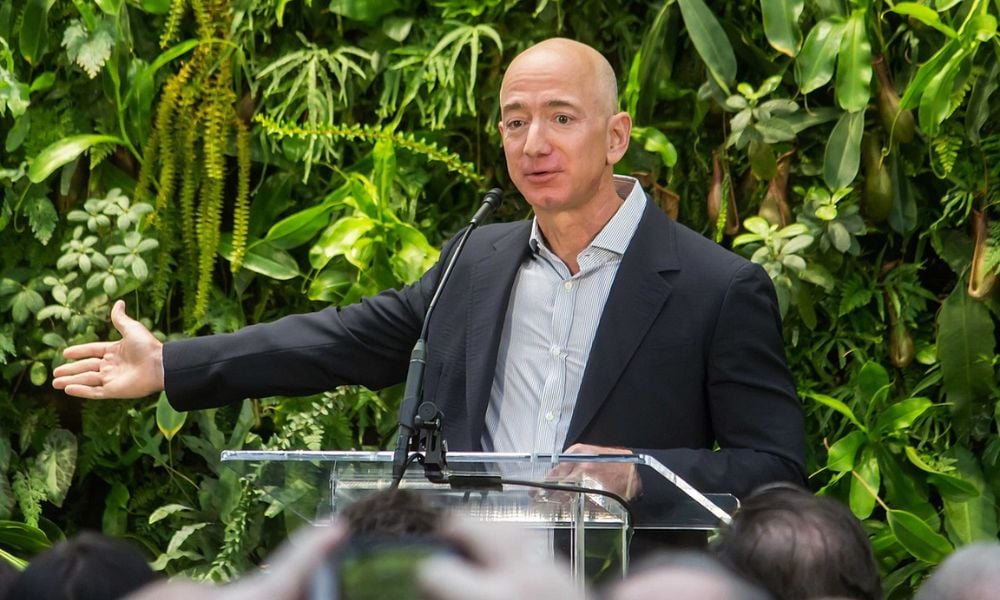
Image from: Seattle City Council from Seattle, CC BY 2.0, via Wikimedia Commons
The week Dario Amodei published a 20,000-word essay warning that AI-driven job loss may be an "intrinsic" feature of the technology, Jeff Bezos sat down with the Financial Times and said the labour market's real problem will be the opposite: not enough workers to fill the jobs that AI creates.
"The people who are jumping to the conclusion that the jobs are all going to go away," Bezos said. "I think these people are just wrong."
The two men run companies that are, in a meaningful sense, partners - Amazon is a major backer of Anthropic, Amodei's AI safety company. But on the question of what AI does to employment, they have arrived at views that cannot both be right.
The $41 billion bet
Bezos is not offering this opinion from the sidelines. He is now co-CEO of Prometheus, the industrial AI venture he quietly founded last November with Vikram Bajaj, a physicist and former Google X executive. This week the company emerged from stealth, announcing it had raised $12 billion at a $41 billion valuation from JPMorgan Chase, BlackRock, Goldman Sachs, and DST Global - one of the largest early-stage AI financings on record.
The goal, as Bezos describes it, is to build an "artificial general engineer": an AI system trained not on internet text but on real-world physical data, capable of understanding the laws of physics well enough to help engineers design, test, and manufacture complex objects - jet engines, semiconductors, pharmaceuticals, spacecraft - at a pace no human team could sustain alone.
"The idea that you might build a set of tools that could actually do engineering - it's a dream that people have had for decades, but it's never really been possible," Bezos told CNBC. "But now it is."
Separately, the FT has previously reported that Bezos and Bajaj are raising up to $100 billion through a dedicated holding company to acquire legacy manufacturing firms and rebuild them from the inside using Prometheus technology. It is, in effect, a private equity play premised on the belief that the physical economy is undergoing a transformation as significant as what the internet did to information.
Manufacturing employs approximately 8 per cent of US nonfarm workers. Bezos's argument is that making it dramatically easier and cheaper to build physical things will generate demand for human labour across the economy that outpaces whatever productivity gains eliminate existing roles. "At root, all civilisational wealth is driven by invention," he said. "Six thousand years ago, somebody invented the plough, and we all got wealthier."
What Amodei actually said
Amodei's position is more nuanced than a simple prediction of mass unemployment - and more disturbing for that reason. In his essay "Policy on the AI Exponential," published this week, he wrote that there is a "decent possibility" that AI causes "significant enduring job loss" and that this outcome "may be an intrinsic property of the technology and the way it broadly replicates human cognition." The adaptive mechanisms economists usually invoke - Jevons paradox, comparative advantage - may, he argued, be overwhelmed by the sheer speed of the technology's advance.
AI job cuts are rising while talent shortages remain near historic highs
Cuts up. Shortages up. The AI paradox in numbers.
US AI-attributed job cut announcements (thousands) vs global employer talent shortage rate (%)
Sources: Challenger, Gray and Christmas (2026); ManpowerGroup 2026 Talent Shortage Survey (39,063 employers, 41 countries). Note: Challenger began tracking AI as a standalone layoff reason in May 2023. No standalone 2024 AI cut total was published.
Alongside the essay, Anthropic pledged $200 million to study AI's economic impact and floated the possibility of universal basic income, financed by higher capital gains taxes or levies on AI companies, as a response if permanent displacement arrives.
The practical gap between these two visions - Bezos's labour shortage, Amodei's jobs apocalypse - is the central workforce planning problem of the next decade.
What the data shows right now
For HR leaders, the live data is currently pointing in both directions at once, which is part of what makes this moment so difficult to navigate.
AI skills have overtaken all other capabilities to become the hardest for employers to find globally, according to ManpowerGroup's 2026 Talent Shortage Survey of nearly 40,000 employers across 41 countries. For the first time, AI model development and AI literacy lead the global ranking of hard-to-fill roles - ahead of traditional engineering and IT. The global talent shortage, at 72 per cent of employers reporting difficulty filling roles, remains near historic highs.
Global talent shortage has nearly doubled since 2016 and AI skills are now the hardest to find
The talent shortage has nearly doubled since 2016
Share of employers worldwide reporting difficulty filling roles (%)
Survey was not conducted in 2017 or 2020.
Source: ManpowerGroup Talent Shortage Survey (2026), 39,063 employers across 41 countries. Survey not conducted in 2017 or 2020.
At the same time, AI has been cited in 87,714 US job cut announcements since January - already exceeding the 54,836 AI-attributed cuts across all of 2025, according to Challenger, Gray & Christmas. In May, AI was the stated reason for 40 per cent of all announced positions eliminated, up from 7 per cent in January.
AI-attributed US job cut announcements have accelerated sharply
AI is now the leading reason US employers give for cutting jobs
Total AI-attributed job cut announcements by year
Challenger began tracking AI as a standalone layoff reason in May 2023. No standalone 2024 annual total was published.
By May 2026, AI-attributed cuts had already exceeded the entire 2025 total -- with seven months still to go
Source: Challenger, Gray and Christmas. All figures are announced (planned) layoffs, not confirmed cuts carried out.
Yet a Gartner survey of 321 customer service leaders found that only 20 per cent had actually reduced staffing because of AI, despite it being cited across tens of thousands of public layoff announcements. Forrester has warned that up to half of AI-attributed cuts may be quietly reversed as organisations discover the technology cannot yet substitute for the human judgment they removed.
The talent war is already here
Whatever the macro outcome over the next decade, the war for AI-capable talent has arrived - and Prometheus is Exhibit A. The company has recruited from OpenAI, xAI, Meta, DeepMind, and Nvidia, with senior AI researcher compensation regularly exceeding $5 million per year. When asked whether he would personally make soup to attract a hire - a reference to Mark Zuckerberg's now-famous recruitment gesture toward an OpenAI engineer - Bezos was unambiguous: "If they want me to make soup for them, I will. That request has not been made."
Bajaj pitched the company's appeal in terms that will be familiar to any HR leader trying to retain technical talent: "deep empathy for the unsung heroes who are engineers that really build the world around us."
The harder question is what happens to the engineers who build today's world, in today's factories, with today's tools - the workers Prometheus's customers will one day replace, retrain, or redeploy. Bezos's historical analogy is the plough: a tool that eliminated backbreaking labour and created the agricultural surplus that underwrote civilisation. What it did not do was make the transition frictionless for the people holding the old tools.
That is the part of the golden age that tends to get left out of the press release.



_(cropped2).jpg)