
Jump to winners | Jump to methodology
The wall between business strategy and people strategy has come down – and Canada’s best young HR professionals knocked it down
They are redesigning hiring systems from the inside of unionized, regulated, risk-averse environments. They are translating workforce data into business outcomes. They are sitting beside chief executives, not as advisors on policy compliance but as architects of organizational performance. They are, as their nominators describe them repeatedly in their submissions, the partner the business actually wants.
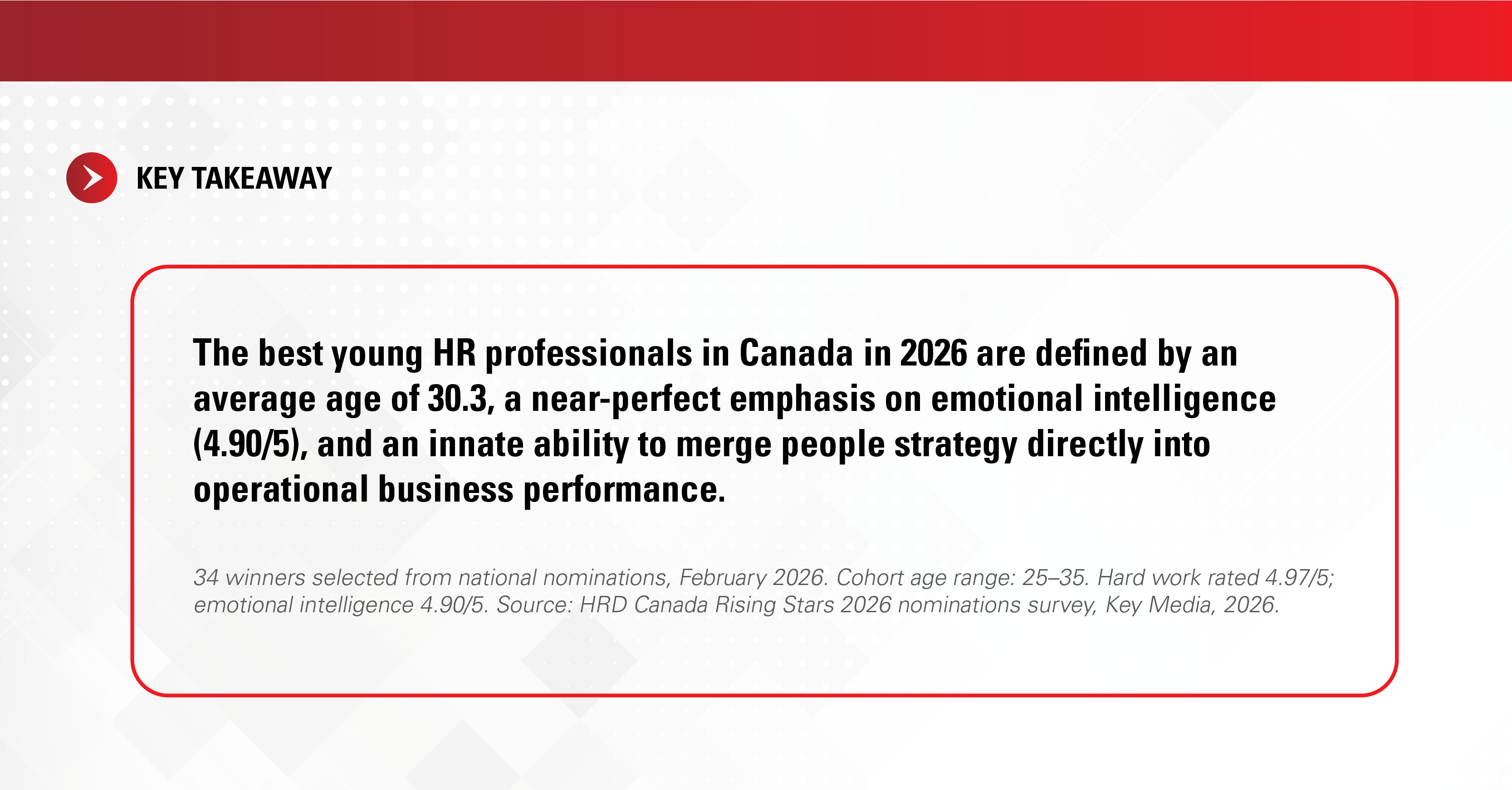
That’s who HRD Canada’s Rising Stars 2026 are, the 34 best young HR professionals in Canada – practitioners aged 35 or under who have, in 2026, demonstrated that the divide between people strategy and business strategy no longer exists in organizations that are serious about performance. Selected from nominations received across the country, they are the emerging HR leaders who are not waiting to be invited into strategic conversations. They are creating the conditions in which those conversations cannot happen without them.


The context in which this generation is operating is not comfortable. Canadian organizations face regulatory change on multiple fronts. Ontario’s Pay Transparency Act, requiring salary ranges in all job postings, took effect January 1, 2026. Quebec’s Law 27 on psychosocial risks in the workplace came into force in October 2025, significantly broadening employer obligations around stress, workload, and harassment as occupational health and safety concerns. The pace of AI adoption is accelerating faster than organizations can build governance frameworks to match it. Skills gaps are widening across every professional function. And the workforce these young HR leaders are managing is itself navigating change – purpose-driven, values-aligned, and increasingly vocal about the conditions under which it will work.
It is a landscape that requires precisely the skills this cohort has been building since the beginning of their careers: not administrative competence, but operational intelligence. Not policy maintenance, but strategic courage.
Canadian organizations are hiring – and struggling. According to Robert Half Canada’s 2026 Demand for Skilled Talent report, 62 percent of HR hiring managers plan to increase headcount in the first half of 2026. Yet the same survey reveals that more than half of Canadian hiring managers report skills gaps in their departments, with 58 percent saying those gaps have grown more pronounced over the past 12 months. Organizations know they need people. They are discovering that finding the right ones is harder than it has ever been.
The soft skills most in demand to complement AI adoption tell their own story. When Robert Half Canada asked HR leaders which capabilities matter most, 63 percent cited critical thinking and problem-solving, 61 percent named creativity and innovation, and 58 percent pointed to adaptability and continuous learning. These are not peripheral skills. They are the exact attributes that define the Rising Stars cohort – and they are the attributes that Canadian organizations are most urgently trying to find in their top HR talent.
ADP Canada’s 2026 Workplace Trends report found that 75 percent of large organizations view AI as essential to their operations – but only 13 percent prioritize hiring for AI skills, and fewer than half rate their core HR processes as highly efficient. Organizations are declaring AI a strategic priority while simultaneously lacking the human infrastructure to deliver on it. Someone has to bridge that gap. Increasingly, that someone is the young HR professional in Canada who came in on day one, asking why things were done the way they were.

SHRM’s 2026 State of the Workplace report – drawn primarily from US-based HR executives and widely cited across North America – adds a further dimension: 72 percent of HR professionals say that workers have higher expectations of their employers today, and 46 percent of CHROs identify leadership and manager development as their single top priority for 2026, the second consecutive year it has held that position.
“HR is now being brought to the table earlier in strategic discussions rather than as an afterthought. CEOs are relying on HR professionals more than ever to educate, advise, and help mitigate risk across their organizations,” says Adriana Scali, MA, CHRIL, founder and chief talent strategist of Link HR.
While Lynn Roger, chief human resources officer at Bayshore HealthCare, adds, “Leaders, including myself, expect more because the realities that business leaders are facing are increasingly difficult. We expect them to understand the businesses they support, come up with innovative solutions that create impact – and we need those solutions yesterday."
The workforce these young professionals are managing is also reshaping expectations from the inside. Deloitte’s 2026 Global Gen Z and Millennial Survey – drawing on responses from more than 22,500 people across 44 countries – found that these generations are “adaptable, pragmatic, and intentional about progress,” prioritizing stability, skills, and well-being over fast-paced advancement. Nearly all respondents described purpose as important to their job satisfaction, and approximately 40 percent reported having rejected employers or assignments that conflicted with their personal ethics or beliefs.
These are the employees the Rising Stars are hiring, onboarding, developing, and retaining. Understanding what drives them is not an exercise in soft management. It is an operational imperative – and the young HR professionals on this list understand it instinctively because they are part of the same generation.
Laura Abrantes, talent acquisition specialist at the Electrical Safety Authority (ESA) in Ontario, is 28 years old and has been in her role for less than a year. In that time, she has led the implementation of the organization’s new applicant tracking system (ATS), redesigned its interview question banks, launched a partnership with IBEW Local 353 to support a pre-apprenticeship program for women and Indigenous peoples entering the electrical trades, and begun designing a persona-based onboarding experience for a workforce that spans field inspectors to corporate professionals – all within a highly structured, unionized environment governed by multiple collective agreements.
She is not unusual among this year’s Rising Stars cohort in delivering this volume of change at this career stage. What makes her a compelling focal point for this report is how she explains what she does and why – and the clarity with which she articulates the philosophy that underpins it. “I think in 2026, it’s about trying to revamp what being an HR partner means,” she says. “And that’s kind of what I lead with.”
Abrantes came to ESA via Bell Canada’s graduate leadership program – an experience that shaped the way she approaches HR work. Rather than entering a new organization and focusing on processes, she focuses on the business.

This is the core of what separates the next generation of HR professionals from the archetype they are working to dismantle. Abrantes does not describe her job as filling roles or managing the recruitment lifecycle. She describes it as understanding what the business actually needs and then building the infrastructure to meet it.
At ESA that meant recognizing a significant opportunity to modernize the organization's people systems and processes. Manual employee files, limited historical tracking, and paper-based processes created an opportunity to transform how HR operated—freeing up time for more strategic, value-added work.
“There’s so much technology out there,” she says. “The less time we are dealing with manual tasks and administrative things, the more we can actually focus on strategy, on experience – things like being able to produce a co-op program. You have to be thinking bigger talent, not just recruiting, but what is talent acquisition? What is building a future pipeline?”
Abrantes came to ESA via Bell Canada’s graduate leadership program – an experience that shaped the way she approaches HR work. Rather than entering a new organization and focusing on processes, she focuses on the business.
The ATS implementation: a case study in change
The ATS implementation – which involved vendor selection, process redesign, automation enhancements, and stakeholder training, all within collective agreement frameworks – is the most visible demonstration of that approach. But Abrantes is candid about the resistance it generated and thoughtful about how she navigated it.
This instinct – to work backward from the desired outcome, to read the room, to frame change through the listener’s perspective – is something the SMEs consistently identify as a hallmark of the standout young professionals they observe.
“Adaptability is what truly sets a Rising Star apart from their peers,” says Scali of Link HR. “In today’s environment, priorities are constantly shifting, and the ability to stay flexible and respond with ease is a significant advantage and differentiator.”
For Abrantes, the same philosophy extends to candidate experience. When ESA replaced manual test proctoring with a dedicated proctoring platform, she framed the decision not as a technology upgrade but as an experience improvement. “It kind of removes having to stand there and awkwardly hover over someone that’s trying to focus on a task,” she says. “I personally don’t want to take a test while someone’s just staring at me.”
As a 28-year-old woman in a male-dominated, predominantly older electrical safety environment, Abrantes is aware of the assumptions she sometimes encounters. She does not describe this with resentment. She describes it with a strategy.
“There could be that upfront kind of assumption – where they think maybe you’re not as professional, not as knowledgeable. That’s why relationship building is so important. But if you have the confidence and capability to turn that around through your work, it can actually be a very big asset. They look at you as, “Wow, look at this person who still has so much to learn, and they’re already making such a big impact.”
This experience resonates across the Rising Stars cohort. Statistics Canada’s Business Conditions report for the first quarter of 2026 found that women account for 45.1 percent of all positions and 46.9 percent of mid-level management roles in Canadian companies – but just 40 percent of senior management positions. Near-parity at every level until it stops. With approximately 82 percent of this year’s Rising Stars being women, this cohort is the pipeline the profession’s future depends on.
On empathy as an operational tool
Q: What is the biggest professional asset you bring to your work in HR?
A: “Being able to put myself in other people’s shoes and really focus on experience – I think that’s what really makes a big difference in everything I do. A lot of times, we get caught up in procedures and what we have to do, but we don’t really take the time to approach tasks with the experience in mind. That empathy, that being able to put myself in other people’s shoes, is what really changes things and why people gravitate to working with me.”
On HR’s hidden strategic work
Q: HR is sometimes undervalued or misunderstood by the rest of the business. How do you respond to that?
A: “People just see a small end result and don’t realize that for you to get to this one job offer, there had to be 20 conversations, 10 different approvals, and problem-solving meetings. A lot of our job is behind the scenes. It’s not like a project manager that gets to wave a flag and say ‘Look what I did.’ A lot of strategy goes behind it – forward thinking, innovation. You need to step outside the box so that you can create strong partnerships. I think in 2026, let’s try to revamp what being an HR partner means.”
On measuring success
Q: What does success look like for you in this role?
A: “It’s not just meeting deadlines or the numbers I need to hit. It’s really being able to gauge what impact it made on other people. When someone does take my advice – and they don’t have to – that’s a job well done to me. It means you’re trusting me. And when you get a new hire, and you see that they’re developing within the company, not only did you get a hire, but you actually got a long-term investment. Relationship is number one.”
On career ambitions
Q: Where do you want to go from here?
A: “I really just want to be in a place where I’m in a people leadership position, where I have teams around me where I can influence – and also, through my experience, show them the importance of putting people first and how that can change not only your job but your own trajectory in your career, the different people you talk to, and the people you build relationships with.”
Abrantes speaks for a generation. The approach she describes – leading with business understanding, driving change through empathy, and using technology to expand what HR can do rather than simply doing the same things faster – appears, in different forms and different sectors, across all 34 of this year’s Rising Stars.
The 34 professionals selected for HRD Canada’s Rising Stars 2026 were drawn from nominations received in February 2026 from across the country. They represent organizations spanning financial services, energy, municipal government, the trades, technology, non-profits, and professional services. They range in age from 25 to 35, with an average age of 30.3 years. Several are still completing their Chartered Professional in Human Resources (CPHR) or Certified Human Resources Leader (CHRL) designations alongside full-time roles that carry significant organizational responsibility. All of them, in one way or another, are already delivering more than their job title formally requires.
The profiles below represent the Rising Stars’ shared characteristics. Taken together, they form a portrait of a generation of young Canadian HR leaders that has arrived in the profession with a different set of assumptions about what HR is for.
Ontario accounts for approximately half the cohort, reflecting both the concentration of Canada’s corporate sector and the density of the profession in the province. But the list spans the country – from Nunavut to Nova Scotia and from British Columbia to Newfoundland – and the geographic breadth matters. These are not just Bay Street professionals. They include an HR specialist building Inuit-centred people practices in one of Canada’s most remote territories, a municipal HR advisor in the Niagara region, and a recruitment manager serving the mining and marine sectors of Atlantic Canada. Eight provinces and territories are represented in total.
Approximately 82 percent of the cohort are women, a proportion that both reflects the demographic reality of the HR profession in Canada and represents something more specific: a generation of women who entered the field with strategic ambitions, not administrative ones, and who are demonstrating those ambitions in results.
Rated traits: what matters most
In their nominations, winners were asked to rate the traits most important for advancing rapidly in an HR career. The results are striking in what they prioritize – and what they dismiss.
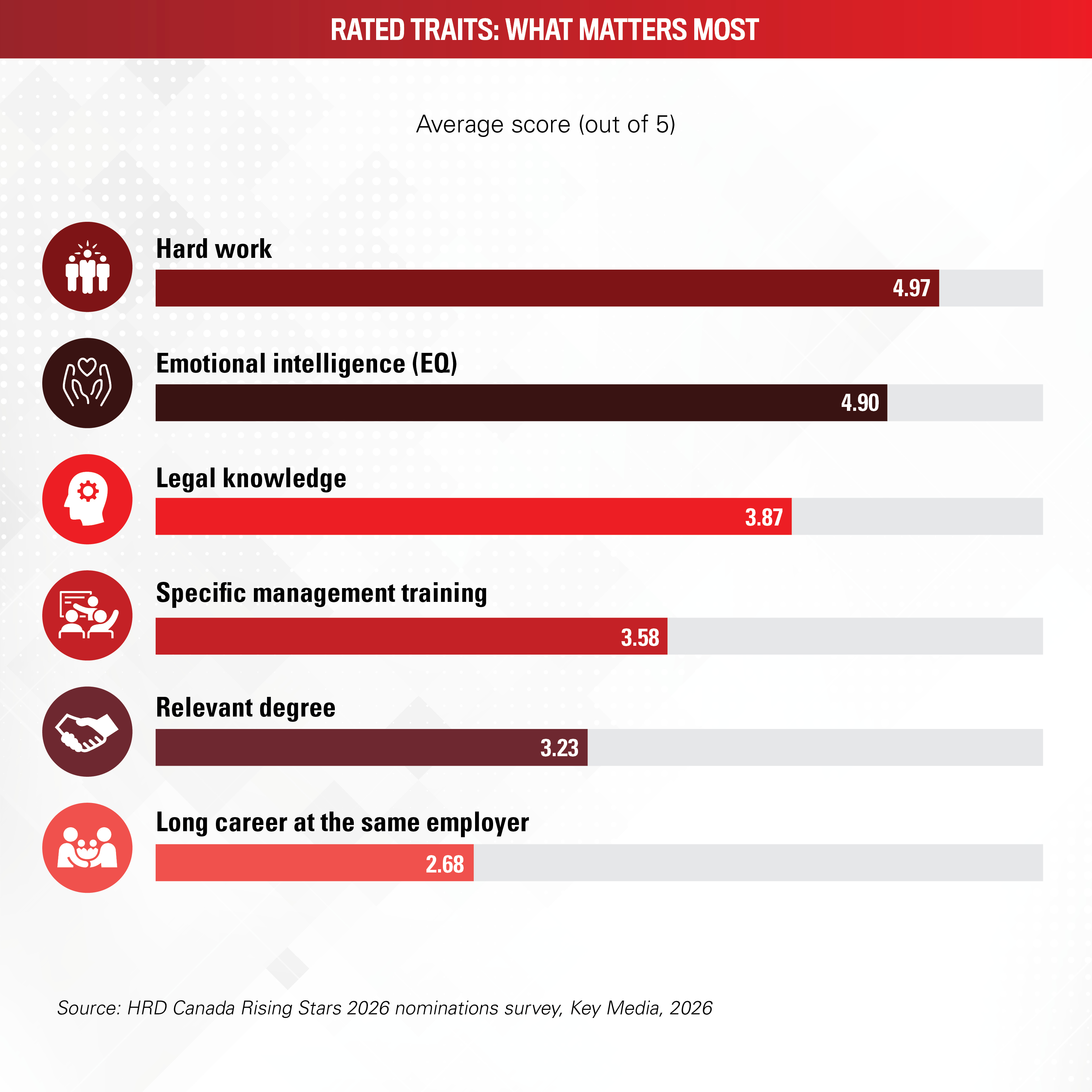
Hard work and emotional intelligence sit at near-perfect scores. Loyalty to a single employer sits at the bottom of the table. These are professionals who define themselves by what they deliver, not how long they stay.
The single most important HR leadership trait
When asked the open-ended question – what is the single most important trait to become a leader in the HR profession? – the cohort’s answers cluster unmistakably around a small number of themes. Empathy was cited by 14 of 34 winners, the clear leader. Courage was cited by seven. Curiosity and continuous learning were cited by nine in total. Emotional intelligence and integrity each appeared in four responses.
Almost no winner describes empathy as a personality trait. They describe it as a professional discipline – a structured practice of understanding the people and organizations they serve. Several frame it explicitly alongside accountability, courage, or business acumen: empathy as the input to better decisions, not as an alternative to them.
Every winner in the cohort is proficient in HR technology. HRIS platforms, ATSs, payroll platforms, performance management tools, and data dashboards – these are table stakes. What distinguishes the cohort is not that they use these tools but what they use them for.
Rising Stars do not adopt technology to do existing tasks faster. They adopt technology to change what HR is capable of doing at all. Multiple winners led full-cycle HRIS implementations within organizations that had previously relied on manual processes. Several built automation workflows and self-service dashboards that shifted HR from reactive reporting to forward-looking insight. A number of organizations are integrating AI-powered tools into their daily practice, and several are actively building organizational literacy around responsible AI use.
“Top young HR professionals are discerning in their approach and do not become distracted by passing trends or the latest shiny objects,” says Scali of Link HR. “In an increasingly crowded HR and tech marketplace, effective HR professionals are able to identify solutions that deliver meaningful value to the business, invest strategically in those initiatives, and then lead change management efforts effectively.”
Slightly more than half the cohort sought out a career in HR deliberately. The remainder arrived through opportunity – moved from adjacent roles, transitioned from other functions, or discovered the field through experience rather than intention. What unites them is not how they started but what they built once they arrived.
Their aspirations follow a consistent thread. They want leadership roles where they can influence at scale. They want to be at the intersection of people strategy and business performance. Several explicitly describe a vision of HR as a function that does not support the business from the outside but shapes it from the inside. None describes their goal as maintaining the status quo.
The 2026 Rising Stars cohort is not emerging into a stable, business-as-usual HR landscape. Four interconnected pressures – a structural skills crisis, a generational shift in what workers expect, the accelerating impact of AI on every Canadian career, and a persistent leadership gap for women – explain precisely why this generation’s approach is not just admirable but necessary. Each data cluster below illuminates one dimension of the same shift.
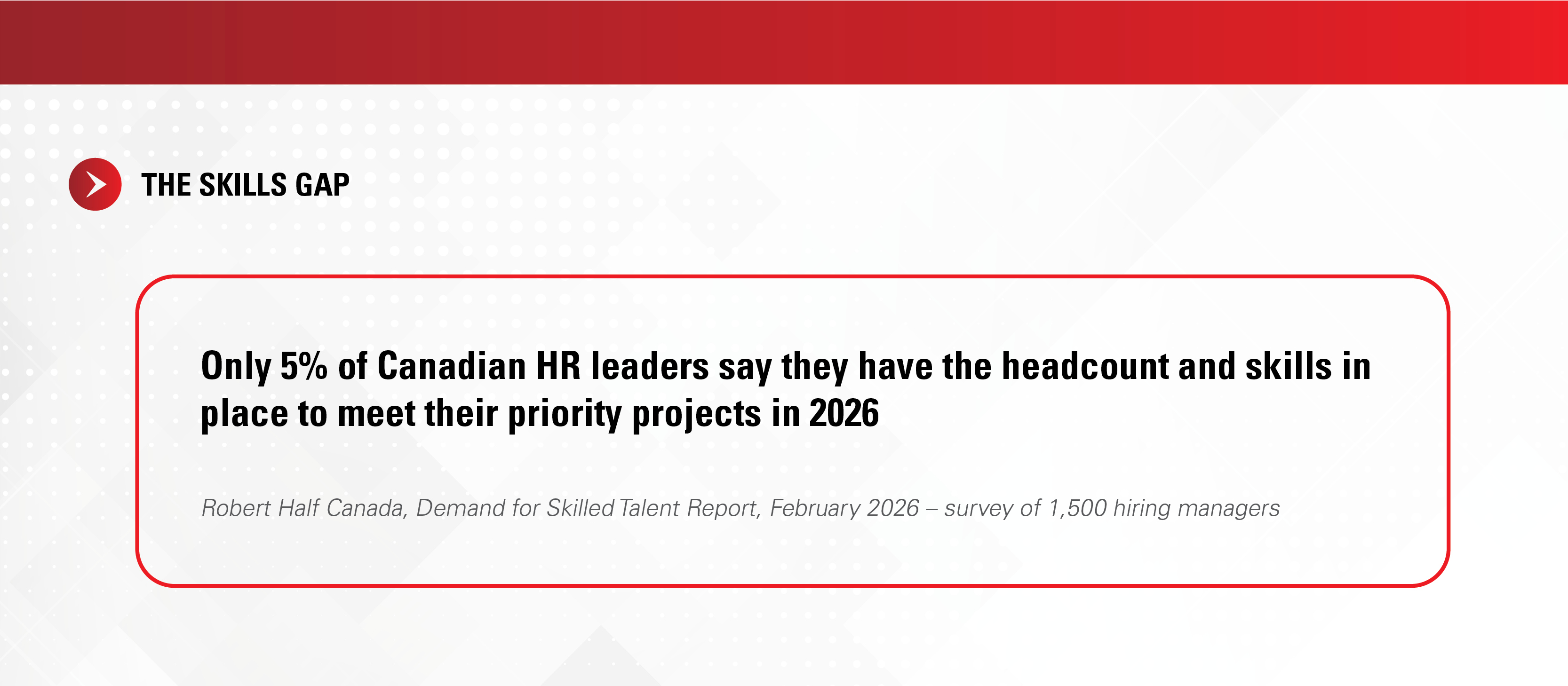
That figure – five percent – is not a rounding error. It is a structural reality. Of 1,500 hiring managers surveyed by Robert Half Canada, 57 percent reported skills gaps in their department, and 58 percent said those gaps were more pronounced than 12 months earlier. The HR professionals filling the remaining 95 percent of organizations’ needs are doing so under resource constraints that would have been unrecognizable to the profession a decade ago.
This is the environment in which the Rising Stars cohort is operating – not as junior talent waiting to be developed, but as immediate contributors to organizations that cannot afford to wait. The speed of impact these professionals are delivering is not exceptional. It is required.
Robert Half Canada’s research asked HR leaders which soft skills matter most to complement AI capability. The answers align directly with the profile of the 2026 Rising Stars: critical thinking and problem-solving (cited by 63 percent of leaders), creativity and innovation (61 percent), and adaptability and continuous learning (58 percent).
These are not skills this generation is developing in response to market demand. They are skills the cohort’s nominations describe as already operational. The market is catching up to what the best young HR professionals in Canada already bring.
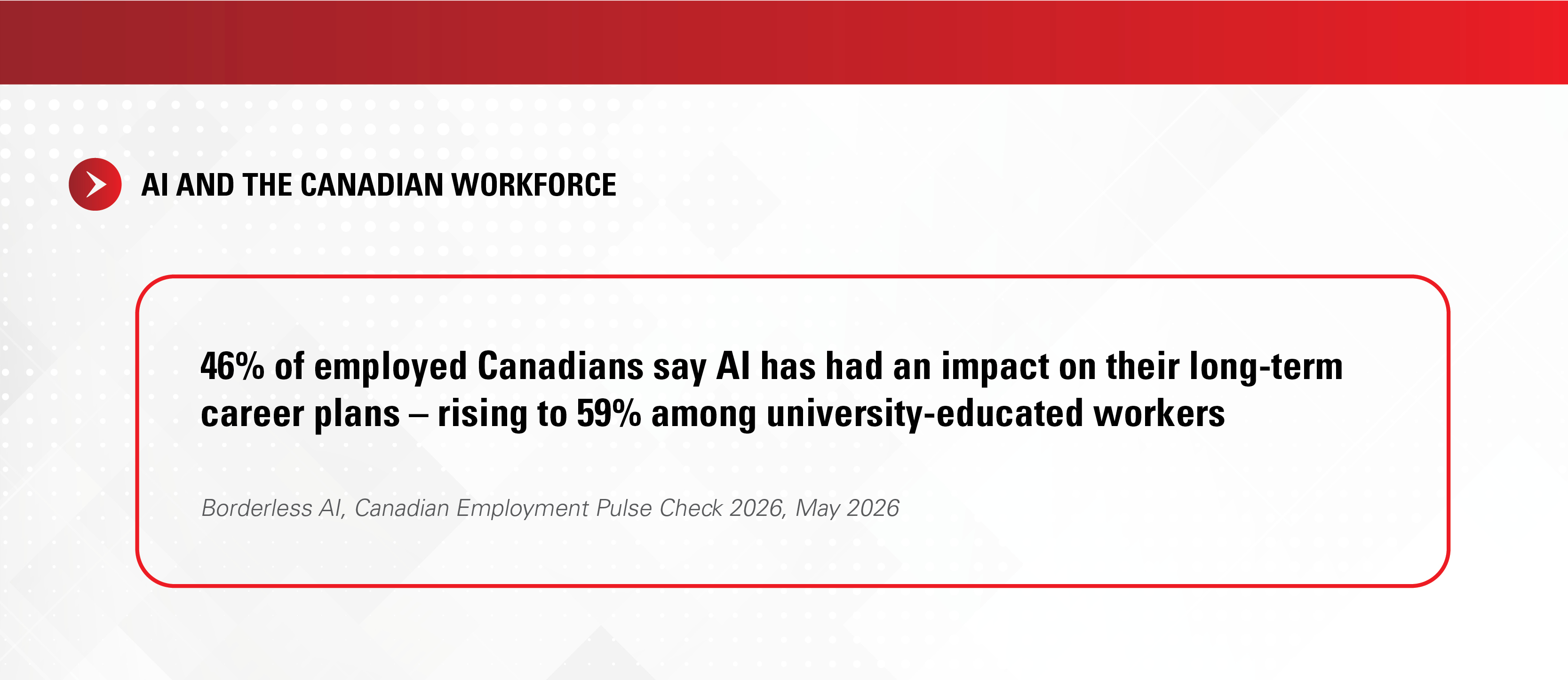
These figures, from Borderless AI’s May 2026 Canadian Employment Pulse Check, capture the scale of the disruption HR professionals are managing from inside their own organizations. The people asking HR for guidance on AI’s impact on their careers are, in many cases, being supported by HR professionals navigating the same questions themselves.
Deloitte’s 2026 Global Gen Z and Millennial Survey describes a workforce that is adaptable and pragmatic but which prioritizes purpose, psychological safety, and sustainable workload above fast-track advancement. Drawing on 22,595 respondents across 44 countries, it found that nearly all described purpose as important to their job satisfaction, and 40 percent had rejected work that conflicted with their personal values. More than half of both Gen Z (58 percent) and millennial (54 percent) respondents reported digital fatigue.
The HR professionals managing this workforce are, in many cases, part of the same generation. They do not have to infer what these employees need. They understand it from the inside – and that proximity is a professional asset that no amount of seniority can replicate.
Statistics Canada’s first quarter 2026 Business Conditions report found that women account for 45.1 percent of all positions and 46.9 percent of mid-level management roles in Canadian organizations – but just 40 percent of senior management positions. At every level below senior management, near-parity has been achieved. At senior management, the gap persists.
With 82 percent of this year’s Rising Stars being women, the cohort is the pipeline that Canadian organizations need to close that gap. These are professionals building the track records, relationships, and strategic credibility that senior leadership requires. The question is whether the organizations they work for will provide the pathways to match their potential.
The regulatory and technological landscape will continue to intensify. CPHR Canada, which represents 31,000 HR professionals across nine provinces and three territories, identified AI regulation, employment insurance reform, workforce mobility, and psychological health and safety as its core policy priorities in its April 2025 submission to the federal government.
The Human Resources Professionals Association, which supports more than 24,000 members in Ontario alone, has similarly identified the convergence of AI governance and human-centred leadership as the defining challenge for HR professionals in Canada in the years immediately ahead.
SHRM’s 2026 Talent Trends report reinforces the urgency: 42 percent of HR professionals reported difficulty retaining full-time employees in the past 12 months. Job rotation programs – identified as highly effective at addressing talent gaps by 93 percent of HR professionals – are used by fewer than 25 percent of organizations. The gap between what the profession knows works and what organizations actually implement is where the next generation of HR leaders will do some of their most important work.
“More than ever before, I am seeing young HR professionals being hired into stand-alone HR roles within growing organizations,” says Scali of Link HR. “They are expected to build and implement flexible, operationally sound programs and systems that support corporate values, align with business goals, and create a positive employee experience. They wear many hats and manage significant responsibilities with limited support and resources. AI and automation have reduced some of the administrative burden traditionally associated with HR roles, creating greater opportunity for young professionals to contribute more strategically to the business.”
Thirty-four professionals. Eight provinces and territories. Ages ranging from 25 to 35. organizations spanning financial services, energy, municipal government, hospitality, technology, non-profit, and professional services. The backgrounds are varied. The sectors are varied. The size of the organizations they work for ranges from lean start-ups to national institutions.
What they share is harder to quantify – but it is present in every nomination, every interview, and every self-description the HRD Canada team reviewed in building this list.
They share a refusal to accept that HR is a service function that follows strategy rather than shapes it. They share an instinct to understand the business before they try to improve the people practices within it. They share a willingness to challenge legacy processes – not for the sake of disruption, but because they can see, clearly and early, where the old ways are creating friction for the organization and the people in it. They share the confidence to say, quietly but firmly, “Why can’t we do this differently?”
They also share something that is easy to mistake for softness but is, in practice, a sophisticated operational capability: they genuinely care about the people they serve, and they have turned that care into a professional discipline. Empathy, in the hands of the 2026 Rising Stars cohort, is not a personality trait. It is a methodology.
The wall between business strategy and people strategy has come down. The 2026 Rising Stars did not wait for permission to walk through it. They helped knock it down from their very first day on the job.



HRD Canada’s Rising Stars 2026 list names 34 of the best young HR professionals in Canada, selected from nominations received across the country in February 2026. Eligible nominees were aged 35 or under, had no more than 10 years of HR experience, and had demonstrated measurable success in executing progressive HR initiatives. Winners span eight provinces and territories and work across industries including financial services, energy, technology, municipal government, and the trades.
HRD Canada’s Rising Stars is an annual recognition program that identifies the most outstanding young HR professionals in Canada. To be eligible, nominees must be aged 35 or under, have no more than 10 years of HR experience, and have demonstrated success in executing progressive HR initiatives. The 2026 list comprises 34 winners selected from nominations submitted in February 2026 and reviewed by the HRD Canada editorial team.
According to HRD Canada’s 2026 Rising Stars nominations data, the traits that define a rising star in Canadian HR include hard work (rated 4.97 out of 5 by winners), emotional intelligence (4.90), and a refusal to accept the status quo. In open-ended responses, 14 of 34 winners cited empathy as the single most important HR leadership trait – framed not as a personality trait but as an operational methodology. Lynn Roger, chief human resources officer at Bayshore HealthCare, describes a Rising Star as “curious, never settling for the status quo; passionate about the impact of their work; a continuous learner; creative and wanting to make a difference.”
In February 2026, HRD Canada invited HR professionals across Canada to nominate their most exceptional young talent. Nominees were assessed on their current role, key achievements, career goals, and contributions to shaping the industry, with recommendations from managers and senior professionals also taken into account. The HRD Canada team reviewed all nominations and narrowed the list to 34 winners.
According to Robert Half Canada’s 2026 Demand for Skilled Talent report, only five percent of Canadian HR leaders say they have the headcount and skills already in place to meet their priority projects this year. Fifty-seven percent report skills gaps in their department, and 58 percent say those gaps are more pronounced than they were 12 months ago. The top soft skills HR leaders want to complement AI capability are critical thinking and problem-solving (63 percent), creativity and innovation (61 percent), and adaptability and continuous learning (58 percent).
Deloitte’s 2026 Global Gen Z and Millennial Survey, drawing on 22,595 respondents across 44 countries, found that Gen Z and millennial workers prioritize stability, skills development, and well-being over rapid advancement. Nearly all described purpose as important to their job satisfaction, and approximately 40 percent had rejected employers or work that conflicted with their personal values. Borderless AI’s 2026 Canadian Employment Pulse Check found that 46 percent of employed Canadians say AI has had an impact on their long-term career plans, rising to 59 percent among university-educated workers.
The 2026 Rising Stars cohort is 82 percent women, reflecting both the demographic composition of the Canadian HR profession and the particular drive and career commitment of this group. Statistics Canada’s Q1 2026 Business Conditions report shows that while women account for nearly 47 percent of mid-level management positions in Canadian organizations, they hold only 40 percent of senior management roles. The Rising Stars cohort represents the pipeline that, if properly supported and developed, will address that persistent gap.
An integrated strategy means that workforce planning, talent development, and organizational culture are built into business decisions from the start – not added afterward. Lynn Roger, Chief Human Resources Officer at Bayshore HealthCare, describes it directly: “Gone are the days when we had a business strategy and a people strategy. Progressive organizations are integrating how a strategy will be executed into their plans from the start.” For the 2026 Rising Stars, this integration is not aspirational. It is how they operate from day one.
In February 2026, HRD Canada invited HR professionals across Canada to nominate their most exceptional young talent for the Rising Stars list.
Nominees had to be aged 35 or under with HR work experience of 10 years or less, as well as experience in executing progressive HR initiatives, and be committed to a career in human resources with a clear passion for the industry. Nominees were asked about their current role, key achievements, career goals, and the contributions they had made to shaping the industry. Recommendations from managers and senior industry professionals were also taken into account.
The HRD Canada team reviewed all nominations, narrowing the list down to 34 of the sector’s most outstanding young professionals.