Digital Benefits, Wellbeing & Health Tech Platforms
Canada’s benefits industry is going digital fast.
Adoption is another story.
When it comes to technology – including the headliner AI – Canada’s benefits industry has moved well beyond the pilot stage. Claims and wellness platforms now come equipped with AI-powered chatbots ready to answer questions before a human ever picks up the phone. Employees have no shortage of digital tools at their fingertips, but trust in these new technologies continues to lag.
Reconciling access and adoption
A cross-section of the country’s employers is enthusiastically rolling out AI, using it for everything from claims processing to personalized employee coverage recommendations. Giant supermarket chain Sobeys, for example, uses AI to respond instantly to employee inquiries about benefits coverage, reducing call volume and delivering answers in seconds.
At 1Password, AI-enabled features built into the benefits provider’s app are making claims processing fast enough that reimbursement wait times are in free fall compared to a few years ago. Quebec-based Beneva, Canada’s largest mutual insurer, has rolled out AI across its administration processes, with an internal pilot involving a specific group of employees finding time savings of two hours per week.
Lucy Van Scheltinga, director of Westland Benefits, Eastern Canada – whose role involves helping employers decide which tools earn a place in their benefits plans – is watching these moves closely. She’s keen to make the point that none of it is a plot to overthrow the human side of the job.
“Across the industry, insurers like Beneva are explicit that the goal of AI is to improve efficiency in service of a better experience, not replace the relationship,” she says, adding that it starts with taking repetitive administrative work off advisors’ desks so they can spend more time with clients. “Nobody got into this work because they love processing enrollment forms,” she adds.


Lucy Van ScheltingaWestland Benefits
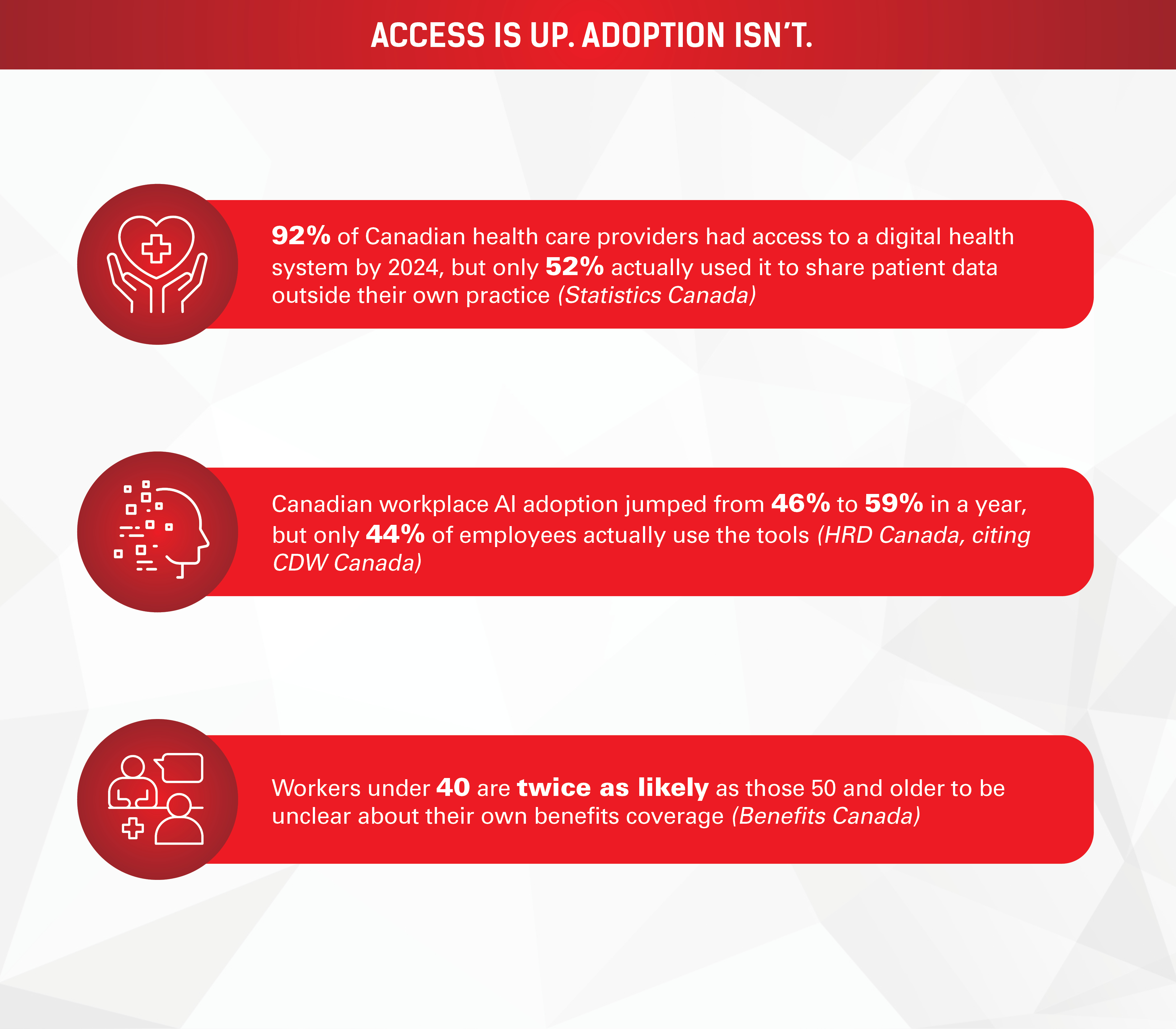
Access and adoption, however, are distinct aspects of the employee experience with benefits tools. Though the technology has made real strides in improving efficiency, that’s only one side of the equation. Across industries and technologies, the data tells a similar story when it comes to inconsistent usage rates.
A CDW Canada report found that the number of Canadian organizations using workplace AI tools jumped from 46 percent in 2024 to 59 percent in 2025 – but only 44 percent of employees are using them. Statistics Canada found nearly the same pattern in health care: just over nine in 10 health care providers had access to a digital health system by 2024, but only about half were actually using it to share patient information electronically outside their own practice.
Canadian benefits platforms are running into the exact same wall, with usage lagging despite significant investment in impressive tools. Why is that?
“The biggest barrier is friction,” says Nadim Kara, executive vice president and head of people and culture at GreenShield, Canada’s only national non-profit health care and insurance organization. “When experiences are fragmented – separate apps, separate logins, separate processes – people disengage.”
The team at GreenShield has found that integrating services, such as claims management and mental health support, into a single experience significantly increases engagement. It becomes, Kara says, “intuitive rather than effortful.”
To that end, “we’re focused on creating smarter, more proactive experiences, nudges, recommendations, and next best actions, so employees don’t have to figure it out on their own. We meet them where they are.”
The price of getting it wrong
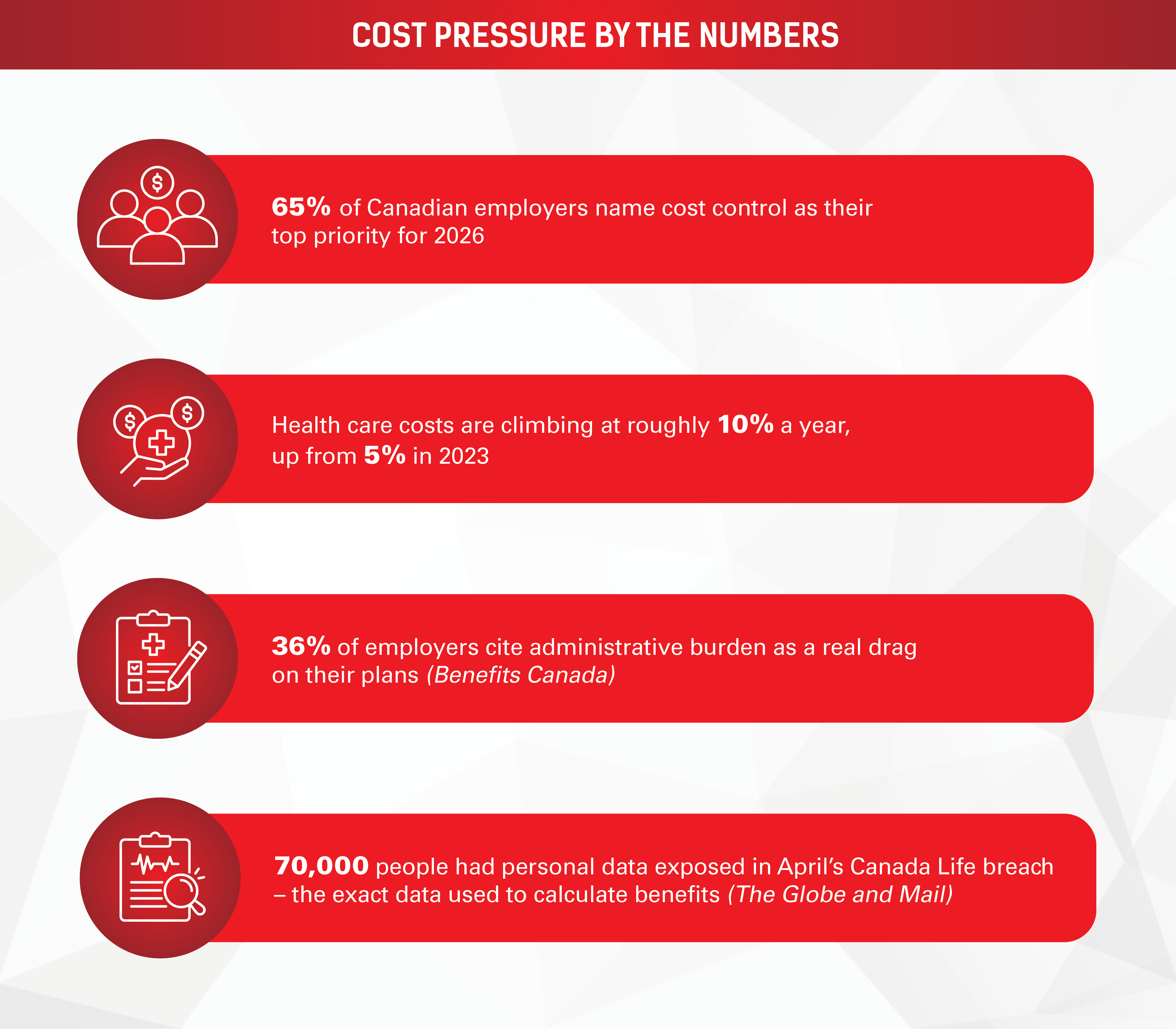
The push to address the usage gap comes from financial considerations as well. Digital tools are helpful in absorbing pressure from areas of coverage experiencing a sharp spike in spending. Health care costs are a timely example. A survey of more than 200 Canadian employers found that the rate at which health care costs are climbing has roughly doubled since 2023, from about 5 percent a year to 10 percent. Sixty-five percent now name cost control as their top priority, and more than a third point to administrative burden as a real drag on their plans. Automating administration seems like the silver bullet, but even the best technology in the world can only work if it’s actually adopted.
Employees are sending mixed signals of their own. In one survey, 72 percent of plan members say they would welcome personalized information from their insurer based on their own usage, showcasing a real appetite for platforms that know them better. Hesitation is still prevalent, however, as two priorities square up: people want the ease of their favourite shopping app applied to something personal while harbouring serious doubts about whether an algorithm can handle it.
The pattern isn’t unique to Canada; it shows up south of the border too. A US study from Prudential, reported by HRD Canada earlier this year, found that 83 percent of employers are interested in using AI to help workers understand their benefits, but only 58 percent of employees are willing to use it for that purpose. Privacy and security concerns, along with general distrust of the technology, ranked among the top reasons why.
While friction is one reason people disengage, a deeper issue often sits underneath. Van Scheltinga notes that employee trust really comes down to two things: follow-through and transparency. With the former, it’s about consistency. If there’s a disconnect between the carrier’s pitch and the actual experience, forget it.
“If a carrier promises an easy claims process, a quick beneficiary change, or a smooth digital enrollment, that ease needs to show up in practice,” she says. “The moment it doesn’t, people don’t troubleshoot; they just call HR or check out of the benefit entirely.”
Her advice to employers is to go further than just vetting the sales pitch. They should vet the actual user journey by testing it the way an employee would before it’s rolled out – that’s where trust is really won or lost.
“On transparency, people need clear, upfront language about who actually sees their data, especially anything touching health or financials,” Van Scheltinga adds. “If employees are left guessing who has access to what, trust will fade fast, no matter how good the tool is.”
Earning trust, earning its place
That caution proves prudent given the rise in cybersecurity issues. In April, Canada Life confirmed a cyber incident in which hackers accessed personal information – names, birthdates, addresses, income levels, and the exact data used to calculate someone’s benefits – for up to 70,000 people, most of them employees covered under a single corporate plan. The breach reportedly started with one compromised employee account.
For an industry asking plan members to trust it with more personal health and financial data than ever in exchange for smarter, more personalized digital tools, it’s a real-time reminder of what’s on the line. Canadian employers recognize the stakes and are moving carefully, adopting AI in specific, measurable areas rather than handing broad plan decisions over to an algorithm.

Nadim KaraGreenShield
That selectivity plays out at the brokerage level, where enrollment and communication tools must be relied on to continuously refine coverage instead of keeping benefits design stuck as a once-a-year exercise. Every platform is a pitch, every line item is a cost, and employers must decide which tools genuinely earn their place and which only sounded good when discussed at a vendor meeting a few years ago.
“It’s having the harder conversation about what to add or cut,” Van Scheltinga says, adding that the focus at Westland is on addressing the gap between the benefits employers offer and what employees understand and therefore actually use.
Cutting dead tech weight is a great start, but what’s retained or added matters even more: employers must give people something to pay attention to. From Kara’s perspective, the biggest opportunity to do that is customization. There’s a demand for highly intuitive, customized digital experiences, and that’s where employers can differentiate.
“Health, benefits, and employee experience can’t be fragmented or one-size-fits-all anymore; they need to be integrated, personalized, and built around real human needs across different life stages and experiences,” Kara says. “It’s about creating benefits experiences that feel modern, relevant, and tailored so people don’t feel like they’re living in two completely different worlds: Flintstones at work and Jetsons at home.”
Further along the same curve – for now
Where does that leave the industry heading into the back half of 2026? Likely exactly where it is now, just further along the same curve: more automation in the plumbing, justified caution about what sits in front of the employee, and a widening space between what providers can build and what plan members are ready to embrace.
Closing it will take more than better software. It’ll take the kind of patient, plan-by-plan, and tool-by-tool judgment that no chatbot – yet, anyway – is able to handle.