New report finds employers are dissatisfied with the IR reforms
Arbitration in many enterprise bargaining rounds is becoming a "real possibility" under the government's industrial relations reforms, as employers warn the system has grown more complex, more costly, and less productive, according to a new report.
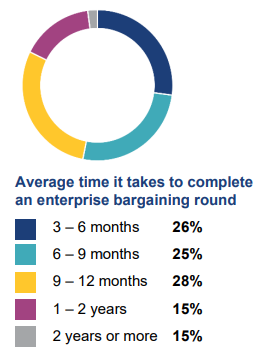
A Herbert Smith Freehills Kramer (HSF Kramer) survey of 65 senior leaders and IR practitioners in Australia found that enterprise bargaining rounds are now usually taking nine to 12 months.
Another 17% said the process is taking more than 12 months.
Rohan Doyle, an industrial relations partner at HSF Kramer, said these bargaining timeframes are "significant."
"Because after nine months of bargaining, and provided the current agreement has been expired for nine months, unions and employees are able to request that the Fair Work Commission end bargaining by arbitration," Doyle said.
"It shows that arbitration is a real possibility in a large portion of enterprise bargaining rounds. Employers generally view this as a risk, as it means they lose control over the outcome."
The FWC has the authority to make an intractable bargaining workplace determination when bargaining parties cannot be settled within a specified post-declaration negotiation period.
This intractable determination ultimately decides the terms and conditions of employment that parties cannot agree upon, replacing what would otherwise have been the enterprise agreement.
Nearly three in four (74%) of HSF Kramer's respondents disagreed that intractable bargaining reforms have been able to reduce industrial action or create stronger incentives to reach agreement quickly.
According to 54% of the respondents, unions or employees are using intractable bargaining determination as a tactic during bargaining.
Dissatisfaction over bargaining system
The forecast on bargaining comes in the wake of dissatisfied businesses when it comes to the government's IR reforms.
The majority of employers believe the reforms have made it more difficult to reach an agreement with unions or workers.
They also believe the enterprise bargaining system has become overly technical and prescriptive (75%) and that they give unions or employees too much bargaining power (70%).
The rise of AI adoption in workplaces also makes 44% of employers believe that related protections will need to be included in their next enterprise agreement proposal in order to reach an agreement.
"Many employers are grappling with the need to renegotiate a large number of agreements, which puts their teams in a permanent bargaining state," Doyle said.
"This level of resource intensity, the difficulty of reaching agreements, the spectre of third-party arbitration, concerns about being forced into agreements with unrelated employers, and the complexity of the bargaining process are driving employer dissatisfaction with the current enterprise bargaining environment."
Psychosocial harm is also emerging as a real risk amid extensive bargaining, according to the report.
Many employers (60%) reported stress, anxiety, or burnout among their representatives during their most recent bargaining round, while they also observed more workplace conflict, employee mental health impacts, and even aggressive behaviour.
What can employers do
Rachel Dawson, an industrial relations partner at HSF Kramer, said employers should plan ahead to manage the risks stemming from extensive bargaining processes.
"Employers should plan early and ensure they have the right measures in place to manage those risks," Dawson said.
The report also noted that employers are adjusting their negotiation timelines to start bargaining earlier since the intractable bargaining reforms, as well as adopting a more proactive employee communications and engagement strategy.
Some 38% of employers are also investing more time and resources in determining their bargaining position, but only 29% feel very confident that they could demonstrate that this position is fair and reasonable in intractable bargaining proceedings.
"Employers have brought forward bargaining timelines and adopted more proactive communication and engagement strategies to counteract this, which is fantastic to see, but there is clearly more work to do," Dawson said.