Georgie Harman explains why workplace culture, not compliance, is the real lever for mental health prevention
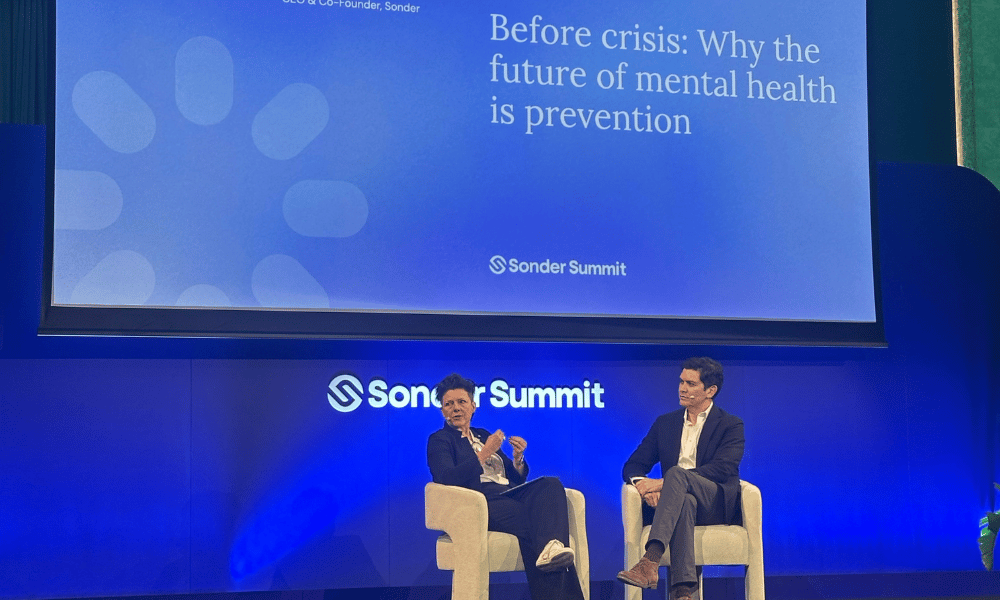
"Don't be a dickhead." That was Beyond Blue chief executive officer Georgie Harman AO's answer when asked, at the Sonder Summit 2026, what one message she'd want every workplace leader to take away.
In conversation with Sonder chief executive officer and co-founder Craig Cowdrey, Harman used the line to make a serious point: that mental health at work is too often treated as a compliance box to tick rather than a matter of basic human decency.
"I think we often forget about the power of humanity and human connection," Harman said. "We're all incredibly busy, stressed, and sometimes we can allow that to change who we are as people… Don't think about this as a compliance task."
Financial stress now the leading driver of distress
The blunt framing sat alongside new population-level data Harman previewed on stage, due for release in the coming weeks. Approximately 50 per cent of Australians are now reporting signs and symptoms of depression and anxiety, she said, with severity increasing – from around 6 per cent to about 8 per cent over the past two years.
Money worries remain the primary driver of that distress, Harman said, while cost is also the number one barrier stopping people from seeking help. Housing stress has emerged as the second-largest driver, up roughly 10 percentage points since 2022.
"We've got this triple whammy of money concerns being the main driver of psychological distress across Australia at the moment," Harman said. "The number one barrier to help-seeking [is] the cost of services, whether it's having to travel 100 miles to get to a service or a copayment, or whatever it is."
Harman pointed to one positive signal: people are increasingly reaching out earlier, before symptoms become acute. This is evidence, she said, that a quarter-century of public health messaging is starting to shift behaviour, even if change of this kind takes years to land.
The business case: the return is measurable
For HR leaders building the case for preventive investment internally, Harman cited a PwC report, published roughly 12 years ago, that found an average return of $2.30 for every dollar spent on this type of workplace investment.
She also referenced new research conducted with the CSIRO (Commonwealth Scientific and Industrial Research Organisation) examining how technology, climate change, social disconnection and economic stress will shape mental health and help-seeking over the next decade, and an independent evaluation commissioned from the University of Melbourne which found Australia's reductions in stigma and improvements in help-seeking have not been matched elsewhere in the world.
"It's not a case of having to discover that anymore," Harman said of the return-on-investment data. "It's just how you convert that into measurable impact that's going to convince your CEO."
The "frozen middle" carrying the load
Harman also raised a concern specific to people managers, whom she described as caught in a "frozen middle" – expected to act as the front line of psychological safety while managing their own competing pressures, without being mental health experts themselves.
She called for clearer, more realistic conversations between employers and employees about what managers can reasonably be expected to carry, arguing that regulation has moved faster than that practical discussion.
Leadership development: consistency over compliance
That same theme – care applied consistently rather than performed for compliance – ran through the summit's leadership workshop with Shelley Johnson, founder and leadership coach at Boldside and a columnist for The Age and The Sydney Morning Herald.
Johnson argued effective leadership rests on three "non-negotiables": care, belief and challenge, noting that challenge only lands well once care and belief are established.
"Care and belief give you permission to challenge," Johnson said. Read alongside Harman's comments, the message to HR and safety leaders is consistent: sustainable workplace wellbeing depends less on new frameworks and more on leaders showing up for people the same way, every day.