For employers, the talent shortage era is giving way to something harder to read
For most of the past four years, HR's biggest headache was finding people. Heading into 2027, the harder question is how many people the business will need, and what to do with the ones it already has.
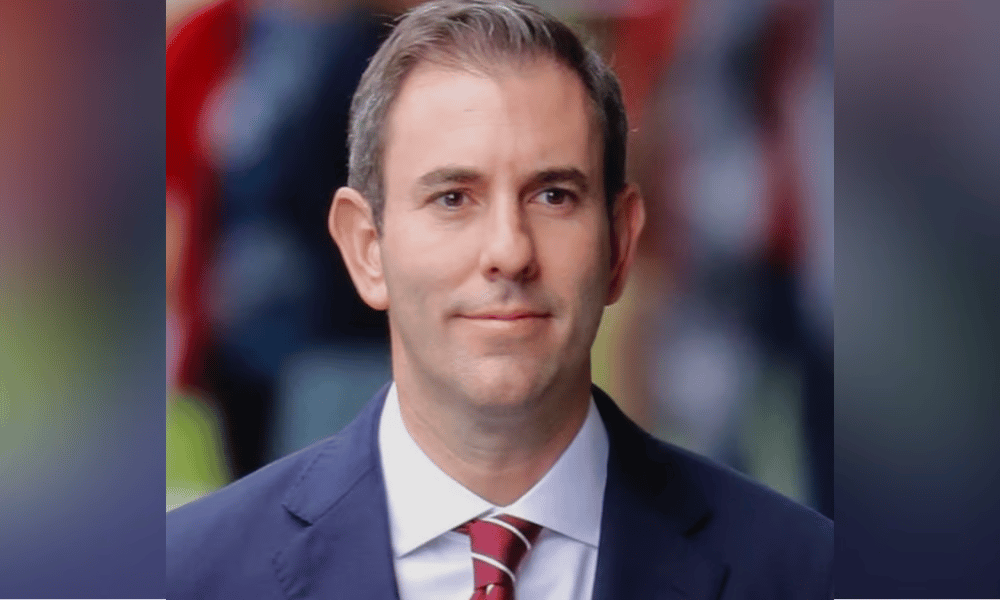
Treasurer Jim Chalmers will tell the Citi A50 Economic Forum in Sydney on Friday that Treasury is reworking its numbers for December's mid-year budget update, and that the revisions point to softer growth and slightly higher unemployment, according to speech excerpts seen by Reuters. He will also concede the slowdown is already showing up at work: "we can see that in the softening of the labour market", according to leaks.
The jobless rate hit 4.7 per cent in September, its highest point since late 2021. The number of unemployed people rose to 732,000, while the youth unemployment rate climbed to 11.1 per cent, according to the Australian Bureau of Statistics.
Fewer ways out, longer queues
The headline rate only tells part of the story. ABS flows data shows sixty percent of people who were unemployed in August were still looking a month later, and just 21.4 per cent had found a job, down from 28.4 per cent three years earlier.
"This September a higher proportion of people remained unemployed compared to recent years," ABS head of labour statistics Sean Crick said in the bureau's September release. Underemployment also edged up to 6.3 per cent. The ABS recommends trend figures as the best guide to the underlying market, and trend unemployment sits at 4.6 per cent.
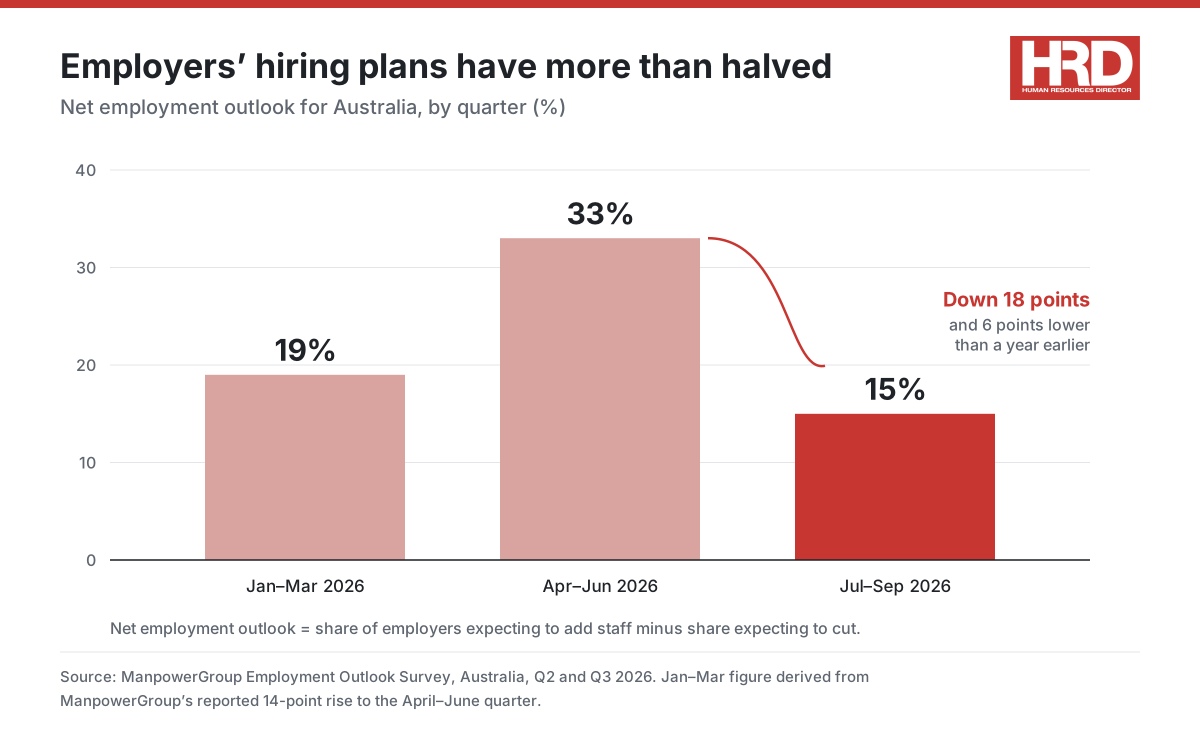
Employers' own plans have cooled too. ManpowerGroup's Employment Outlook Survey for the September quarter put Australia's net hiring outlook at 15 per cent, down 18 points on the previous quarter. In Jobs and Skills Australia's latest recruitment survey, just 17 per cent of employers expected to add staff in the next three months, down from 20 per cent a year earlier. The share of recruiting employers struggling to fill roles fell to 44 per cent, from 49 per cent.
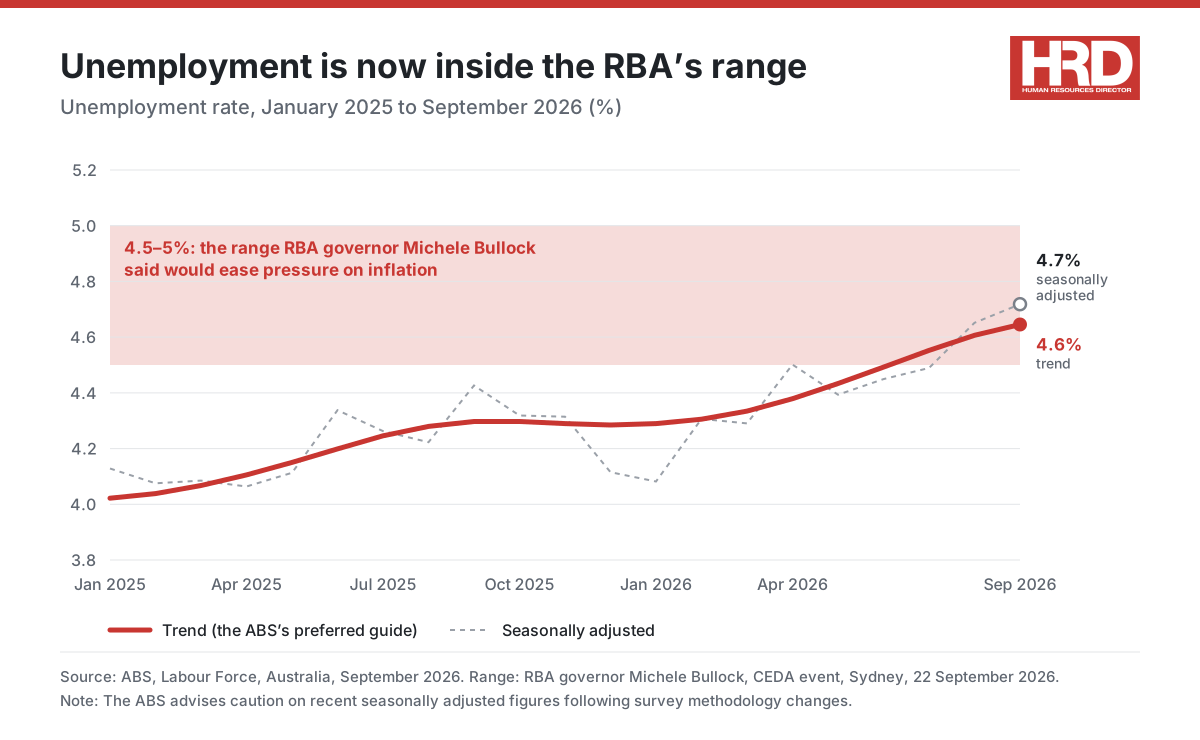
None of this is unwelcome news at Martin Place. The Reserve Bank lifted the cash rate to 4.6 per cent on 29 September, its fourth rise this year and a 15-year high. A week earlier, Governor Michele Bullock told a CEDA event in Sydney that unemployment may need to rise to as high as 5 per cent to take the pressure off inflation. A rate between 4.5 and 5 per cent, she said, would probably cool the labour market enough to ease inflation.
This week her deputy, Andrew Hauser, went further. "The inflation outlook looks materially worse than we projected in the August report," he told a Citi investment conference in Sydney on Wednesday, as reported by Australian Broker. He also warned that some people were starting to doubt inflation would return to the 2 to 3 per cent target, which he described as the worst-case scenario for a central bank. "We can't allow expectations to shift away from target," he said, according to the ABC.
Markets took the hint. Pricing for a fifth hike, to 4.85 per cent, jumped from about 30 per cent to 62 per cent after his remarks. The September quarter inflation figures will be released on 28 October, and the board hands down its decision on Melbourne Cup day, 3 November.
Read next: The entry-level job is disappearing
Squeezed on both sides of the payslip
For employees, the picture is tight. The Wage Price Index rose 3.2 per cent in the year to June, with private sector pay up 3.1 per cent and the public sector up 3.4 per cent. Big pay rises are getting rarer: 79 per cent of jobs recorded an annual wage change of less than 4 per cent, the largest share since mid-2022, the ABS said.
With inflation running ahead of that, the Treasurer's own office conceded real wages fell 0.8 per cent through the year to June. Add four rate rises on top, and plenty of staff are feeling it in their mortgage or rent before they see it in their payslip.
For employers, that means the 2027 pay round will be negotiated against a backdrop of stretched households and softer hiring demand at the same time. That's an awkward combination, and one where clear communication about how pay decisions are made will matter as much as the number itself.
The AI wildcard
The one bright spot in the Treasurer's speech is business investment, which he expects could more than double compared with May's budget forecast and rise by more than 5 per cent this year. Much of that uplift, worth about $50 billion, is being driven by data centre developments.
That money doesn't automatically translate into broad-based hiring. Hauser flagged the building boom as an inflation risk in its own right: "we're having a boom in data center construction here in Australia as well", he has said.
Bullock has flagged a less obvious risk. In the same CEDA appearance she warned that if workers whose roles are no longer needed struggle to move into new jobs, the jobless rate the economy can sustain without stoking inflation may sit higher for a while. For employers, that makes reskilling and redeployment an economic issue as well as a people one.
Inside workplaces, the evidence on AI is still mixed. A federal government report found no evidence of broad AI-driven upheaval in the Australian jobs market as of February 2026. Earlier this year, one economist's analysis found no clear evidence that generative AI is lifting productivity yet, and overseas surveys suggest companies are scaling AI faster than they are training staff to use it.
Read next: Unemployment rises to 4.6% as full-time jobs slip in August
Read next: When AI redundancies backfire: Employers now scrambling to rehire humans
A long, flat stretch
Private forecasters aren't expecting a quick bounce. Deloitte Access Economics this month cut its growth forecast for 2027 to 1.7 per cent, down from 1.9 per cent, and expects unemployment to peak just under 5 per cent. The firm thinks Australia will narrowly dodge a recession, but warns many households and businesses could face conditions that feel like one.
Its verdict on the run of growth that carried the country for three decades was blunt. "It was good while it lasted," Deloitte partner Stephen Smith said. The firm argues reforms to tax, regulation, government spending and skills have been put off for too long.
Economists closer to the month-to-month numbers aren't any more upbeat. Challenger chief economist Jonathan Kearns told Guardian Australia the full effect of this year's four rate rises has yet to flow through, and that unemployment will keep climbing from here. He nominated 5 per cent as a level that would be "a difficult threshold for the government". NAB chief economist Sally Auld expects a tough six to nine months, though she is hopeful inflation will be lower by this time next year.
That puts productivity squarely in HR's lap. With growth this weak, more of it will have to come from getting more out of the workforce businesses already have.
What HR can do before the next jobs report
The next labour force figures are due on 19 November. Some practical steps in the meantime:
- Run a 5 per cent scenario. If unemployment heads towards the top of the range Bullock flagged, what happens to your demand, your margins and your headcount plan? Workforce plans built in the tight market of 2022 and 2023 may need a rethink.
- Look at redeployment before redundancy. Cutting deep and fast can leave a business short when conditions turn. Mapping skills already on the books gives leaders other options.
- Use the softer market to hire well. Roles that sat open for months two years ago may now attract strong candidates. Check that screening rules aren't filtering out good people on employment gaps alone.
- Be upfront about pay. With wage growth easing and costs biting, staff will want to understand how decisions are made, even when the budget is tight.
- Back financial wellbeing. Another rate rise would hit mortgage holders again. Salary packaging, flexible pay timing and access to financial counselling cost relatively little.
- Make AI pay off in output per worker. Rolling out tools without training or work redesign is unlikely to fix the productivity problem Deloitte and the RBA keep pointing to.
The Reserve Bank's next move will be clearer after the inflation figures on 28 October. Either way, the jobs market of 2027 looks set to be looser, slower and harder to call than the one HR has been managing.
Read next: The 'surprising' impact of AI on Australia's labour market