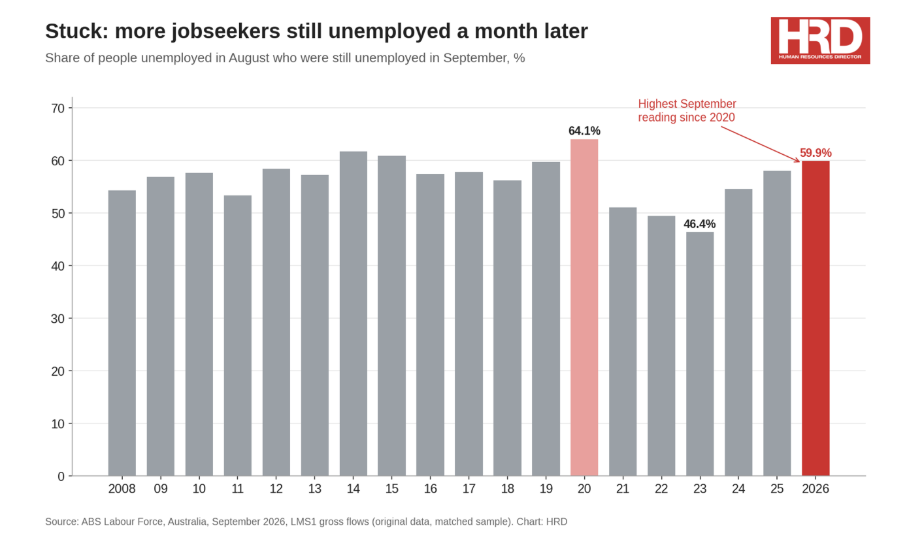
New ABS flow data shows six in 10 people who were unemployed in August were still looking for work in September, the highest share for the month since the pandemic

It looks like losing a job in Australia is turning into a stickier problem that it used to be.
The headline unemployment rate rose to 4.7 per cent in September, with 39,300 fewer people in work and 8,900 more out of it, the Australian Bureau of Statistics said on Thursday. But the more telling number sits in the ABS gross flows data, which tracks what happens to the same people from one month to the next.
Of everyone who was unemployed in August, 59.9 per cent were still unemployed in September. That is the highest September reading since 2020, when COVID-19 restrictions had frozen much of the jobs market, and well up on 46.4 per cent in September 2023.
The flip side is the job-finding rate. Only 21.4 per cent of August's unemployed had found work a month later, down from 28.4 per cent three years earlier.
ABS head of labour statistics Sean Crick flagged the shift in the bureau's release. "This September a higher proportion of people remained unemployed compared to recent years," he said.
Crick said that followed August, when an unusually high share of people who had been outside the labour force moved straight into unemployment. Put together, the two months suggest more people are starting to look for work, and fewer of them are finding it quickly.
Read next: The entry-level job is disappearing
A slow leak, not a burst pipe
Trend unemployment, which the ABS says is the best guide to what is happening underneath the monthly noise, held at 4.6 per cent. It has crept up every month this year, from 4.3 per cent in December. Underemployment rose to 6.3 per cent.
Employers haven't stopped hiring. Trend employment is still growing by roughly 16,000 people a month. It just isn't growing fast enough to soak up everyone coming into the labour force, so the people at the back of the queue are waiting longer.
That suits the Reserve Bank. It lifted the cash rate to 4.60 per cent on 29 September, its fourth increase this year. Governor Michele Bullock had said days earlier that unemployment of between 4.5 and 5 per cent would be needed to ease pressure on inflation. September's result puts the rate inside that band.
Read next: Unemployment rises to 4.6% as full-time jobs slip in August
The CV gap problem
For HR, longer spells out of work run straight into an old screening habit: marking down candidates with gaps.
A 2024 review of the research by economists Liam D'hert, Stijn Baert and Louis Lippens for the IZA Institute of Labor Economics found people out of work for more than 12 months are at a significant hiring disadvantage compared with people in a job, and that the longer someone is unemployed, the lower their chances of a callback.
Competition is fiercest at the bottom rung. Anglicare Australia's Jobs Availability Snapshot, reported by HRD late last year, found 39 jobseekers chasing every entry-level vacancy, the toughest ratio in a decade.
There are a few practical checks worth making now. Look at the knock-out rules in your applicant tracking system and see whether any filter on recent employment or the length of a gap. Ask recruiters how many candidates are being screened out on gaps alone. Where you can, test for skills instead of inferring them from an unbroken work history.
There is an upside, too. In 2022 and 2023, when the market was at its tightest, many employers struggled to find anyone. Some of the people who are now stuck looking for work are exactly the candidates those employers were chasing.
Read the numbers with care
Gross flows use original data rather than seasonally adjusted figures, which is why HRD has compared September only with previous Septembers. The flows are drawn from the part of the survey sample interviewed in both months. The ABS has asked users to treat flows for May to July 2026 with caution after changes to its sample, and has warned that September's seasonally adjusted figures may carry some leftover effect from its new supplementary survey model.
Read next: Unemployment rate rose to 4.5% in July