
New government report finds 'no evidence' of widespread job market upheaval due to AI
The adoption of artificial intelligence has yet to cause broad disruption in Australia's job market, according to new government data, defying initial warnings that AI will lead to widespread job losses.
The Department of Employment and Workplace Relations (DEWR) released on Wednesday its first-of-its-kind AI and Employment in Australia report that examined how occupations exposed to generative AI have changed since its emergence in late 2022.
"The AI and Employment in Australia report reveals that artificial intelligence is not currently causing upheaval in the labour market," said Employment and Workplace Relations Minister Amanda Rishworth.
'No evidence' of AI-driven labour shifts
The report found "no evidence" as of February 2026 of broad AI-driven labour market upheaval in Australia, citing the low unemployment rate and the lack of rapid reshuffling across occupations.
It also noted employment outcomes for young workers and graduates remained resilient, despite previous warnings that they would be the most impacted as entry-level jobs would likely disappear because of AI adoption.
According to the report, the gap between youth and overall unemployment rates is relatively low and below the typical pre-COVID range.
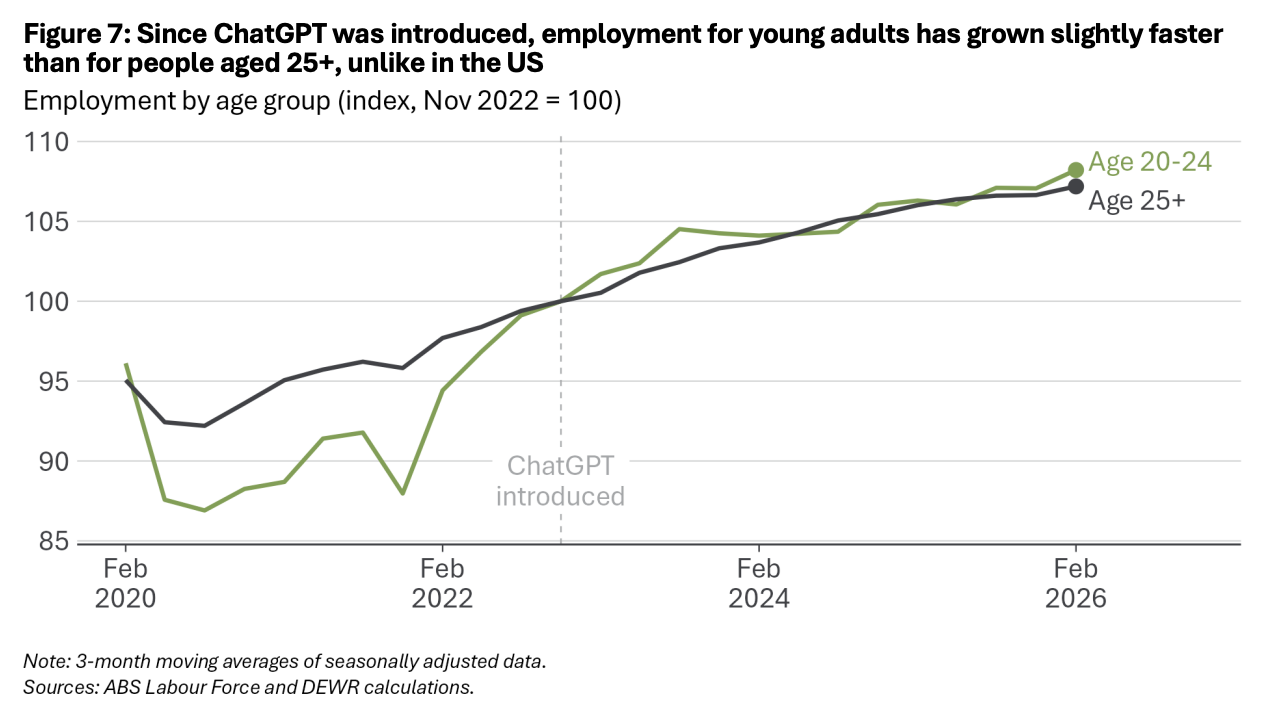
In fact, jobs for people aged 20 to 24 have even grown slightly faster than for those aged 25 and over since the introduction of ChatGPT in late 2022, the report added.
The unemployment rate for young tertiary graduates also remains low in historical terms, performing relatively well compared to the rate for tertiary graduates who are now 25 and older.
"Artificial intelligence could yet reshape the jobs market in Australia, but this report shows labour market conditions remain strong by historical standards, youth outcomes have mostly held up, and occupational reshuffling has not accelerated," Rishworth said.
Slowdown in some AI-exposed jobs
There is an indication, however, of a slowdown in employment growth in some occupations that are highly exposed to AI.
Clerical and administrative roles are growing more slowly than those less exposed to AI, according to the report.
But it also noted that there is "no common employment trend" across the jobs most exposed to potential automation by AI.
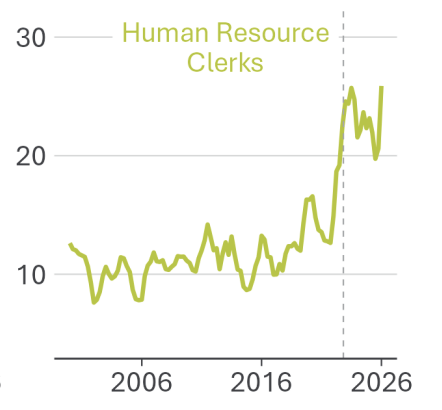
It noted that software developer employment has increased by 25% since November 2022. Employment for "Human Resource Clerks" is also above its November 2022 level after a period of volatility.
The government's findings are in line with recent reports indicating that AI adoption is leading to job growth and higher wages.
A labour market analysis by the Australian Institute of Business found that overall net job availability for AI-exposed roles grew by 10% between 2019 and 2024.
Wages for AI-skilled employees also grew from 25% in 2023 to 56% in 2024.
AI's impact on work under ongoing monitoring
The DEWR said it will continue to monitor the relationship between AI exposure and employment growth.
"The framework in this report can be used to track whether the current signal grows, fades or persists," the report read. "Future work should extend the evidence base by using administrative data and updating exposure measures as AI capabilities evolve."
The Productivity Commission has estimated that productivity gains from AI will be above 2.3% in the next decade, with labour productivity growth estimated at 4.3%.
But it also warned of a "painful transition" for workers whose roles will be made redundant from AI adoption.
"AI is changing how we work, but it also has real potential to lift productivity, build skills and create new opportunities," Rishworth said.
"We will continue to make sure Australians are supported through this change, with the skills, training, and pathways needed to adapt and benefit."


