A diagnostic AI has just beaten GPs and internists on tough cases in a new Science study. For
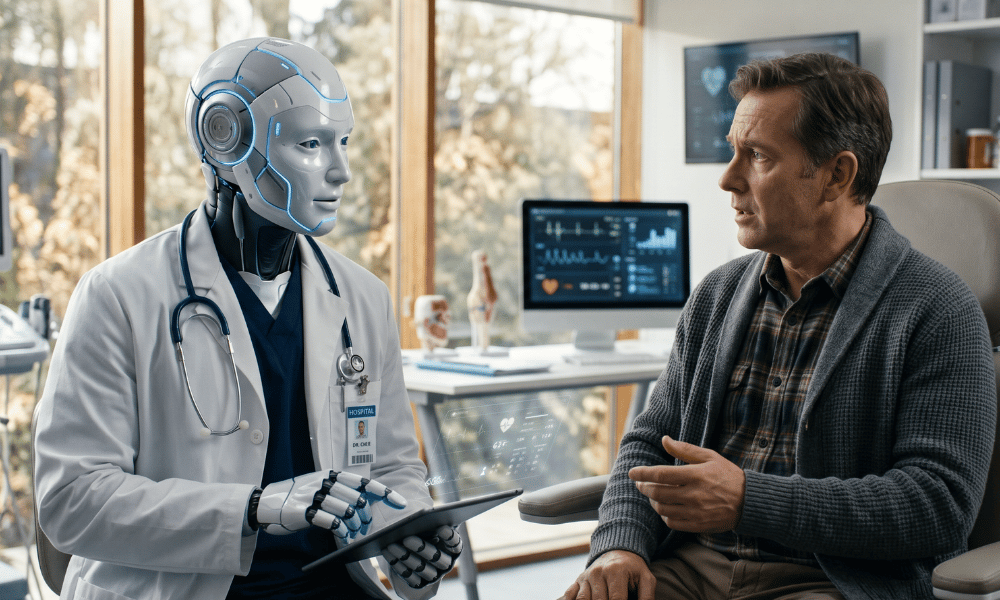
Microsoft says its AI can work through a difficult medical case the way a doctor does, asking questions, ordering tests and revising its hunches as results come in, and land on the right diagnosis more than twice as often as a generalist physician.
In a peer-reviewed paper published this week in Science, researchers at Microsoft AI reported that their Microsoft AI Diagnostic Orchestrator, or MAI-DxO, correctly diagnosed 83 per cent of complex case records drawn from the New England Journal of Medicine. Primary care doctors and general internists, working alone with reference materials, got 36 per cent right.
The system has an AI model play a panel of clinicians who question the patient, order tests and argue over the likely cause. To test it, the team turned 304 NEJM cases into step-by-step challenges in which findings are only revealed when someone asks for them, and the cost of every test counts against the final score, according to Microsoft Research.
The results come with caveats. Specialists and physician teams, who would normally handle cases this complex, weren't tested. The cases were simulations rather than live patients.
On its own, OpenAI's GPT-5 scored 78.9 per cent on the complex cases at an estimated cost of about US$8,400 a case. Adding Microsoft's orchestrator cut roughly US$3,000 from that bill but lifted accuracy by only about four points. On emergency department cases, the newer GPT-5.5 scored about 85 per cent with or without it.
The gap between machine and doctor has also narrowed since Microsoft first released the research. In a June 2025 preprint, physicians who were barred from search engines and AI tools averaged 20 per cent, against the system's 80 per cent.
Read next: Barclays cuts 5,000 jobs as it leans on AI to lower costs
Why this is an HR story
Microsoft frames the technology as an answer to a staffing problem. "The biggest challenge in healthcare delivery at the moment is the growing mismatch between demand and supply of medical expertise," Dominic King, Microsoft AI's vice president of health, told TechCrunch.
Australian health employers know that mismatch well. The Australian College of Nursing has warned of a projected shortfall of 70,000 nurses by 2035, and this week the Queensland nurses' union raised concerns about overtime and on-call shifts at Townsville Hospital.
Microsoft already sells dictation and radiology tools to clinicians, and chief executive of Microsoft AI Mustafa Suleyman told TechCrunch the company is working with Mayo Clinic on a healthcare foundation model due for release next year. He expects healthcare models to get "an order of magnitude better in capability within the next 24 to 36 months".
"We have to have the absolute number one state-of-the-art medical clinical decision support products over the next few years," he said.
The training pipeline problem
The most immediate risk for HR may sit with junior clinicians. Registrars learn by working up patients, ordering tests and being corrected by a consultant. Hand that work to software and some of the learning goes with it.
Sarah Stone, co-founder and director of linkABLE and ThriveABLE AI, made the same point about knowledge work in a recent HRD piece on AI and workforce capability. "It might have looked like junior work, but it was also capability-building work," she said. "Remove the task and you may inadvertently remove the learning experience with it."
Stone's advice was to assess the learning value of a task before automating it, then replace what's lost through coaching, simulations, case work and rotations.
Read next: Fair Work Commission AI disclosure rules now in force for employers
Who’s fault is it if something going wrong?
In Australia, responsibility stays with the clinician. Under Ahpra's guidance on AI in healthcare, practitioners remain accountable for safe care whatever technology they use, need to understand an AI tool well enough to use it safely, and should check their indemnity cover extends to it.
Employers aren't bound by that guidance, but law firm MinterEllison has advised health service providers to keep it in mind when building AI governance, so that what the organisation asks of staff lines up with their professional obligations.
A tool that suggests a diagnosis raises the stakes well beyond an AI scribe. Employers will need to settle who signs off on AI-assisted decisions, what training staff receive and which uses are approved before any such tool is switched on.
Read next: AI data breach exposes gaps in Australia's government cyber defences
What it means for other jobs
Doctors aren't the only professionals whose expertise is being tested against software. A system that gathers information, tests hunches and makes a call could in principle be pointed at plenty of other work built the same way, from insurance claims assessment to IT support.
The best Australian evidence so far points to jobs changing rather than vanishing. Jobs and Skills Australia's Generative AI Capacity Study found the technology is more likely to augment work than replace it, especially in high-skilled occupations. The exposure sits further down the ladder. Data entry, record-keeping, accounting and communications roles were among the most vulnerable, and administrative roles, entry-level workers and female-dominated occupations were more exposed to automation.
"This has the potential to displace people in some jobs, particularly administrative and clerical roles," Jobs and Skills Australia commissioner Barney Glover said when the study was released in August 2025.
Health sits on both sides of that line – winning and losing. The study listed midwifery and nursing professionals among the occupations that could gain the most employment by 2050, while much of a hospital's back-office work is the kind of clerical task it flagged as most exposed.
For now, employers say they favour redesign over redundancy. In EY-Parthenon's survey of 60 Australian chief executives, 44 per cent ranked large-scale reskilling as a first or second workforce priority over the next three years, and 41 per cent prioritised redesigning roles to combine human and AI capabilities.
In Microsoft's study, the software took over one part of a doctor's job: the diagnostic work-up. HR teams can run the same task-by-task audit on any role. Which parts can software already do, who checks its output, and how will junior staff learn the parts it takes away?
What health employers can do now
HR teams don't need to wait for a vendor pitch to start preparing. Sensible first steps:
- Audit which AI tools clinical and administrative staff already use, and whether they're on work or personal accounts.
- Identify the tasks that build junior clinicians' judgement before any are automated.
- Write accountability for AI-assisted decisions into position descriptions, policies and credentialing.
- Bring clinicians, unions and consumer representatives into pilots from the outset.
- Weigh independent trial results above vendor benchmarks.
The real-world test
Those trial results are on the way. Through a partnership with Beth Israel Deaconess Medical Center in Boston, patients will get standard care, while those who consent will also interact with Microsoft's system. Researchers will then compare its recommendations with those of the treating doctors.
"This technology is ready for real world evaluations, and you can imagine the complexity and diversity of issues that come from a Boston emergency department on a Friday evening," King said. "We think this will be the biggest study of its kind."