Tax cuts, wage reforms and workforce investment headline a landmark budget built for uncertain times
The Albanese Government has handed down what Treasurer Jim Chalmers has called the most ambitious Federal Budget in decades – and for HR leaders and business executives navigating rising costs, workforce pressure and a volatile global economy, the detail warrants close attention.
Delivered against the backdrop of a Middle East conflict that has pushed oil prices above $100 a barrel and sent inflation forecasts climbing to around 5%, the 2026–27 budget combines sweeping tax reform with productivity measures, wage changes and significant investments in skills and workforce participation.
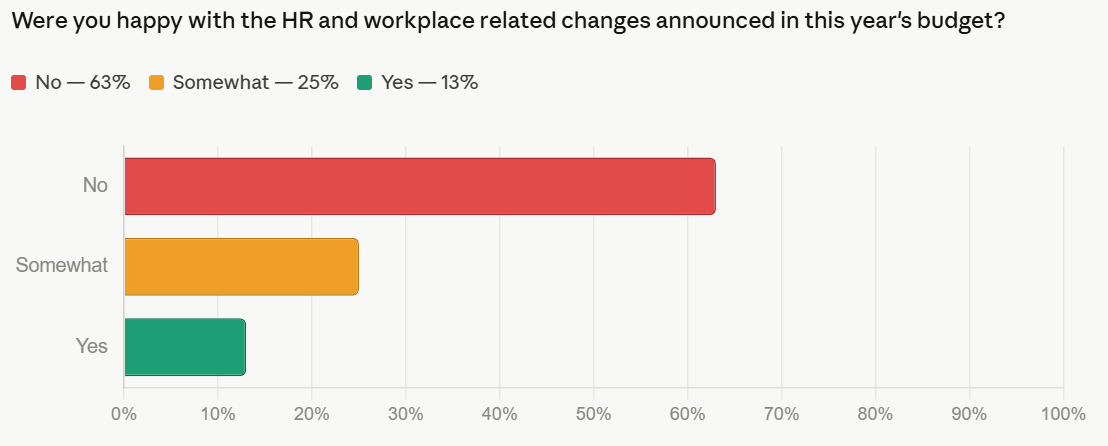
Now, industry figures are weighing in on the changes. Opinions are divided as some walk away happy and others are left wanting more. A recent poll posted to HRD Australia's LinkedIn captured this sentiment:
Here are the biggest changes affecting HR and what leaders are saying about them.
Tax relief that will reshape take-home pay
The centrepiece for employees is a package of five cumulative tax cuts that will leave the average Australian worker on $81,245 up to $2,816 better off annually from 2027–28, compared to 2023–24 settings.
From 1 July 2026, the 16% tax rate on income between $18,201 and $45,000 drops to 15%, falling again to 14% from 1 July 2027. A new Working Australians Tax Offset (WATO) of up to $250 per year kicks in from 2027–28, benefiting more than 13 million workers. Alongside these cuts, a $1,000 instant tax deduction – requiring no receipts – will deliver an average saving of $205 to 6.2 million workers from 2026–27.
For HR and payroll teams, these changes will require updated systems and employee communications as new tax settings take effect. The permanent nature of the WATO and instant deduction also provides more stable long-term planning parameters than temporary measures.
Wages, junior pay rates and gender equity
The budget takes direct aim at several long-standing workforce equity issues. The Fair Work Commission's decision to phase out junior pay rates for retail, fast food and pharmacy workers aged 18 to 20 is now backed by federal policy direction – an important signal for employers in those sectors to begin planning workforce cost adjustments.
On gender pay equity, the Government confirmed support for a historic review that has found gender undervaluation in five priority modern awards across female-dominated sectors, including child care, health and social services. HR leaders in those industries should expect further award changes as this review progresses.
The Government has also amended the Fair Work Act 2009 to allow the Fair Work Commission to issue orders adjusting pay rates for road transport workers in response to fuel price movements – a mechanism that could, in time, set a precedent for other cost-linked wage adjustments.
Skills, migration and workforce planning
The budget commits $85.2 million to accelerate skills assessments for migrant trades workers and occupational licensing, directly addressing critical workforce shortages in construction, health and infrastructure. The reform to the permanent migration points test – selecting better educated, higher-skilled and younger migrants – signals a longer-term shift in Australia's talent pipeline strategy.
A National Credit Recognition Framework will allow university students with relevant TAFE qualifications to complete degrees faster, which has flow-on implications for graduate recruitment timelines and workforce planning in professional services and health.
CEDA CEO Melinda Cilento welcomed the skills reforms but noted work remains: "We also strongly welcome faster recognition of overseas qualifications. This has been a considerable pain point for businesses and has meant jobs have remained vacant longer than they needed to," she said.
HR leaders working on talent acquisition and skills gap strategies will find the migration and licensing reforms particularly relevant to medium-term workforce planning.
What business leaders are watching
The Australian Council of Trade Unions (ACTU) welcomed the budget as a step toward fairness for workers and young people. ACTU President Michele O'Neil said the changes begin to rebalance a system that has "been taxing work harder than taxing wealth," noting that the average worker currently pays 25% in tax – more than some asset-rich Australians who use trusts and other mechanisms to reduce their taxable income.
Unions backed the $2 billion in enabling infrastructure to support 65,000 new homes and the permanent Working Australians Tax Offset as measures that "put workers first." O'Neil also welcomed the $14.8 billion fuel resilience package and the new east coast domestic gas reservation as job-saving measures, while arguing that revenue raised from trust and capital gains reforms being redirected to workers through the tax offset made the overall package a "major step forward for fairness."
Meanwhile, Nick Martin, APAC GTM lead at Remote, welcomed the government's red tape reductions and $85.2 million skills assessment investment but said employers also need to act on the levers within their own control. Citing Remote research finding that 75% of Australian businesses believe current regulations increase compliance burden without improving outcomes, Martin said skills shortages, payroll complexity and administrative load remain the key drags on productivity – directly affecting how quickly businesses can hire, expand and free up HR teams for strategic work.
On the other hand, The Australian Industry Group offered a more cautious verdict. CEO Innes Willox said the budget "failed to grasp the nettle on the structural reform we need," warning the global oil shock had fundamentally shifted economic conditions and that the government could have done more to boost productivity and business confidence.
Willox criticised the removal of apprenticeship incentives for larger employers – a move he warned would deepen existing skills shortages. On the positive side, Ai Group welcomed regulatory reforms reducing compliance burdens, the trusted trader scheme expansion, TAFE-to-university pathway recognition, and the retention of skilled migration above 70% of the overall program.
Ciaran Hale, CTO at Deputy, was also critical, and said the budget falls short of a full national strategy for Australia's shift workers. While welcoming tax cuts, fuel relief and aged care investment, Hale argued the budget fails to address three critical gaps for shift-based businesses – childcare availability outside standard hours, workforce sustainability amid burnout, and industrial relations complexity that leaves SMBs navigating award compliance without targeted relief. "Australia's economy doesn't stop at 5pm," he said. "Its budget thinking should not either."
The Committee for Economic Development of Australia (CEDA) broadly welcomed the budget's reform agenda while cautioning that implementation will be the test. "This was a genuinely difficult budget to calibrate, and it contains many moving parts," Cilento said. "While higher commodity prices have boosted national income, the cost of living is biting, inflation remains too high and the global outlook remains highly uncertain."
The Actuaries Institute raised a pointed concern about mental health investment, noting that Australia's financial safety net remains fragmented across 22 separate supports and $18.5 billion in annual funding. CEO Elayne Grace said the budget missed an opportunity to address systemic gaps – a finding that may prompt HR leaders to revisit their own employee assistance and wellbeing frameworks in the absence of stronger government support.
CreditorWatch's analysis added a note of caution for people managers: business confidence remains very weak, forward orders are falling and profitability indicators are soft. "Activity measures have arguably held up better than expected so far, but forward orders and profitability, both components with leading properties, are weak," the organisation noted.
Laurence McLean, director of operations at Peninsula Australia, welcomed the budget's small business measures – including the permanent instant asset write-off and red tape reduction initiatives – as a positive signal for business confidence, but cautioned that financial incentives alone won't address the day-to-day pressures owners face.
McLean argued the real challenge for many SMEs is no longer cash flow but time, capacity and managing complex workplace obligations, warning that tax incentives don't reduce the Fair Work Act compliance burden carried by business owners daily. As confidence improves, he said businesses should focus on building strong HR foundations, as "scaling without the right HR systems in place can quickly expose employers to operational and compliance risks."
For HR leaders, the broader signal is clear: the operating environment remains difficult, reform is moving but slowly, and workforce strategy will need to absorb multiple changes simultaneously – from tax settings and award variations to migration policy and AI investment – over the next two to three years.
Those looking to stay across evolving employment law and workforce policy will need to monitor the implementation of these measures carefully as the Government moves from announcement to legislation.