ForHealth's Jason Bowers says AI has turned complaints into legal-style filings, forcing HR to raise its standard of review
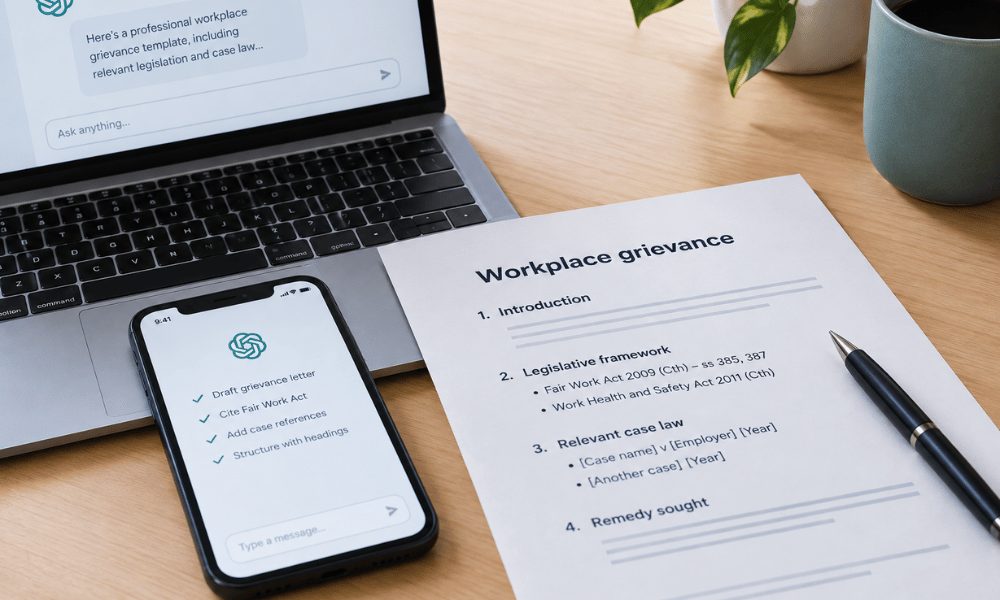
Australian employers are being pushed to treat everyday workplace complaints with the same rigour as formal legal claims, as generative AI tools give employees the ability to draft grievances that read like submissions prepared by lawyers.
Jason Bowers, head of people partnering at ForHealth, an Australian healthcare provider that operates a nationwide network of medical centres, said the shift has been driven by accessibility rather than any underlying rise in the number of disputes.
The trend comes as the Fair Work Commission (FWC) prepares to enforce a new Guidance Note on the use of generative AI in Commission cases from 20 October 2026, following a reported 70 per cent increase in the Commission's total workload over three years, with unfair dismissal claims growing 41 per cent between 2022–23 and 2024–25.
AI puts a legal research assistant in every pocket
Bowers said ForHealth has not seen more complaints land on his desk, but the way they are written has changed markedly. "We haven't seen an increase in the number of complaints or grievances, but we have seen a real shift in the sophistication of how they're written," he said.
"It's increasingly common now to see submissions referencing specific sections of the Fair Work Act, work health and safety legislation, or even prior case decisions – the kind of detail that, previously, we would only expect to see once a union or legal representative became involved."
He described the change as one of access rather than intent. "What's changed is accessibility: AI has essentially put a legal research assistant in every employee's pocket, at no cost and with no real barrier to entry," Bowers said.
"For us, that means a grievance that might once have been a few informal lines is now often a structured document with headings, numbered points and legislative citations attached. That's not necessarily a bad thing – some employees are simply better able to articulate a legitimate concern than they once were – but it does mean every complaint now needs to be read and responded to with the same rigour we'd apply to a formal legal claim, regardless of how it originally landed on our desk."
The pattern echoes what other HR and legal specialists have reported across the sector, including how AI has turned workplace grievances into an employer crisis for employers navigating the same dynamic in grievance and unfair dismissal matters.
ForHealth responds by raising the bar on review
Bowers said the response internally has been to assume every complaint could end up before the Commission. "It's meant a genuine uplift in how we operate as a team," he said.
"Where a straightforward complaint might once have had a fairly quick, informal response, we now approach almost everything as though it could end up in front of the Fair Work Commission or a similar body. In practice, that means every legislative reference gets checked against the actual source, every work health and safety claim gets verified against our own policies and incident records, and responses go through more layers of review before they're sent. It has added time and workload, but it's the right approach given what's at stake for both the employee and the organisation."
Notably, ForHealth has begun using the same technology to manage the load. "We've turned the same technology back on the problem: we now use AI ourselves to help draft initial responses and to quickly cross-reference the legislation or clauses an employee has cited, so we can confirm or challenge it with confidence rather than relying on memory," Bowers said. "Used well, it has made us faster and more thorough, not just more cautious."
His advice to other HR leaders facing rising complaint volumes was to focus on process rather than panic. "My first piece of advice is not to panic or treat this as a crisis. It's a shift in how people communicate, not necessarily in the underlying number or severity of issues," he said.
"Where I'd focus energy is on process: make sure you have a methodical, well-documented framework for triaging and responding to complaints, so that everyone, however it's written, is assessed consistently against the same standard. Don't be intimidated by the legal language either; check it rather than accepting it at face value, because AI-generated references aren't always accurate."
New Fair Work Commission disclosure rules loom
Bowers welcomed the tribunal's move toward mandatory disclosure. The Fair Work Commission's finalised Guidance Note requires anyone using tools such as ChatGPT, Claude, Copilot or Gemini to prepare an application, submission or witness statement to disclose that use and verify the accuracy of the resulting document, with the rules taking effect on 20 October 2026 and applying to unfair dismissal and general protections matters, a step Bowers said should extend well beyond formal tribunal proceedings, referencing the Fair Work Commission's new rules for AI use in cases as a template other regulators could follow.
"I'd like to see the same kind of transparency requirements now emerging in areas like social media and the music industry applied here too, and it's encouraging that regulators are already moving in that direction," Bowers said.
"That's exactly the kind of standard I'd like to see become common practice more broadly, not just within formal tribunal proceedings. The underlying issue is reliability, not the technology itself. AI can be an excellent aid, but it can also produce convincing legislative references or case citations that turn out to be wrong or entirely invented, and we've already seen instances where AI-generated content, including the prompts themselves, has been left in submitted documents by mistake. That's a reminder that people are increasingly leaning on these tools without fully checking the output, and it's exactly the kind of risk sensible disclosure requirements are designed to catch."
The dynamic mirrors broader coverage of AI flooding Australia's employment system and forcing a rethink of how law is practised, as employers and regulators alike adjust to a workforce increasingly armed with AI-generated legal reasoning.