The number of women aged 65 and over in work has almost doubled in a decade, while participation among men aged 60 to 64 has fallen to its lowest level since early 2022
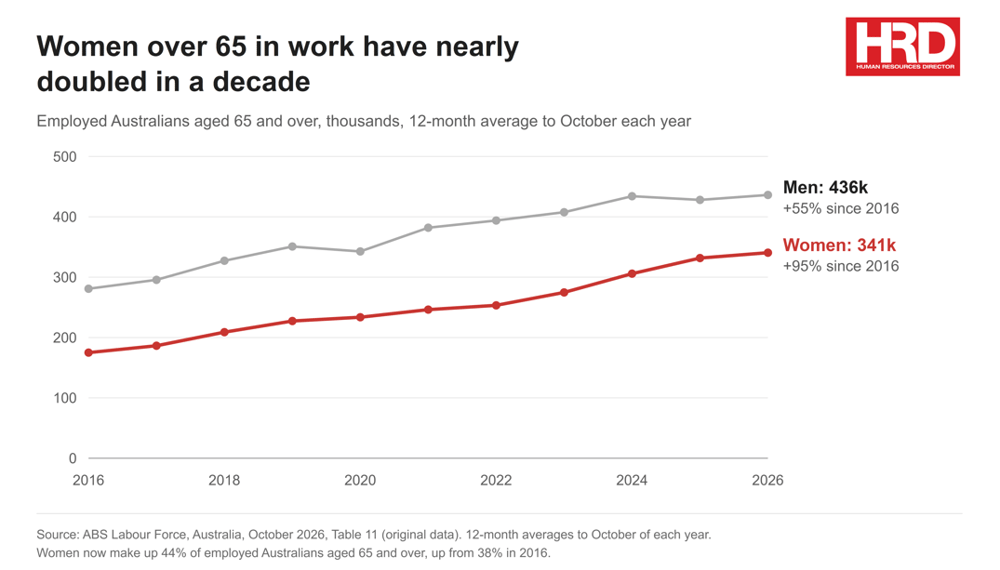
More than 340,000 Australian women aged 65 and over are now in paid work, almost double the number a decade ago – even as a growing number of men in their early 60s leave the workforce.
Across both sexes, an average of 776,900 people aged 65 and over were employed in the year to October, a record, according to Australian Bureau of Statistics (ABS) labour force figures. A decade earlier the figure was 455,700.
Employment among women aged 65 and over rose 95% over the decade, from 175,000 to 340,600, compared with 55% for men, from 280,800 to 436,300. Women now make up 44% of working over-65s, up from 38%.
Population growth accounts for part of the rise, but older women are also more likely to work than they were. The participation rate for women aged 65 and over – the share working or looking for work – rose from 9.1% to 13.1% over 10 years. For men it rose from 16.7% to 19.4%.
The ABS age figures are not seasonally adjusted, so this analysis uses 12-month averages to smooth out monthly swings in small survey groups.
Read next: Over-65s took a third of the year's new jobs as youth unemployment hits 11.1%
Men in their early 60s step back
Among men aged 60 to 64, the trend runs the other way. Their participation rate peaked at 68.1% in the 12 months to January 2025 and has since fallen to 65.7%, the lowest since early 2022. On average, about 11,000 fewer men in that age group were in work than a year earlier. Participation among women aged 60 to 64 has held steady at about 55%.
The fall is all the more striking set against the age group below. Participation among people aged 55 to 59 has reached 78.1%, the highest annual average since records began in 1978, with men in that group up more than a percentage point over the year.
The labour force survey does not explain why men are leaving in their early 60s, but superannuation may play a part. Since 1 July 2024 the preservation age – the earliest age most people can draw on their super once retired – has been 60 for anyone born on or after 1 July 1964, the Australian Taxation Office (ATO) has confirmed. Under ATO rules, people who stop paid work at 60 or over are treated as retired and can generally access their super.
The ABS's separate Retirement and Retirement Intentions survey, last conducted in 2024-25, offers some clues. A third of all retirees (33%) said they left their last job because they had reached retirement age or become eligible for super. Another 13% cited sickness, injury or disability, and 6% had been retrenched, dismissed or could not find work. Men who retired in 2024-25 did so at an average age of 64.9, while people aged 45 and over who are still working plan to retire at 65.6.
That matters for workforce planning: many people expect to work into their mid-60s, but ill health and job loss push some out years earlier than planned.
Mid-career women are also worth watching. As we reported last month, participation among women in their 40s has slipped from a record high, while men's has held steady.
Read next: Age bias hits young and old workers differently
What HR teams can do
Map the retirement pipeline. Count staff aged 58 and over by role and gender, and find out how many expect to leave within three years. The figures for men suggest some will go earlier than workforce plans assume.
Give people a reason to stay. Phased retirement, part-time or project-based roles and flexible hours are the usual tools. The rise in older women's participation suggests many people will keep working if the terms suit them.
Check for age bias. In a survey covered by HRD last year, about a quarter of employers said they already regarded people aged 51 to 55 as older workers. The age discrimination commissioner, Robert Fitzgerald, urged employers at the time to support workplaces "where competency isn't assessed against age or career stage".
Test redundancy criteria. Retrenchment, dismissal or lack of work accounts for about 6% of retirements, so a restructure can quietly become an early retirement scheme for older staff. HRD has reported that subjective or informal selection criteria can expose employers to discrimination claims.
Plan handovers early. If experienced men in technical, trade or senior roles are leaving at 61 rather than 66, succession planning needs to start sooner.
Employers counting on older staff to work for longer should test that assumption against their own workforce – particularly men approaching 60.
Read next: Age discrimination commissioner vows crackdown on ageism at work