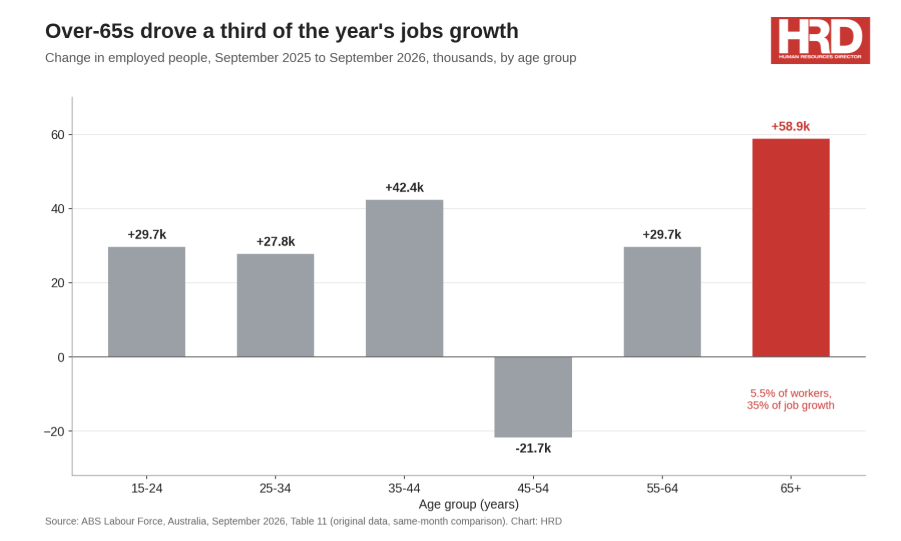
Australians aged 65 and over make up about one in 18 workers, but they accounted for more than a third of jobs growth in the past year.
The fastest-growing part of Australia's workforce isn't graduates or career-changers. It's people aged 65 and over.
The number of employed over-65s rose by 58,900 in the year to September, to a record 813,900, according to Australian Bureau of Statistics data released on Thursday. That is about 35 per cent of the 166,900 net jobs added across the economy over the same period, from a group that makes up just 5.5 per cent of employed Australians.
Part of that is simple demography: there are more Australians in their late 60s and 70s every year. But it isn't only that. The participation rate for over-65s rose - 0.8 percentage points over the year to 16.6 per cent, close to its record of 16.7 per cent in November 2024. A larger share of older Australians is choosing, or needing, to stay in work.
Read next: AI is redefining entry-level roles, and young workers have the edge
Meanwhile, at the bottom rung
The picture for younger workers is less rosy. The youth unemployment rate rose 0.3 percentage points to 11.1 per cent in September, its highest since October 2021. About 285,000 Australians aged 15 to 24 are now unemployed. For teenagers aged 15 to 19, the rate is 15.9 per cent.
This is also reaching into the early-career years. Comparing September with September, unemployment among 20 to 24-year-olds jumped from 7.0 to 7.8 per cent, and among 25 to 29-year-olds from 4.0 to 4.7 per cent.
It is worth being clear about what the data doesn't show. Employment among 15 to 24-year-olds still grew by about 29,700 over the year. Young people aren't losing jobs to older workers; more of them are looking, and openings aren't keeping pace. The idea that older workers "take" young people's jobs is one most labour economists reject, because the number of jobs in an economy isn't fixed.
The bigger pressure on entry-level hiring may be how firms are using technology. As HRD has reported, a Harvard working paper found junior employment fell about 9 per cent at US firms that adopted generative AI, mostly because they hired fewer people at the bottom rather than letting existing juniors go.
Read next: Is AI replacing entry level Gen Z workers?
Ageism, in both directions
For employers, the two trends raise the same question: is your recruitment process unwittingly filtering people out by age?
Research by Diversity Council Australia and the Australian Human Rights Commission, covered by HRD, found 39 per cent of workers aged 18 to 29 had experienced discrimination or harassment in the past 12 months, compared with 19 per cent of those aged 55 and over. Older workers reported a different problem: being shut out of training and promotion.
AHRI chief executive Sarah McCann-Bartlett said in the same report's coverage that "one in five HR professionals say their recruitment practices negatively impact older workers, and 23% say the same about younger workers."
The cost of getting it wrong is substantial. KPMG Australia estimates the economy could gain nearly $29 billion a year by keeping more older workers employed. The same research, citing Jobs and Skills Australia data, found jobseekers aged 55 to 64 take around 20 months on average to find a new job, more than twice as long as prime-age workers.
Read next: Age discrimination commissioner vows crackdown on ageism at work
What HR can do with this
Workforce plans built for a tight market may need a rethink. A few starting points: check whether graduate and junior intakes have shrunk quietly as teams adopt AI tools; look at how many over-65s you employ, and whether flexible or phased retirement options would keep more of them; and pair the two groups deliberately, so experience is passed down before it walks out the door.
One caveat on the numbers. The age breakdowns come from the ABS's original, not seasonally adjusted, data, so HRD has compared September 2026 only with September 2025.
Read next: Unemployment rises to 4.6% as full-time jobs slip in August