Rohit Mathur of Ramco Systems explains how AI is transforming payroll accuracy, compliance, and employee experience for global HR leaders

Artificial intelligence (AI) is fundamentally reshaping how organisations manage payroll compliance – and one of the industry's leading voices says the transformation is accelerating faster than most HR teams realise.
Rohit Mathur, SVP and SBU head of HR and Payroll at Ramco Systems, a global HR and payroll technology provider, said AI is already changing payroll at three critical stages: tracking regulatory change, configuring payroll systems correctly, and validating outputs before employees are paid.
"Payroll is a heavily compliance-regulated industry, which means we are playing with people's salary and there's no way that we can go wrong out there," Mathur said. "AI is a crawler which is going all around the internet, looking at the tax authority websites, looking at forums, looking at payroll associations, on the discussions that are happening on upcoming changes. So it proactively picks up those conversations and interprets what it means for a product function."
The stakes have never been higher. The global payroll software market is projected to reach $7.86 billion in 2026, with 73% of payroll professionals expecting AI to significantly impact their operations within the next year – yet adoption remains uneven.
According to the Rise Global Payroll Compliance Report 2026, 42% of organisations still have no formalised global payroll strategy in place, and a further 30% are still in the process of developing one.
This mirrors the results of a June 2026 survey survey conducted on HRD's LinkedIn, which revealed just how wide that gap really is:
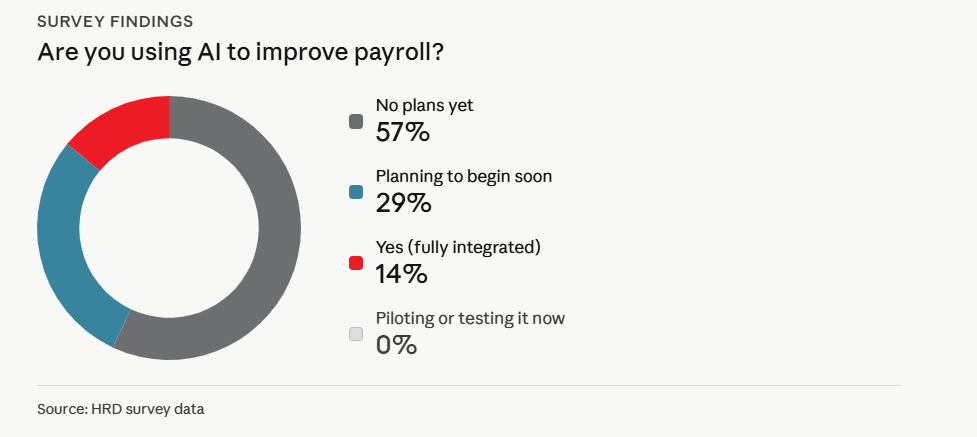
More than half (57%) of the respondents said they had no plans for using AI to improve payroll processes. A further 29% said they were planning to begin soon, while just 14% reported full integration. Not a single respondent said they were currently piloting or testing the technology.
AI as a compliance safety net
For Mathur, the compliance function is where AI delivers the most immediate value, and in today's regulatory environment, that value is hard to overstate. Across the globe, regulators are increasingly assuming that employers have access to automated calculations, compliance engines, anomaly detection, and audit-ready reporting – meaning a manual error that once resulted in a correction notice may now trigger a deeper regulatory review.
AI-enabled systems don't simply flag errors after the fact; they anticipate them. If a taxation rate or minimum wage threshold changes in any jurisdiction, an AI-enabled payroll platform can alert the team to update configurations before a pay run is processed.
Mathur also highlighted the configuration stage as an underappreciated source of risk. Getting a payroll engine set up correctly for a specific industry and region is complex, and gaps are easy to miss.
"Let's say if there is a specific hazardous leave that needs to be incorporated for a chemical-based industry, the AI would alert to say, hey, this is a pay element that you need to configure because it's required for this region and for this industry," he said.
The third layer is validation – using AI to detect anomalies in payroll outputs by reading patterns from previous pay runs. A Gartner report found that 58% of finance and HR teams are already using or testing AI technologies, with 21% planning full integration by 2026. Mathur describes AI's role here as finding a needle in a haystack: "Humanly it becomes a very, very big task for somebody to look up various Excel sheets and ensure that there is no anomaly or there is no compliance-related issue."
Keeping humans in the loop
Despite the enthusiasm for AI-assisted payroll, Mathur is measured about what the technology should and should not do autonomously. The final sign-off on any payment run, he argues, must remain with a human who understands the consequences of getting it wrong.
"It's not that you're leaving the entire payroll to be processed by an AI. What you're using AI as is an assistant. The final validation, the final go ahead for the payments to be released or the advice to the bank still remains with people out there."
This matters especially to employees. Pay is the most fundamental element of the employment contract, and any perception that AI is making autonomous decisions about take-home income risks eroding trust. Mathur's framing is deliberate: "Make AI do the job for you, but not let it do the work for you."
While AI agents are expected to automate between 40 and 60% of routine payroll tasks such as data entry, human expertise remains essential for high-level governance, complex dispute resolution, and interpreting nuanced international labour laws. For HR leaders tracking developments in AI and employee trust in the workplace, that distinction is becoming a critical one.
Data privacy in a sensitive function
Payroll data is among the most sensitive information an organisation holds, and the question of where AI models sit, and what they can access, is not theoretical. Mathur said Ramco's approach is to ensure large language models (LLMs) operate within a client's own environment, rather than pushing data to public cloud infrastructure.
"The data or the LLM model should sit within your environment and not be completely going out. And at the same time they should be able to read only the metadata and not the exact data which is underlying the systems out there."
In practice, this means AI analyses patterns and aggregates rather than reading individual pay slips – a distinction Mathur describes as non-negotiable. "We would rather be much safer and conservative in using AI rather than overdoing it."
From administration to strategy
The longer-term promise Mathur sees is less about efficiency and more about elevating the payroll function itself. The global payroll solutions market, valued at US$32.6 billion in 2025, is projected to reach US$51.4 billion by 2030 – a growth trajectory that signals payroll is no longer a back-office cost centre but a strategic driver of workforce planning.
Rather than spending time validating inputs across spreadsheets, payroll professionals could be analysing whether overtime costs in a given region signal a need to hire, or whether gender pay gaps are emerging across business units. "You're contributing more towards the growth of the organisation rather than just doing mundane, repetitive work," Mathur said.
A global study found that 37% of organisations now view real-time workforce planning as the most strategic use of payroll data – a shift that reframes payroll not as an operational obligation, but as a source of competitive intelligence.
There is also a meaningful gain in employee experience. Mathur described an AI-powered assistant that allows employees to interrogate their own pay slip in natural language, asking why this month's take-home differs from last month's, and receive a clear, personalised explanation. "It's an interactive assistant that can really help them decipher how they have been paid. So it's a whole lot of transparency that you bring in with the employees using AI."
For HR leaders navigating the intersection of payroll compliance and workforce strategy, that combination of accuracy, privacy, and transparency may be the most compelling case for AI-powered payroll yet.