New report reveals rising skills insecurities among Singaporeans in the AI era
Nearly half of employees in Singapore are wary of being displaced by artificial intelligence as the country emerged as one of the least confident markets when it comes to the topic of AI adoption, according to a new report.
Findings from the latest Robert Walters report revealed the top concerns of employees in Asia amid the rapid integration of AI tools in organisational workflows.
In Singapore, 48% of its employees there have expressed concerns that AI adoption will include the risk of job displacement due to automation. Other employees also said they are worried about:
- Potential bias or unfair treatment from AI-driven decisions (42%)
- Anxiety that their skills become obsolete (41%)
Lack of optimism on AI
The job displacement concerns come as Singapore's workforce emerged as the one of the least optimistic groups when it comes to the impact of AI to their careers.
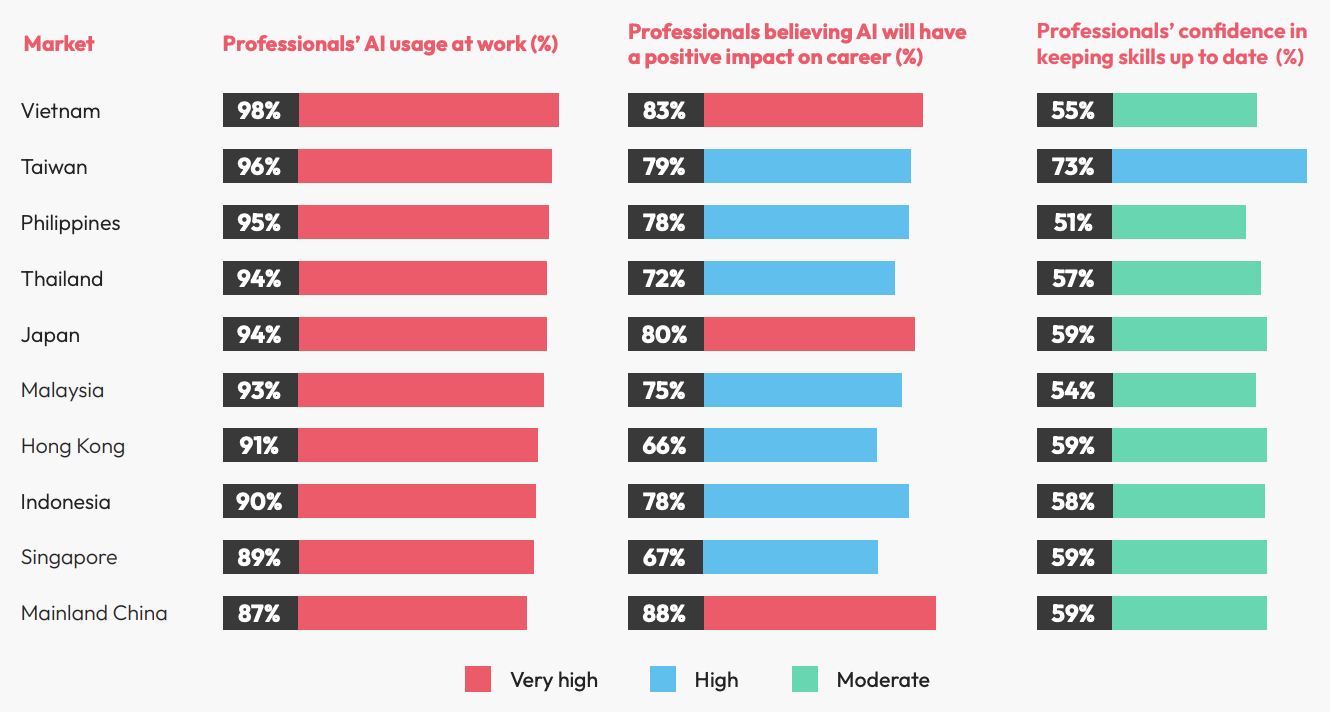
According to the Robert Walters report, 89% of Singapore's professionals are already using AI at work, but just 59% of employees are confident that they can keep their skills up to date as AI reshapes the kind of work that they do in their current role.
Only 67% of workers in Singapore also believe that AI will have a positive impact on their career.
This is below the regional average of 75%, according to the findings, and makes Singapore the second-least confident market in the survey after Hong Kong.
"The findings show that there is a need for companies to invest in reskilling as a core strategy, in view of the anxiety about falling behind or being unable to keep up as jobs evolve," said Kirsty Poltock, country manager of Robert Walters Singapore, in a statement.
The Singapore government has been taking steps to ensure that employees remain on top of technological changes at work, including the expansion of the TechSkills Accelerator to support non-tech workers in becoming AI-bilingual.
Top uses of AI
In Singapore, the top use for AI is Research and Information Gathering (49%). It is also being used for copywriting and content creation (41%), as well as data analysis and insights-generation (30%).
This is consistent with how employees in other parts of Asia are using AI, according to the findings. The top use case for the technology is for content creation (47%), data analysis (40%), and research (38%).
It also has the strongest impact in the Administration and Business Support functions in 43% of workplaces in Asia. Other functions where AI has an impact include:
- IT & Digital transformation (35%)
- Accounting and finance (32%)
- HR (17%)
- Sales and marketing (11%)
The reconfiguration of work in many workplaces has been attributed in the report as one of the factors why employees are "increasingly concerned" about skills relevance.
For employers, the report stressed the need to adopt AI "responsibly and transparently" to build trust in the workforce.
It also advised firms to invest in reskilling, redesign roles to combine automation with higher-value contribution, as well as to shift from short-term headcount planning to long-term capability training.
"The jobs of tomorrow are already taking shape at this intersection of technology and human capability," the report read.
"Organisations that succeed will be those that view AI not just as a productivity lever, but as a workforce transformation journey — investing in skills, reskilling pathways and responsible use to ensure people remain central to how work evolves and value is created."