Frontline workers don't want free food – they want training

Workplace perks may be less effective at keeping frontline employees than many employers assume, with new research suggesting that career development opportunities carry far greater weight.
A survey of 1,000 frontline workers aged 18 to 34 by learning platform Schoox found that 40% would stay in their current role for another year if offered more purposeful learning and development.
This is nearly double the 23% who said the same about perks, such as free food or sponsored social gatherings.
The findings challenge a common assumption that younger frontline workers are more motivated by immediate benefits than long-term growth. Instead, the data points to a workforce that is hungry for development but largely underserved by the training they currently receive.
Offered training at work falls short
Two in three respondents said their company does not provide the right training to help them perform better in their role. Nearly four in five cited lack of time or management not prioritising learning as the biggest barriers to completing programmes.
Workers were also clear about what effective training looks like. Three in four preferred hands-on learning and job shadowing, while 65% favoured shorter, microburst-style content over lengthy modules.
A further 42% called for more engaging and interactive training, and 34% wanted content tailored specifically to their role, according to the findings.
Sandra Moran, Chief Marketing Officer at Schoox, said the results expose a design flaw in how organisations approach frontline learning.
"Frontline workers value training, but when it isn't built based on their current skill level or specific capabilities they need to master, it fails to improve performance," Moran said.
"Workers are not asking for more courses. They are asking for practical, role-specific training that helps them perform better, advance faster, and build a future with their employer."
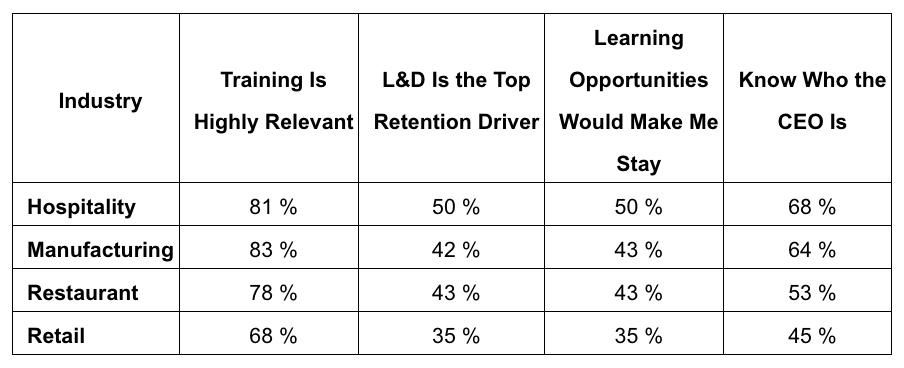
The retention gap is particularly pronounced in retail, where workers ranked last across every learning-related measure, including training relevance, the influence of learning on their decision to stay, and awareness of company leadership.
Hospitality workers were the most engaged, with half identifying learning and development as their top retention driver.
What can employers do?
Drew Brees, Hall of Fame quarterback and co-owner of Surge Entertainment and Schoox customer Smalls Sliders, said the findings reflected his own experience managing frontline teams.
"You can invest in branding and technology, but if your people are not confident, connected, and continuously developing, the business feels it immediately," Brees said.
"Frontline workers want a strong playbook for success and a clear path forward. When you invest in training that helps everyone, you build stronger teams and more consistent customer experiences."
Moran said organisations that continue treating training as a compliance exercise rather than a strategic investment risk falling behind competitors.
"Learning is no longer a one-and-done support function. It is critical infrastructure for upskilling to improve an organisation's operating results over time."