A convenience-store trial run on Amazon's cloud shows what the next generation of retail robots can do, and how much of their training still comes from people
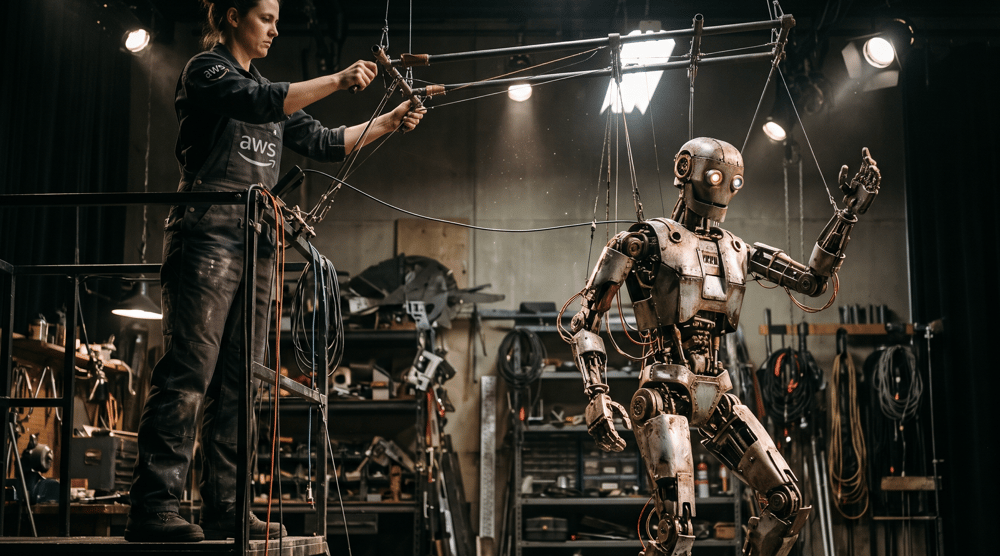
Amazon Web Services spent part of this year helping a Tokyo robot maker test whether a machine at a shop counter can learn to think one step ahead.
The robot maker is Telexistence, which says it has deployed more than 300 robots with major Japanese convenience-store chains. Its machines restock drinks, and its newer humanoids are being trained to scan and bag shopping at the till. Most of what they know came from people. Human operators steer the robots remotely through real tasks, and those sessions become the training data.
In a write-up AWS published in September, Telexistence and scientists from the AWS Generative AI Innovation Center described fitting one of NVIDIA's newest models onto that set-up. The model, DreamZero, is a world action model. Before it moves, it predicts what its cameras should see a moment later and plans its arm movements to fit. Telexistence's current robots respond to what is in front of them. DreamZero tries to anticipate.
Amazon supplied the computing and the expertise. The model was fine-tuned and tested on AWS servers running NVIDIA chips, through the Physical AI Fellowship that AWS runs with NVIDIA and MassRobotics. Telexistence says it was one of nine companies picked for the 2026 cohort and the first from Japan.
The results were uneven, and the engineers haven’t hidden that fact. In a simulator, the best version of the model completed a block-picking task 45% of the time. Trained on recordings from Telexistence's physical robot and then tested in the same simulator, it succeeded zero times. The team blamed mismatches between the real robot and its digital copy, along with noise in the recordings. On the fastest hardware tested, each step took about 583 milliseconds, which the team said was close to what real-time control requires. AWS notes the figures come from internal testing.
Genki Sano, Telexistence's co-founder and chief technology officer, said the work showed "where DreamZero helps, where the real-to-sim gap bites."
Read next: Amazon looking to replace over 600,000 US jobs with robots: report
Who teaches the robots
Telexistence has pitched remote operation as a staffing idea for years. When it launched its Model-T shelf-stacking robot, it said store staff could work from anywhere with an internet connection. The DreamZero trial shows the other half of that arrangement: how much the robots depend on what people feed them.
The team went through 183 recorded demonstrations of the block-picking task. Human reviewers threw out 91, almost half. In some, the robot sat idle for long stretches. In others, the operator picked up a block of the wrong colour, or someone's hand drifted into the camera's view. The engineers also built an AI reviewer to do the screening automatically. It flagged 72, or 39.3%, close enough to work as a first filter, they said, though it had trouble telling blue blocks from purple ones.
Read in the relevant HR document, that could be a pretty important part of the job description. Someone has to perform a task cleanly and consistently for a camera, and someone else has to check the footage. Neither role fits neatly into a retail organisation chart today. Both will need standards, training and a pay rate.
HRD has reported that when staff are filmed to train robots, employers should handle it as workplace monitoring, and agree in writing who owns the footage, whether people are paid for it and whether it can be used in performance reviews. Local privacy and surveillance rules apply on top of that.
Read next: How close are robots to replacing human workers?
Why the pressure is building
Japan is the test market because it is running out of workers. The Recruit Works Institute, a think tank run by Japanese employment company Recruit, projected in 2023 that the country would be about 3.41 million workers short in 2030 and more than 11 million short by 2040. Employers there have already tried other fixes, from keeping older staff on for longerto hiring from overseas.
Seven-Eleven Japan, which has more than 20,000 stores, agreed in September 2025 to develop a humanoid with Telexistence. The robot, called Astra, is due in stores in 2029. The companies said the aim is to "transform the very role of employees in convenience stores," handing routine work to robots so staff can focus on service only people can provide.
Singapore has chosen to set a pay floor while the job changes around it. About 142,000 people worked in retail in 2023, according to the Tripartite Cluster for Retail. Under the Progressive Wage Model, the baseline gross wage for full-time resident retail assistants and cashiers rose to S$2,305 a month in September 2025 and to S$2,435 in September 2026. The cluster also rewrote the cashier job description to include running self-checkout counters.
HR teams should hold employers to the promise of better jobs for the people who stay. Research covered by HRD found that working alongside robots can erode employees' sense of autonomy and meaning, so the redesigned human role needs as much planning as the robot.
Read next: 7 in 10 Japan employers boost hiring for new graduates: reports
How far off is it?
Further than the videos from the robot Olympics might suggest (although if you watch the outtakes, you can see the behind the scenes footage that doesn’t make good robot worker advertising.
In a June update on its autonomous bagging robot, Telexistence posted the footage at normal speed and at eight times speed, and said plainly that the robot is not yet fast enough for real use. Its movements are still jerky. Shift an item a few centimetres and accuracy can drop. Sano described the demo as a starting point.
Gartner expects fewer than 20 companies to put humanoid robots into production in supply chain or manufacturing through 2028. HRD has also covered why machines still struggle with common sense.
By the numbers
- More than 300 robots Telexistence says it has deployed with Japanese convenience-store chains
- 45% success for the best DreamZero model on a simulated block-picking task
- 91 of 183 recorded human demonstrations rejected as unusable
- 2029 is Seven-Eleven Japan's target for its Astra humanoid
- More than 11 million: Japan's projected worker shortfall by 2040
- [EDITOR: add one local figure from the regional option you keep]
So, is this the future? For some convenience-store counters in Japan, quite possibly, if Seven-Eleven keeps to its 2029 timeline. For most employers, the nearer change is the job this trial exposed: the person who shows a robot how to do the work.
Read next: Robots expected to become allies in closing labour gaps