New report shows skills mismatch is the biggest hiring pain point for employers
Skills mismatch has ranked first in the list of manpower challenges facing employers in Singapore, according to a new report from the American Chamber of Commerce in Singapore (AmChamSG).
The chamber's 2026 AmChamSG Manpower Survey found that skills mismatch has surpassed the difficulty of hiring locals as the leading issue facing employers in Singapore.
The mismatch in skills due to changing business needs has been cited by 46.2% of employers in the survey, up from 33.6% a year ago.
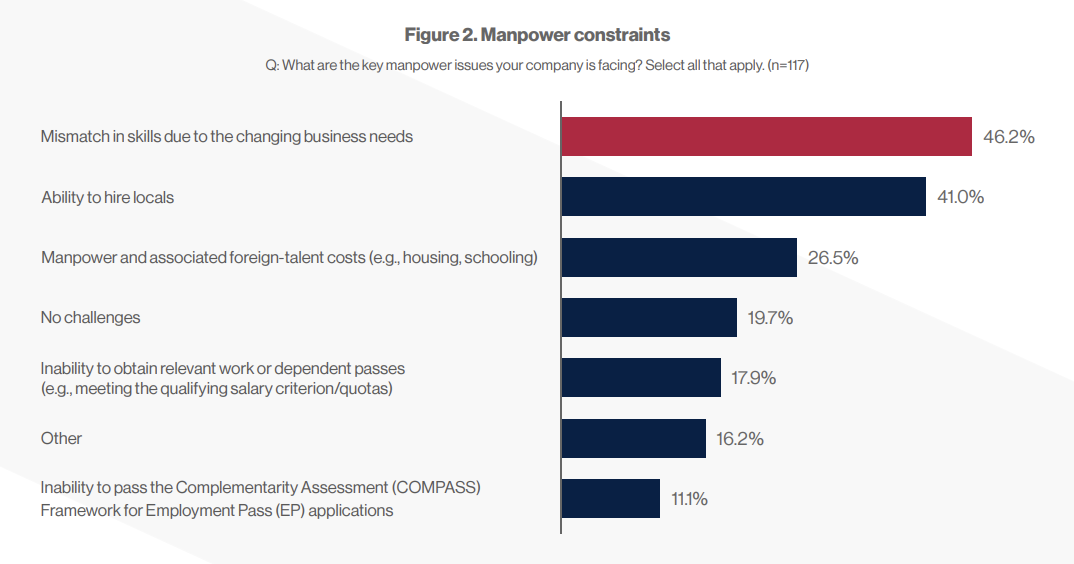
The share of employers finding it hard to hire locals, on the other hand, dipped to 41.0% in 2026 from 46.9% in 2025.
More than half of employers (56.6%) said the top challenge in recruiting entry-level Singaporeans is their "unrealistic salary expectations."
For experienced hires, the biggest obstacle in hiring them, according to employers, was their adaptability or resilience gap (42.2%).
In senior-level hiring, the top challenge cited by employers in hiring locals is their lack of necessary specialised skills (46.7%), as well as their lack of overseas and regional exposure (40.0%).
These hiring challenges come in the wake of stable recruitment plans among employers in Singapore.
According to the report, 60.8% of employers plan to maintain their headcount in 2026, while 25.8% are planning to expand theirs.
Only 13.4% of employers said they have plans to reduce their headcount, down from the 22.0% recorded last year, and close to the levels recorded in 2023.
AI changing needed workplace skills
Another factor influencing hiring challenges in Singapore is the adoption of artificial intelligence (AI) tools, the findings revealed.
Six in 10 employers (60.02%) said AI changed the skills required for existing roles, prompting 89.8% of them to upskill their employees to address the change.
"This indicates that developing existing staff is a key response among employers anticipating AI-driven changes in skills needs," the report read.
Upskilling is the top approach taken by employers in a bid to meet their organisations' AI-related skills needs. Others are taking different approaches, including:
- Hiring new employees with AI skills (28.3%)
- Using external consultants or vendors (19.2%)
- Redeploying employees from other functions (10.1%)
- Hiring talent outside Singapore (1.0%)
Only 15.2% of employers don't have a specific strategy to address the skills gap in their workforce when it comes to AI, according to the report.
What can employers do?
Training employees on AI is just the first step. The report noted that employers should give employees an opportunity to put their AI skills into practice.
"The findings support a continued focus on training that addresses specific skills gaps, earlier opportunities for regional experience, and clear policies for flexible work," the report read.
"Giving employees time to apply what they learn, with support from their managers, should be part of that effort."
On the overall skills mismatch, the report advised employers to target specific skills gaps in their workforce.
"Identify the missing skills and connect training to tasks where staff need them," the report read.