383 HR professionals across Australia and New Zealand rewarded integrated platforms and AI governance over feature lists
Integration and artificial intelligence (AI) governance now decide which HR service providers earn the trust of HR leaders, according to the 2026 HRD Readers' Choice Awards.
Between 1 and 26 June 2026, 383 human resources (HR) professionals across Australia and New Zealand cast confidential ballots to name the best providers across 29 categories and eight practice areas.
The vote recognised 45 distinct companies across 86 placements. Two stood out: Xref, winner in the pre-employment screening provider category, and Frontier Software, which won four HR technology categories.
Unlike judged awards, the program involves no sponsorship and no submission documents. Winners are decided entirely by the HR professionals who use the products.
Why integration now drives HR technology vendor selection
HR leaders consulted for the report say feature lists no longer win contracts. Megan Reed, head of people and culture at Infinity Coaching Group, said HR teams have moved from feature shopping to ecosystem thinking.
“If a platform does not plug cleanly into our core HR system, our collaboration tools and our identity stack, it rarely makes the shortlist, however impressive the demonstration was,” she said.
Reed says an internal AI governance committee at her organisation reshaped vendor selection from day one. The caution reflects national data. A Gartner Global Talent Monitor survey of 574 Australian employees in the first quarter of 2026 found 38% are expected to use AI in their role.
Of those, 85% are given enterprise AI tools – yet 86% also use unsanctioned “shadow” personal AI tools, a gap HR teams are now racing to close as companies scale AI faster than employee guidance.
Tanith Jones, chief people officer at Gallagher Bassett Australia, describes the same shift. “The biggest shift I have seen is a move away from buying technology primarily for its features and towards assessing whether it will genuinely work within the organisation’s broader operating environment,” she says. “Tight budgets now demand measurable value rather than promises of transformation.”
In New Zealand, Gil Sewell, chief people and culture officer at Ember Korowai Takitini, said budgets leave no room for extras. “There’s no spare money for ‘bells and whistles’ at the moment,” Sewell said..
Xref rebuilds pre-employment screening around ‘one person with one journey’
Xref, the Readers' Choice winner for pre-employment screening, rebuilt its platform after rejecting a takeover. In 2025, Australian job board Seek attempted to acquire the company, but Xref’s shareholders – many of them clients – voted the bid down. Lee-Martin Seymour, CEO and co-founder, describes the period that followed as “pure liberation”.
Over the past five to six years, Xref has rebuilt its technology stack on the idea that a candidate, an employee and a former employee are the same person. The platform now links reference and background checks at hiring, engagement and pulse surveys during employment, and exit surveys on departure. Seymour says the research and development investment exceeds $60 million.
The platform also uses a fraud-detection algorithm that analyses patterns between referees and candidates to flag fabrications. Xref identifies between three and nine fraudulent references within organisations, and Gartner projects that by 2028, one in four candidate profiles worldwide could be fake. Seymour has also argued that phone-based reference checks are 15 years behind.
He is blunt about the wider market. “We have some old, clunky behemoth vendors of technology that need to either spend more on R&D and give us some fresh thinking or move aside,” he said.
Xref has also moved away from charging strictly on hiring volume – a model that rewarded high turnover – towards a retention focus. Seymour distinguishes turnover from attrition: an organisation can report flat attrition while masking 40% turnover through like-for-like replacement hiring.
Company data shows 60% of past employees will complete an exit survey after time has passed, and 25% of those say they would return. “A rehire will stay longer than anybody,” Seymour said..
Frontier Software’s connected payroll platform wins four categories
Frontier Software won Human Capital Management (HCM), Payroll Solutions, Performance & Talent Management, and Time & Attendance. The company says the sweep reflects payroll, HR and workforce management running from one common data foundation built around its ichris product, without duplicate data entry.
Compliance is central to that pitch. In Australia, Frontier Software supports continuous Single Touch Payroll (STP) reporting and Payday Super, which has required superannuation to be paid alongside wages since 1 July 2026. The Australian Taxation Office (ATO) introduced the reform partly to address unpaid superannuation, estimated at more than $6 billion in the prior financial year.
In New Zealand, the company supports payday filing, which requires employment information to reach Inland Revenue within two working days of each payday. Failed rollouts show the stakes: as HRD has reported, payroll go-live problems usually start with readiness decisions.
CEO Nick Southcombe expects buyers to grow more sceptical of AI as a standalone selling point. “The strongest business cases will be based on operational outcomes: dependable pay, reduced manual handling, clearer workforce information, better service outcomes and a platform that can adapt as legislation, workforce expectations and organisational needs continue to change,” he said.
On the reader vote, he says: “There is no submission document shaping the result; people choose the providers they believe deserve recognition.”
What will separate HR service providers in 2027?
Breadth is beating single-function tools. Of the 45 winning companies, 13 placed in more than one category. Consultants and HR technology led with 15 placements each, while employment law had the fewest, at three.
Jones says the pattern matches what buyers experience. “Organisations can end up with several good individual products that do not work well together, creating duplicate data, manual workarounds and inconsistent reporting,” she says.
Looking to 2027, Reed says AI is delivering value in automation, knowledge management and open-text survey analysis, provided humans stay in the loop. She warns against fully automated hiring, promotion or exit decisions under Australian and New Zealand regulatory settings.
Jones says an AI agent without disciplined governance may act confidently on outdated or conflicting information. Deloitte’s 2026 State of AI in the Enterprise survey of 3,235 business and IT leaders found only one in five organisations has a mature governance model for autonomous AI agents.
Jones also says localisation cannot be cosmetic: employment law, payroll rules, awards and privacy requirements dictate how a platform must operate in both markets.
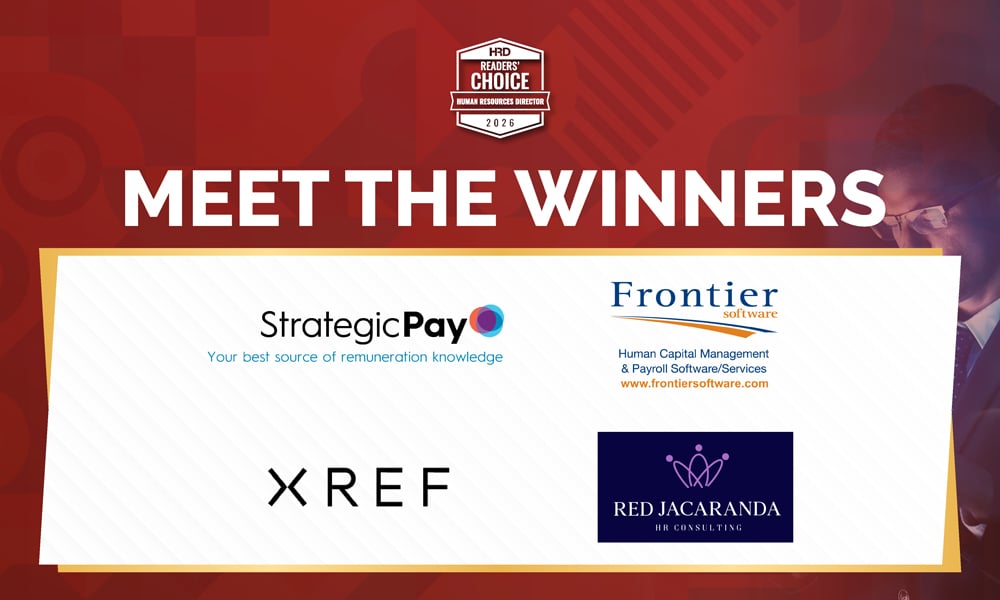
The 2026 Readers’ Choice Awards winners
This year's winners include:
- Frontier Software – Human Capital Management, Payroll Solutions, Performance & Talent Management, and Time & Attendance
- Xref – Pre-Employment Screening Provider
- Strategic Pay – Salary Benchmarking & Forecasting
- Red Jacaranda Group – HR Management Consultant
To read the full list of winners, click here.