New research shows a third of employers have lost customers due to skills shortages, fuelling a shift toward offshore hiring
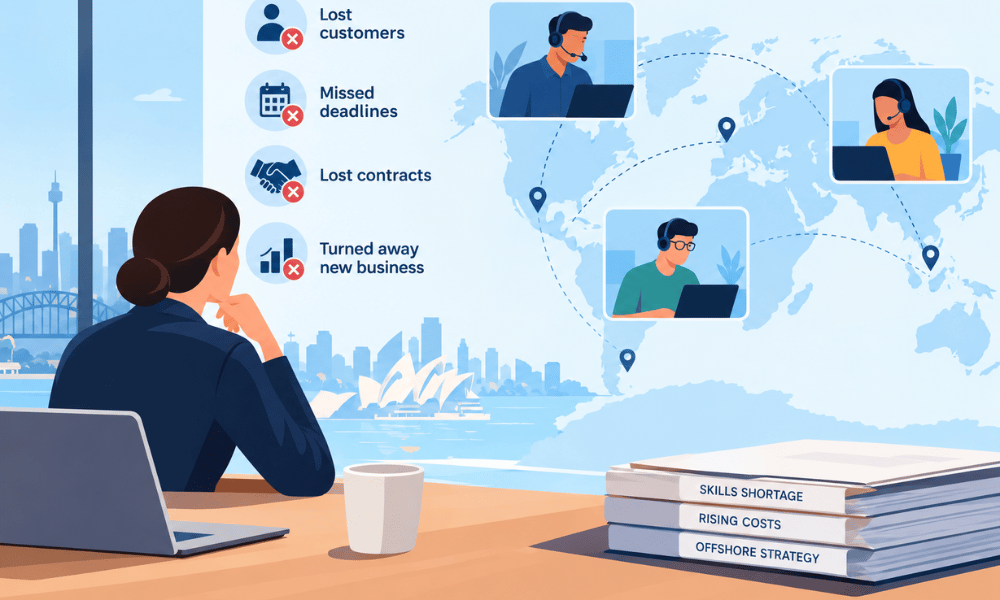
Australian organisations are losing customers, missing project deadlines and turning away new business because they cannot recruit the skilled staff they need, according to the ConnectOS State of Offshoring Report, which found that persistent skills shortages and rising labour costs are pushing more businesses, from small start-ups to major enterprises, toward offshore staffing, even as the practice draws public criticism.
The report found that 33 per cent of employers experienced reduced service quality because of hiring difficulties, while 32 per cent lost customers outright. A further 31 per cent missed project deadlines, 27 per cent lost or delayed contracts, and 26 per cent declined new business altogether because they could not secure the talent required. Sixty per cent said critical onshore roles had taken between 30 and 60 days to fill before they turned to offshore staffing.
Steve Evans, founder and chief executive of ConnectOS said the findings show recruitment difficulties have moved well beyond an operational headache. "Talent shortages have become a boardroom issue with measurable impacts on revenue, productivity, customer experience and long-term growth," Evans said.
Sixty-six per cent of respondents plan to increase their offshore investment over the next 24 months, and only 3 per cent expect to scale it back. Evans was careful to frame the trend as a response to capacity constraints rather than a substitute for local employment.
"This isn't about replacing Australian workers. It's about Australian businesses struggling to access enough of the skills they need," he said. "Organisations are increasingly building integrated onshore and offshore teams to fill capability gaps, support local employees and create the capacity required to continue growing."
The report also points to compliance as the industry's biggest confidence gap: 79 per cent of employers said offshore compliance expectations were higher than three years ago, yet only 25 per cent described themselves as very confident in their current compliance position, and 29 per cent were unsure which standards applied to their offshore operations. For HR leaders assessing an offshore arrangement, the Fair Work Ombudsman's guidance on employer obligations remains a useful starting point when local staff and offshore contracts intersect.
Small business offshoring is a different story
The report's release follows weeks of public debate after Coles confirmed it would move several hundred back-office roles offshore through a partnership with Accenture, days after Qantas revealed it was in talks to outsource finance, marketing and HR roles to India. Jess Whatman, founder of AgentSync argues that lumping large-scale corporate offshoring in with small business hiring decisions is a "dangerous false equivalence."
"A lot of our clients aren't even considering hiring in Australia, but they do need support. That's when they're looking at offshoring – so they can either get by, or scale to the next level so they can afford to hire more onshore people," Whatman said.
She pointed to the cost gap driving that decision: a fully loaded administrative salary in Australia typically runs between $79,000 and $100,000, a figure she said puts local hiring out of reach for many early-stage founders.
Whatman said the reaction to her own business has, at times, conflated the two trends. "I always get people commenting on my Meta ads saying I'm taking roles offshore. I like to explain that a lot of our clients definitely aren't huge corporations – we're not sending thousands of roles offshore. We're literally helping our clients scale their business so they can actually afford to hire onshore," she said.
AI is changing offshore roles, not replacing them
The ConnectOS report found 79 per cent of employers said their offshore teams were adopting AI at the same pace as, or faster than, onshore staff, with data analyst, AI engineer and automation specialist emerging as the fastest-growing offshore roles.
Evans said the technology is reshaping the nature of offshore work rather than eliminating the need for it. "AI is changing the nature of offshore work, not removing the need for offshore capability. Routine and rules-based activities will increasingly be automated, but organisations still need people who can interpret information, exercise judgement, understand customers and apply AI within a specific commercial context," he said.
Employee sentiment data in the report also challenges assumptions about offshore turnover: 84 per cent of surveyed offshore employees said they felt proud to work for their organisation, and 86 per cent expected to remain with their employer for at least the next 12 months.
What HR leaders should weigh before offshoring
For HR leaders fielding pressure from the C-suite to consider offshoring, Whatman's advice is to map the work before making the decision. "Before jumping into offshoring, have a really clear idea of the role. Look at what you're doing day to day and week to week, and if anything on that list is lower-value work that someone else could be doing, that's where you need to focus your time to grow your business," she said.
The findings arrive as Australia's broader national talent shortage remains a persistent workforce challenge, with employers across sectors turning to offshore recruitment to plug critical skills gaps. The debate also echoes long-running tension over offshoring in aviation, after Qantas previously shifted maintenance work offshore amid union opposition.