A purple rabbit, a leaf blower and Richard Marx walk into a small business…
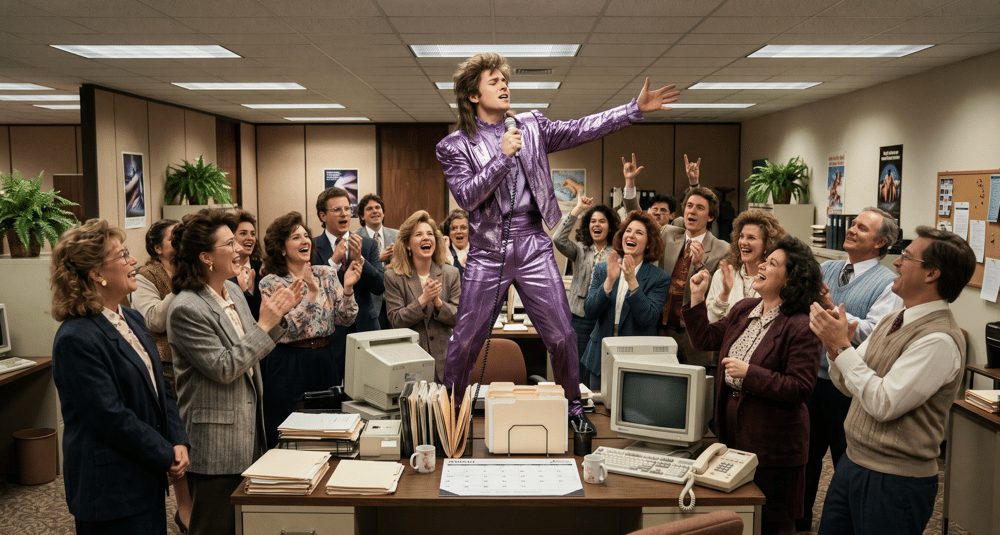
Somewhere in Australia this week, a café owner is wading through her 147th CV for a barista role while a man with magnificent hair mimes a 1989 power ballad at her down the barrel of a camera.
That, more or less, is the premise of Employment Hero’s new brand campaign. And for once, the ad people may have undersold how bad things are.
The Australian-based HR, payroll and hiring platform has borrowed Marx’s “Right Here Waiting” for a campaign called “Your Next Hire is Right Here Waiting.” The song spent six weeks at the top of the ARIA charts in August 1989, which makes it roughly the same age as some of the job ads still sitting on your careers page.
In the ad, frazzled business owners are serenaded by backlit, windswept candidates who are then verified and hired on the spot. The big reveal is that the music-video hair was never natural. It was Big Ears, the company’s purple rabbit mascot, pointing a leaf blower at them from just out of shot.
It is daft, and it is meant to be. The campaign was made by Employment Hero’s in-house creative team, the Hero Collective, with production houses Crater Global and Sure Studios. It runs in Australia, New Zealand and Canada until mid-December across connected TV, outdoor, radio, digital audio and paid social.
Under the big hair sits a simple sales pitch: stop posting and praying. Employment Hero says verified job seekers are already inside the same system that more than 350,000 businesses use for HR, payroll and hiring. Global marketing director Tasman Page didn’t dress the problem up with padded shoulders: “Finding the right people is consistently the hardest part of running a business,” he said.
The company now advertises a pool of more than 2.3 million ready-to-hire candidates, alongside an AI recruitment agent that screens applicants and produces shortlists.
The ad is being launched as the platform gets ready to take a leading part in Australia’s biggest HR Fest on November the 18th in Melbourne alongside some of the country’s most senior HR professionals.
Read next: ‘Nobody wants to let good people go’: Small business hiring rebounds
The bit that isn’t a joke
Scrape off the hairspray and the ad is pointing at a paradox most HR teams will recognise. More people are looking for work, yet hiring hasn’t got any easier.
Australia’s unemployment rate rose to 4.7 per cent in September, the highest since October 2021, and underemployment ticked up to 6.3 per cent. Meanwhile, Jobs and Skills Australia’s latest Recruitment Experiences and Outlook Survey found 45 per cent of recruiting employers struggled to fill roles in the September quarter, up from 42 per cent a year earlier. That rise came even as the share of employers recruiting slipped to 47 per cent. Trades remain the toughest get, with 65 per cent of employers chasing technicians and trades workers reporting difficulty.
So candidates are waiting. Employers are waiting. Everyone is, it seems, right here waiting. Just not for each other.
Employment Hero’s own research suggests a fair chunk of the gridlock is self-inflicted. In a survey of 1,518 Australian workers commissioned by the company, 51 per cent of hirers admitted they had lost good candidates because their process was too slow, and 59 per cent said there was too much manual admin in recruitment. On the other side of the desk, 32 per cent of under-35s said they had been ghosted, compared with 20 per cent of those 35 and over.
It should be said that a hiring software company finding that hiring needs better software is not the biggest plot twist of 2026. But the pain points ring true. David Holland, Employment Hero’s managing director of talent solutions, put the stalemate simply: “When recruitment breaks down, nobody wins.”
Read next: Meet Employment Hero at HR Fest on November 18th in Melbourne
What HR can actually take from a power ballad
You don’t need a leaf blower to fix the worst of it. Russell Ayles, owner of recruitment firm Etisk, has suggested employers simply tell applicants upfront that it could take two or three weeks to get through every application, speaking to Employment Hero’s newsroom. He also defends applicant tracking systems, which let small businesses send bulk updates to unsuccessful candidates rather than leaving them hanging. “For me, it’s just about transparency,” he said.
The numbers back him up. Getting little or no feedback after missing out on a role was the most common bad recruitment experience in Employment Hero’s survey, cited by 41 per cent of respondents.
Small business owners are also hiring with one eye on costs. James Keene, Employment Hero’s managing director for Asia-Pacific, said last month that with costs still high, “many are weighing every hiring decision very carefully”. In that climate, a slow process doesn’t just annoy candidates. It hands them to whoever replies first.
In the song, someone promises to wait for as long as it takes. Real candidates are less patient: 22 per cent of those surveyed had lost interest in a role while waiting to hear back. Nobody is asking for a power ballad. An email would do.
Read next: The underemployment puzzle: Why the workers you need may already be on your payroll